Showing posts with label ya-historical. Show all posts

Saturday, May 24, 2014

BEA 2014 Anticipation!

It’s summertime, and that means fun! (And also constant sunscreen and AC, in my case. Fun, right? Come visit the glorious American Southwest!) Much like last year, early summer means some exciting doings in RTET-land—Susan will be attending Book Expo America in NYC again, while I will be covering the book and author track at Phoenix Comicon. Susan is planning her galley-grabs and author visits for BEA, and it looks like there will be the standard convention problem of so much to do, so little time! We’ve been following the info coming out of various publish-y sources to keep up-to-date on what will be available there. Looks like there will be a lot of highly anticipated books up for grabs! Here are some of the ones I’ve been eagerly awaiting or recently had brought to my attention and think sound cool:

“Fifteen years from now, a new virus sweeps the globe. 95% of those afflicted experience nothing worse than fever and headaches. Four percent suffer acute meningitis, creating the largest medical crisis in history. And one percent find themselves “locked in”—fully awake and aware, but unable to move or respond to stimulus.

One per cent doesn't seem like a lot. But in the United States, that's 1.7 million people ‘locked in’...including the President's wife and daughter.

Spurred by grief and the sheer magnitude of the suffering, America undertakes a massive scientific initiative. Nothing can restore the ability to control their own bodies to the locked in. But then two new technologies emerge. One is a virtual-reality environment, ‘The Agora,’ in which the locked-in can interact with other humans, both locked-in and not. The other is the discovery that a few rare individuals have brains that are receptive to being controlled by others, meaning that from time to time, those who are locked in can ‘ride’ these people and use their bodies as if they were their own.

This skill is quickly regulated, licensed, bonded, and controlled. Nothing can go wrong. Certainly nobody would be tempted to misuse it, for murder, for political power, or worse….”

I enjoy John Scalzi very much, so I’m looking forward to his newest. It sounds a little claustrophobic, but also like an interesting change up from his other stuff I’ve read (the Old Man’s War series and Redshirts). I’m looking forward to giving it a go!


“ ‘Miss Rook, I am not an occultist,’ Jackaby said. ‘I have a gift that allows me to see truth where others see the illusion--and there are many illusions. All the world’s a stage, as they say, and I seem to have the only seat in the house with a view behind the curtain.’

Newly arrived in New Fiddleham, New England, 1892, and in need of a job, Abigail Rook meets R. F. Jackaby, an investigator of the unexplained with a keen eye for the extraordinary--including the ability to see supernatural beings. Abigail has a gift for noticing ordinary but important details, which makes her perfect for the position of Jackaby’s assistant. On her first day, Abigail finds herself in the midst of a thrilling case: A serial killer is on the loose. The police are convinced it’s an ordinary villain, but Jackaby is certain it’s a nonhuman creature, whose existence the police--with the exception of a handsome young detective named Charlie Cane--deny.

Doctor Who meets Sherlock in William Ritter’s debut novel, which features a detective of the paranormal as seen through the eyes of his adventurous and intelligent assistant in a tale brimming with cheeky humor and a dose of the macabre.”

While “Doctor Who meets Sherlock” sounds like an awesome hook that is probably doomed to set the expectations bar much too high, I am most definitely interested. Historical supernatural is my jam! (Or one of my jams, at least.)
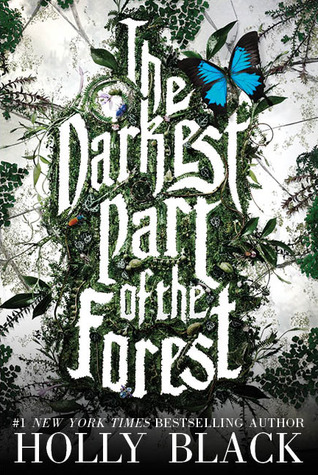

“Children can have a cruel, absolute sense of justice. Children can kill a monster and feel quite proud of themselves. A girl can look at her brother and believe they’re destined to be a knight and a bard who battle evil. She can believe she’s found the thing she’s been made for.

Hazel lives with her brother, Ben, in the strange town of Fairfold where humans and fae exist side by side. The faeries’ seemingly harmless magic attracts tourists, but Hazel knows how dangerous they can be, and she knows how to stop them. Or she did, once.

At the center of it all, there is a glass coffin in the woods. It rests right on the ground and in it sleeps a boy with horns on his head and ears as pointed as knives. Hazel and Ben were both in love with him as children. The boy has slept there for generations, never waking.

Until one day, he does…

As the world turns upside down, Hazel tries to remember her years pretending to be a knight. But swept up in new love, shifting loyalties, and the fresh sting of betrayal, will it be enough?”

The blurb for this one is both intriguing and cryptic, and you know what? It doesn’t matter. The blurb could just say Bobloblaw’slawblog and I would be down. Holly Black is always, ALWAYS an instabuy.


“THE ACCIDENTAL HIGHWAYMAN is the first swashbuckling adventure for young adults by talented author and illustrator, Ben Tripp. This thrilling tale of dark magic and true love is the perfect story for fans of William Goldman’s THE PRINCESS BRIDE.

In eighteenth-century England, young Christopher ‘Kit’ Bristol is the unwitting servant of notorious highwayman Whistling Jack. One dark night, Kit finds his master bleeding from a mortal wound, dons the man’s riding cloak to seek help, and changes the course of his life forever. Mistaken for Whistling Jack and on the run from redcoats, Kit is catapulted into a world of magic and wonders he thought the stuff of fairy tales.

Bound by magical law, Kit takes up his master’s quest to rescue a rebellious fairy princess from an arranged marriage to King George III of England. But his task is not an easy one, for Kit must contend with the feisty Princess Morgana, goblin attacks, and a magical map that portends his destiny: as a hanged man upon the gallows….

Fans of classic fairy-tale fantasies such as STARDUST by Neil Gaiman and will find much to love in this irresistible YA debut by Ben Tripp, the son of one of America’s most beloved illustrators, Wallace Tripp (AMELIA BEDELIA). Following in his father’s footsteps, Ben has woven illustrations throughout the story.”

Okay, again with the setting-expectations-way-too-high thing with that reference to The Princess Bride, but color me charmed by the cover and the title. I’ve been burned by Tor Teen books in the past that sounded awesome and ended up tepid, but this one sounds too fun to pass up.


“Finn Easton sees the world through miles instead of minutes. It’s how he makes sense of the world, and how he tries to convince himself that he’s a real boy and not just a character in his father’s bestselling cult-classic book. Finn has two things going for him: his best friend, the possibly-insane-but-definitely-excellent Cade Hernandez, and Julia Bishop, the first girl he’s ever loved.

Then Julia moves away, and Finn is heartbroken. Feeling restless and trapped in the book, Finn embarks on a road trip with Cade to visit their college of choice in Oklahoma. When an unexpected accident happens and the boys become unlikely heroes, they take an eye-opening detour away from everything they thought they had planned—and learn how to write their own destiny.”

I’ve never read any of Andrew Smith’s books before, but I’ve heard great things about both Winger and Grasshopper Jungle. I haven’t read much contemporary YA lately, but this sounds like it could be a good introduction to the author.
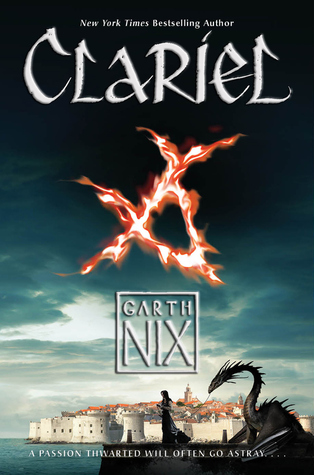

“Clariel is the daughter of the one of the most notable families in the Old Kingdom, with blood relations to the Abhorsen and, most importantly, to the King. When her family moves to the city of Belisaere, there are rumors that her mother is next in line for the throne. However, Clariel wants no part of it—a natural hunter, all she ever thinks about is escaping the city’s confining walls and journeying back to the quiet, green world of the Great Forest.

But many forces conspire against Clariel’s dream. A dangerous Free Magic creature is loose in the city, her parents want to marry her off to a killer, and there is a plot brewing against the old and withdrawn King Orrikan. When Clariel is drawn into the efforts to find and capture the creature, she discovers hidden sorcery within herself, yet it is magic that carries great dangers. Can she rise above the temptation of power, escape the unwanted marriage, and save the King?”

I’ve talked about this one before, and my excitement remains undiminished. If I had to choose only one book coming out of BEA to read, this might edge out Holly Black to take the prize. I am THAT psyched about it!
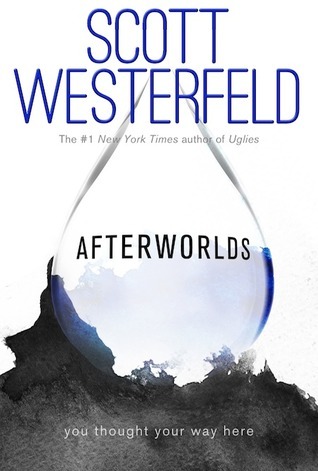

“From the #1 New York Times bestselling author Scott Westerfeld comes a smart, thought-provoking novel-within-a-novel that you won’t be able to put down.

Darcy Patel has put college on hold to publish her teen novel, Afterworlds. With a contract in hand, she arrives in New York City with no apartment, no friends, and all the wrong clothes. But lucky for Darcy, she’s taken under the wings of other seasoned and fledgling writers who help her navigate the city and the world of writing and publishing. Over the course of a year, Darcy finishes her book, faces critique, and falls in love. Woven into Darcy’s personal story is her novel, Afterworlds, a suspenseful thriller about a teen who slips into the ‘Afterworld’ to survive a terrorist attack. The Afterworld is a place between the living and the dead, and where many unsolved—and terrifying—stories need to be reconciled. Like Darcy, Lizzie too falls in love…until a new threat resurfaces, and her special gifts may not be enough to protect those she cares about most.”

Scott Westerfeld is another favorite author of mine, and this novel sounds really different and intriguing. Is it just me, or does anyone else get a whiff of foreboding from the blurb…? Eh, it’s late. I’m probably imagining it.
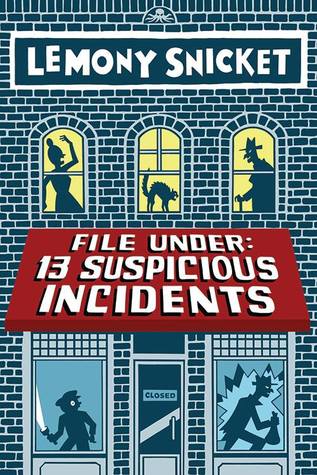

“Match wits with Lemony Snicket to solve thirteen mini-mysteries.

Paintings have been falling off of walls, a loud and loyal dog has gone missing, a specter has been seen walking the pier at midnight -- strange things are happening all over the town of Stain'd-By-The-Sea. Called upon to investigate thirteen suspicious incidents, young Lemony Snicket collects clues, questions witnesses, and cracks every case. Join the investigation and tackle the mysteries alongside Snicket, then turn to the back of the book to see the solution revealed.

A delicious read that welcomes readers into Lemony Snicket's world of deep mystery, mysterious depth, deductive reasoning, and reasonable deductions.”

This one technically already came out in April, but it’s being featured at BEA, too. It sounds like just the sort of thing my younger self would’ve loved, and I imagine my current self would have fun with it, too.


“Aaron Becker, creator of JOURNEY, a Caldecott Honor book, presents the next chapter in his stunning wordless fantasy.

A king emerges from a hidden door in a city park, startling two children sheltering from the rain. No sooner does he push a map and some strange objects into their hands than he is captured by hostile forces that whisk him back through the enchanted door. Just like that, the children are caught up in a quest to rescue the king and his kingdom from darkness, while illuminating the farthest reaches of their imagination. Colored markers in hand, they make their own way through the portal, under the sea, through a tropical paradise, over a perilous bridge, and high in the air with the help of a winged friend. Journey lovers will be thrilled to follow its characters on a new adventure threaded with familiar elements, while new fans will be swept into a visually captivating story that is even richer and more exhilarating than the first.”

Journey was a wonderful wordless picture book, and I think this next one will be just as lovely. I love Becker’s beautiful style of art, and how perfectly he can tell a story with fun, emotion, and humor with just pictures.

Hooray for BEA! Hopefully Susan will be able to snap up one or two of these while dashing around the Javits Center this coming week, and then we can read and chat about them. Any of these sound good to you? What are your most anticipated books at BEA?

Sunday, May 11, 2014

Book Review: Curses and Smoke

Title: Curses and Smoke: A Novel of Pompeii
Author: Vicky Alvear Shecter
Publisher: Arthur A. Levine Books
Publication Date: May 27th, 2014
Read: April 2014
Where It Came From: eARC from publisher via NetGalley*
Genre: YA-historical
Rating: 3 Foreshadowing Earthquakes

The Quick and Dirty:


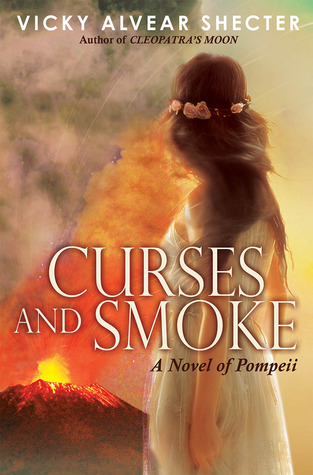
Lucia is the daughter of a gladiator training school owner in Pompeii, and not looking forward to her impending arranged marriage. When her childhood friend, a slave boy named Tag, returns from Rome after training to be a healer, the two reconnect and begin dreaming of a life beyond their current confines. But then there’s all the strange things occurring around Pompeii recently—earthquakes, dead fish in the bay, poisoned springs… Lucia ponders what it could all mean while imagining a life with Tag out from under her father’s thumb, but will they be able to escape life in the shadow of Vesuvius? I didn’t find the characters particularly compelling and the writing was in the middle—not awful, but not super good. Still, it kept me turning pages and as the inevitable drew near there were some unexpected twists that (at last!) got an emotional response out of me.

The Wordy Version:


Guys. This book…I don’t even know what to say. For a book that I was feeling so solidly meh about throughout the entire reading to have that sort of effect on me at the very end… I wasn’t expecting tragedy! Which might sound dumb for a book about Pompeii, but…well, we’ll come back to that later.

Lucia is the only child of a middle-class gladiator training school owner, and she wants more from life than marriage to an old, lecherous man in Rome for her father’s gain. She’s interested in science and nature, and has been noticing strange things happening around the city of late (naturally, no one pays any attention to her when she brings them up). She’s pretty in the middle as far as characters go—she’s not objectionable, but she’s not terribly interesting either. Our other protagonist, Tag, was sent away to Rome to train as a healer for a few years to eventually follow in his father’s footsteps at the training school, but upon his return to Pompeii he dreams instead of becoming a gladiator and winning his freedom. Again, not objectionable, but not a character I felt overly attached to. I did really like his Etruscan heritage, though—the fact that he was descended from a formerly powerful family from the time the Etruscans ruled the area added a new slant and extra fire to his rage at being a slave.

So of course the two fall in love, FORBIDDEN love, and have to keep it secret from everyone around them. The daughter of a training school owner cannot love a slave, especially when she is already promised to a creepy old man! For some reason, Tag and Lucia both came across as younger than their 16 years for much of the book (at least until they start making out in the woods and Lucia debates love vs. lust with her married friend). Other characters are added to the mix—Lucia’s father, mostly portrayed as monstrous; Castor, a young slave boy who takes a shine to Tag; Quintus, a louche patrician dilettante who plays at gladiator training and develops an interest in Lucia; Lucia’s friend Cornelia, sassy and pregnant; and Cornelia’s husband, who sounds like a pretty awesome guy until we actually meet him. Cornelia is one of the more interesting characters, as she has some life and verve to her (although the fact that the word “waddle” is used to describe her every movement got a little irritating. Yes, alright, she’s hugely pregnant! We get it already!). My FAVORITE character, though, was Lucia’s dog Minos. So cute. I even wrote in my notes as I was reading that the most emotional reaction the book got out of me was when someone hit the dog. But…that was before I got to the end.

Wednesday, April 23, 2014

Quick Bites: Stitchery, Double Takes, and the Twilight of Imperial Russia (Again)

I’ve peremptorily decided to create a new feature for RTET, called Quick Bites. The idea is to write short reviews of books read in the recent past (but perhaps not too recently, thus enabling the requisite shortness), and gather them up into a single post. Minute reviews, if you will. Called quick bites, because they’re quick…and bite-sized…and about books on a blog that also occasionally covers food-related topics… (Yes, yes, I’m terribly clever, I know.) This new feature will appear on the blog…well, whenever I feel like creating such a post. It’ll be crazy! Fun! You’ll never know when one’s coming!!! (…have I convinced you that sporadic is cool?)

The Gentle Art of Stitching, by Jane Brocket
Published by Collins & Brown in 2012
Read: March 2014
From: Library
4 Sashiko Needles

Yay for another crafty book! As you can guess from reading the title, this one is about stitching—all different kinds, in fact. That’s what makes it such a fun book—it goes beyond the basics to cover projects involving Japanese sashiko, Indian kantha-style quilts, interesting ways to use buttons, modern needlepoint cushions… The book is full of ideas, and provides practical information and instructions to complete the projects included, while also equipping the reader to take inspiration from them and create projects of their own devising. I had originally picked it up to see what sorts of cross stitch projects it contained, and while they were cute, I was looking for a bit more complex of a project to take on. My absolute favorite project in the book is one where kitschy embroidered linens from the ‘40s (easily found at antique shops and online) are repurposed into a collage quilt with a very vintage, very fun design aesthetic. The one the author made is the coolest thing, and I can’t remember the last time I was so inspired by a project idea—I was showing it off to everyone I know, and got really excited about making one myself someday. There were admittedly a few projects that were a little TOO kitschy for my taste (anything involving felt, pretty much), but most of the projects were things I’d like to try someday. Very cool book—I will be purchasing a copy, and checking out the author’s other craft books.


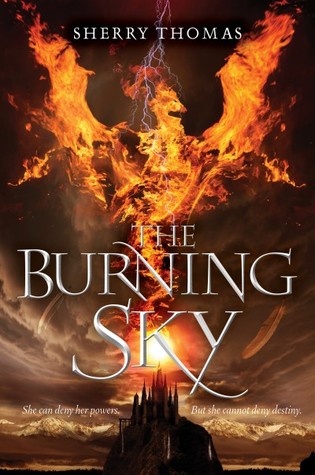
The Burning Sky, by Sherry Thomas
Published by Balzer + Bray in September 2013
Read: April 2014
From: Paper ARC Susan sent me
3.5 Canaries

You may remember when Susan read and reviewed this one last fall, giving the verdict of “very enjoyable.” Now I’ve finally gotten around to reading it, and while I did enjoy it, I think I perhaps enjoyed it with more reservations than she did. Quick plot rundown for those who didn’t click the link: Iolanthe Seabourne is the greatest elemental mage of her generation, being hunted by the Big Bad Guy the Bane and his agents of Atlantis. Titus is the prince of the Domain they live in, but is actually just a puppet of Atlantis, and he wants to find Iolanthe because a prophecy says she’ll help him defeat the Bane. They meet up, he hides her by making her pose as Archer Fairfax, a fellow student at Eton, and they begin training to defeat the Bane and hide from the agents that are trying to capture her.

The book was slow to start, but I kept at it, and overall it was a fun fantasy with historical elements. My main issues with the book, however, involve the world building. It was shaky, holey, and not explained well enough to create a solid base for the story to unfold upon. For example, Iolanthe and Titus are from the Domain. Okay, sounds good. Like maybe some random fantasy place not in our world. But then Titus travels to England to go to Eton. This does not involve spaceships, so maybe the Domain is on Earth, or somewhere close enough for him to reach it by magic? But what about Atlantis? They’re running the show in the Domain and have agents everywhere, and there are mentions of other mage and non-mage realms existing. But do they exist in our world? On parallel Earths? Are they hidden in plain sight in our world, like in another dimension? When I ranted at Susan about this, the best explanation we came up with was perpendicular universes. …when I have a tenuous grasp of something as basic to a book as its setting, that’s a problem for me. I also found Titus too-tragic-to-tolerate for much of the book, but he did get better as it went on. The best scenes were when they were at Eton, and I wish there had been more of that. But even with my complaints, as the book reached its climax involving intrepid travel and danger via the virtual reality-like fairytale training books, I was very invested and flipping pages like nobody’s business. And once Titus stopped being a putz, the romance became cute, too. I’ll probably read the sequel, but it’s not one I’ll feel compelled to grab right when it’s published.


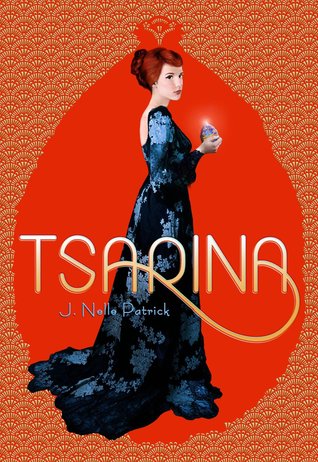
Tsarina, by J. Nelle Patrick
Published by Razorbill in February 2014
Read: March 2014
From: Library
3.5 Fabergé Eggs

Despite crap luck in the past with books involving the downfall of imperial Russia, this one came highly recommended by Maggie Stiefvater, so I thought I’d give it a go. I really, really want there to be a novel on this subject that’s as awesome as Anastasia, and I will keep looking until I find it, dammit! This one was better than the last, but still not quite as much as I’d been hoping for. Natalya, daughter of an aristocrat military officer, is in love with Alexei Romanov. During a ball, Alexei lets his love in on a secret—before Rasputin died, he channeled all of his power into the Constellation Fabergé egg, and it will keep Russia and the Romanovs safe. Soon, however, the Reds rise up in St. Petersburg, raiding the palace and capturing the imperial family. Natalya, along with fellow aristocrat and friend Emilia, will have to team up with a mysterious young man named Leo to track down the egg and save Russia and the Romanovs.

I liked that both Natalya and Leo have convictions about their respective White and Red politics, and that over time they come to see that it’s not quite that simple. They gain an understanding of the other’s point of view as the story progresses, which felt realistic, and provided obstacles to their relationship and a meaningful way for it to develop. While we’re on the subject of relationships, we actually only see Alexei and Natalya together in the first chapter, which is really more of a prologue, since it happens months before the action of the rest of the story. Because we have only that and Natalya’s recollections of him to go on, it was hard for me to be invested in their love. Still, even though I didn’t see their relationship unfold, even though I know that Russian society had some big-time problems that needed to be fixed, even though I KNOW what happens, I found myself hoping that the story would somehow take an alternate history tack and there’d be a way for them to be together and have Russia’s problems solved magically and for everyone to be happy. And when the inevitable comes to pass, it was more affecting than I had expected it to be due to foreknowledge of history and a lack of attachment to their relationship.

One of the weaker aspects of the book was the plot line with the mystics—it was a bit muddled, and I just didn’t find it compelling. As historical fantasy, some liberties are taken with the actual history of the Russian revolution and related topics (aging up Alexei, for one). This isn’t the kind of thing that bothers me, but if it would irritate you, it’s something to consider. Overall, while the novel may not rank among my favorites, it was entertaining and highly readable, though I wish it had made me feel more. I may pick up the sequel, but it’s probably not a must-read for me.

Have you already read any of these or plan on checking them out?

Thursday, January 23, 2014

Already Missing 2013: Susan's Top 10

At Alyssa’s urging, I am spending some time today to order my list of favorite books from the reading I did last year. Back at the beginning of December, Alyssa and I were both playing around with our favorite books lists, and I had a slight advantage going in because I had been assiduously keeping track of my least favorite books of the year (and out of a sense of guilt for the immeasurable fun of rating my ARGH reads, I had started a list of favorite books as well). But it turned out that my guilt was disproportionate! I had 11 books on my Worst-Reads list (and one of them was a little exaggerated to make it there), and a full 18 on my Best-Reads list. Eighteen!! To choose only ten seemed unfair to the other eight that had been scrawled on my scrap of paper. As I looked at the paper, I realized I hadn’t even remembered to put some other well-enjoyed books I’d read this year on it. It really was a better year for my reading than the existence of a “Worst Books of 2013 Reading” list suggests.

Yet, Alyssa and a seeming majority of the book blogosphere seem to have been able to accomplish this feat of winnowing books down to a top-ten list, so it is obviously not impossible. And with that spirit, I shall set about making my list. Because I am having particular trouble deciding on the top-top spots, I am going to deviate from Alyssa’s formatting and do my list count-down style.

S’s Best Books of 2013


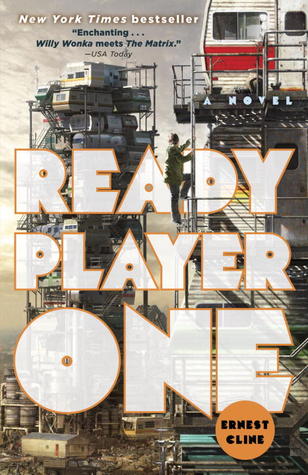
10. Ready Player One, by Ernest Cline

Kicking it off at #10 is Alyssa’s recommended Ready Player One. I, having some distrust of fiction audiobooks, picked up a paperback in February after hearing something that sounded like The Westing Game. So, recommended by Alyssa and bearing at least casual similarity to a beloved work of children’s literature? It was an easy choice to read, but had a lot to live up to based on that. AND IT DID!! I loved it! I like only a handful of things about 80s pop culture, and because I truly despise 80s fashion, I don’t even bother to watch classic Brat Pack movies. Yet the book completely worked for me, and based on the number of times it stops to explain every 80s reference it makes, it should work for anyone.

This is one of those books that is so secure in what it’s doing that it takes a little time afterwards to figure out why it worked so well. The narrative voice of Wade, a teen competing in a virtual reality scavenger hunt of 80s pop culture, is completely compelling, combining authority about his videogame skills and insecurity about his personal relationships. To an extent the book is dystopian, but in a much more realistic way than the popular depictions of overreaching government programs. Here, poverty in the United States has caused an increase in crime, spurring many to retreat to a cyber-reality so they don’t need to go outside, and discouraging them from believing that political elections provide any means of breaking the cycle of poverty and crime. So solid main character, solid setting . . . AND the scavenger hunt, mental puzzle cleverness promised by Westing Game comparison.

And this is only the beginning of my year’s top-ten.

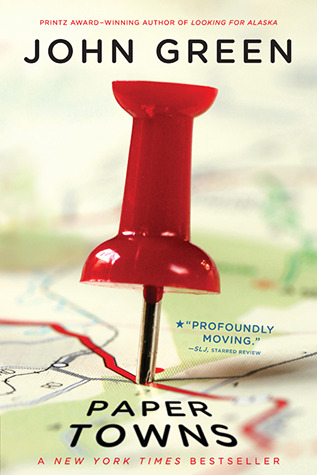
9. Paper Towns, by John Green

Paper Towns is similar to Ready Player One in that it is also narrated by a smart teenage boy. But while Wade was focused on solving the steps of a game (albeit a game with immense monetary value), Paper Towns’ Quentin is navigating the much more complicated world of teenage identity, and trying to solve the mystery of his dream girl neighbor, who has taken him on a crazy night’s adventure before running away from home in the last weeks before high school graduation.

The book is a suspenseful page-turner, but John Green does a clever job layering the book by interpreting Whitman poetry and having characters respond to key symbols differently. What makes it truly deserving of a spot here is that our book club conversation had a LOT to talk about after finishing the book.


8. Sir Gawain and the Green Knight, translated by Simon Armitage

I read “Sir Gawain and the Green Knight” in my Survey of Early English Literature, and I liked it well enough at the time. But after reading Alyssa’s review of the audiobook of Simon Armitage’s translation, I decided to visit it again. I am so glad I did!

If you missed it last spring, now is actually the BEST time to pick up a copy because the small epic poem takes place in winter. The cold landscape evoked in Gawain’s travels, contrasted with the warmth of sitting in a castle resting during the holidays, feels particularly close to me after a day spent shoveling and then nestled with a book. Thematically the poem is also close to us right now because it is about realizing your shortcomings and strengths, and resolving to be a better person as the new year begins.

And, as Alyssa has said, the language (particularly when listened to on the audiobook) is beautiful.


7. Code Name Verity, by Elizabeth Wein

Another wonderful read that our book club had this year. Code Name Verity does so many things exceptionally well that I could spend a lot of space repeating what Alyssa and I already said about it in October. I think what I love the most about it in retrospect is how much Elizabeth Wein successfully manipulates my sense of hope throughout the story. There are some stories that you assume will not end happily: Shakespeare warns us right away that Romeo and Juliet are going to kill themselves, Jodi Piccoult and Nicholas Sparks have built publishing empires on tissue boxes emptied on their books. There are some stories that you know will end happily: genre romances, anything by P.G. Wodehouse. And then there is Code Name Verity, which opens in medias res with the announcement that one main character is dead and the other is being held prisoner. But did you SEE THE DEATH HAPPEN? it tempts you to ask. Where is the rescue mission? It’s very disorienting not to know whether the plotline is heading towards a happy or tragic resolution, and it takes a ton of skill for Wein to make parts of the book very funny even while the tension is high.

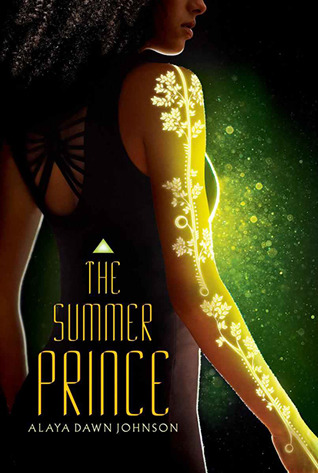
6. The Summer Prince, by Alaya Dawn Johnson

I read The Summer Prince back in April, and my first impression was that the concept was brilliant and the writing artful. In the months since then, my admiration for this book has not waned, and instead has become stronger. I think it’s so well done that it vied for my top spots on this list. The only thing holding me back is that when I went to write just why it was so worthy of the second place spot, most of what I was saying wasn’t about my emotional response. Nevertheless this is my pick for the 2014 Printz Award.


5. The Swerve, by Stephen Greenblatt

Ecce! Coming in at #5 is my only nonfiction work on the final list. It’s the fascinating story of the transmission of Lucretius’s De Rerum Natura from ancient days to the early modern age. I listened to this one in March while snowshoeing behind my old university buildings, so part of my reaction could be nostalgia for college learning and friends, but just thinking about the story of the book is enough to make me quiver a little now.

Lucretius is arguably the only genius of Latin literature, and his lengthy poem about the nature of things is one of the only remaining texts we have of Epicurean philosophy, which (among other things) proposes that living wisely for the absence of pain is the greatest end. Even though I know I should have read this poem (nay, translated it) by now, I never have because philosophy tends to confuse or bore me. Or when I wake up after a quick nap from being bored, I am confused about where I am in the text.

But Greenblatt’s premise is spine-tingling: he claims that the rediscovery of Lucretius’s writing is what sparked the humanism of the Renaissance, and that the event of the rediscovery was far from assured. Unlike the works of Homer, which existed in many Medieval libraries across Europe, De Rerum Natura was found in only one manuscript. Greenblatt tells the story of its Renaissance discoverer, as well as the story of the disappearance of Epicurean philosophy in the late Roman Empire, in such a way that I caught my breath a few times, and felt tears at others.

Read it. Listen to it. Tromp through some snowy woods on a sunny day, taste something delicious, and brush your finger along some dusty old books on your bookshelf as you contemplate what life means, and how your idea of that is related to the survival of one manuscript copied and recopied by monks for a thousand years.

4. Fangirl, by Rainbow Rowell

The way that Alyssa cried over Code Name Verity, I blubbered over Fangirl. It seems a little weird to write them both in the same sentence (and to compare the tears that flowed over each) because they are very different books. But I LOVE Cath as a character, and I adore Rainbow Rowell for validating the world of fanfiction even as Cath’s struggles are mostly to find that the world outside of her fandom is a good place to live. Whereas Eleanor & Park focuses on a romance in the 80s terminally complicated by Eleanor’s danger in her home, Fangirl is about the very modern world of Internet fandoms, and its romance is endangered by Cath’s anxieties. I think that Cath’s story may have the broader appeal, and that Rowell’s writing style fits Cath better, so I am hoping that everyone tries this one in the coming year. Particularly if you have trouble with transitions in life.


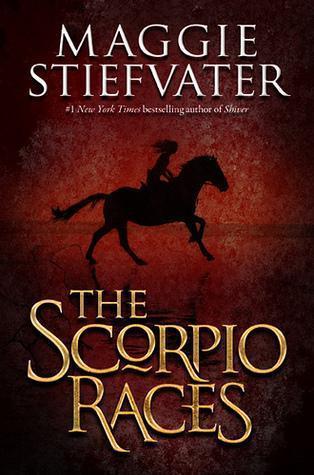
3. The Scorpio Races, by Maggie Stiefvater

Three entries on my general loved-it list this year are Maggie Stiefvater books. After not particularly loving the Shiver trilogy (maybe because I’m not a big fan of wolves in snow?), I wasn’t sure I wanted to read the new Raven Cycle. Then I read a few pages, which turned into the whole book, which then turned into quick consumption of The Scorpio Races, and a hunt for The Dream Thieves at the BEA. Suffice to say, I loved EACH of these Stiefvater books, but out of a sense of diversity I am only picking one of them for this list. The Scorpio Races takes far less plot explanation than the Raven Cycle, so it is my choice. Also, it is tightly written as a stand-alone novel. Puck and Sean are sensitive and brave. The Stiefvateran conflict between rich and poor is handled well. And the idea of racing by the sea on carnivorous giant horses is breathtaking.


2. A Tale for the Time Being, by Ruth Ozeki

If you follow us on Twitter you may remember my angst in reading this in bed back at the October/November cusp, summed up by a quote from the book: “their monstrous barbarity shines a new light on my own small suffering.” Based on my horrified tweeting you’d think that this Booker finalist was a book to be avoided, but I think my immeasurable pain for Nao, a young Japanese teenager, and her long-dead young uncle is an indication that Ruth Ozeki crafted a very strong book. My stomach turned, my palms got sweaty, and I read pages of philosophy with total interest. The ending surprised me and provoked more caps-lock on Twitter. Do yourself and me a favor by reading this and letting yourself get carried away by Nao’s confident and intimate diary of coming to peace with being uprooted to lower-middle class life in Japan from upper-middle class life in California. And then thank Ozeki for breaking up Nao’s story with the rest of the book’s focus on adults who give you some space to calm down before entering the sadistic world of secondary school, office culture, or barracks again.


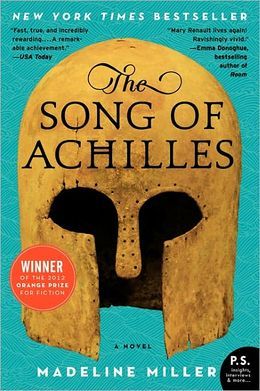
1. The Song of Achilles, by Madeline Miller

As everyone is probably sick of hearing by now, I loved this book. It’s already appeared as my favorite book of the summer, and its depiction of the gods is still in my head. Unlike Homer's Thetis, whom I picture shrouded and hunched with grief, Miller's Thetis is a frightening force of nature and destruction. "Her mouth was a gash of red, like the torn-open stomach of a sacrifice, bloody and oracular. Behind it her teeth shone sharp and white as bone." "[Her] voice hissed like water poured coals." And then I keep thinking about the book, and I remember that a message of the book is that the force of the gods is not as terrifying as the emptiness of death and being forgotten. Ahhhhhh I love this book!

Friday, October 25, 2013

YA Round-Up: Vampires and dystopias and Georgians, oh my!

Over the past few months I’ve accumulated some YA reviews that are purely internal—I have thoughts in my head about the books, but haven’t gotten around to typing them out, and now it’s been so long since I’ve read them that the details are no longer fresh in my mind. But some of these were books I quite enjoyed, and I’d really like to pass that on so maybe some other people can hear about them and possibly enjoy them, too! You see my #booknerdproblems-hashtag-worthy conundrum? Anywho, my solution is to write a mini-review for each (as mini as a verbose individual like myself can manage, anyway), preceded by the Amazon/Goodreads blurb, since too much time has passed since reading and/or I’m too lazy to blurb it myself. Let’s start things off!

First up we have a delightful specimen from the squished-together genre of YA-urban-fantasy-vampires:

Tana lives in a world where walled cities called Coldtowns exist. In them, quarantined monsters and humans mingle in a decadently bloody mix of predator and prey. The only problem is, once you pass through Coldtown’s gates, you can never leave.

One morning, after a perfectly ordinary party, Tana wakes up surrounded by corpses. The only other survivors of this massacre are her exasperatingly endearing ex-boyfriend, infected and on the edge, and a mysterious boy burdened with a terrible secret. Shaken and determined, Tana enters a race against the clock to save the three of them the only way she knows how: by going straight to the wicked, opulent heart of Coldtown itself.

The Coldest Girl in Coldtown is a wholly original story of rage and revenge, of guilt and horror, and of love and loathing from bestselling and acclaimed author Holly Black.

“Snarf” would be the word to describe how I consumed this book. I’ve loved Holly Black ever since my first acquaintance with her work once upon a high school drive back from California, when I turned around and asked my friend in the backseat what she was reading (it was Tithe, now one of my all-time favorite books). Count on this lady to inject some life back into vampire stories (har har) by making them scary and compelling again! I liked how vampirism in this world is like a disease, and the echoes of contagion/zombie fiction I found in the story were a nice twist on what I’m used to in vampire books. Tana is a strong, relatable main character, and in the usual Holly Black fashion the side characters are just as complex and complicated as the protagonist. I believe the book was meant as a standalone (yay for YA standalones!), but while it is self-contained and stands on its own perfectly well, there is room for more to come, and I would definitely read that “more.” Awesome book, and kudos to the author for writing the story that was in her heart, despite naysayers and skeptics in the post-Twilight (post-vampire?) YA landscape. Rating: 4 1/2 Garnets in a Necklace


In the middle of our YA sandwich we have a classic-meets-sci-fi story inspired by one of my favorite books:

It's been several generations since a genetic experiment gone wrong caused the Reduction, decimating humanity and giving rise to a Luddite nobility who outlawed most technology.

Elliot North has always known her place in this world. Four years ago Elliot refused to run away with her childhood sweetheart, the servant Kai, choosing duty to her family's estate over love. Since then the world has changed: a new class of Post-Reductionists is jumpstarting the wheel of progress, and Elliot's estate is foundering, forcing her to rent land to the mysterious Cloud Fleet, a group of shipbuilders that includes renowned explorer Captain Malakai Wentforth--an almost unrecognizable Kai. And while Elliot wonders if this could be their second chance, Kai seems determined to show Elliot exactly what she gave up when she let him go.

But Elliot soon discovers her old friend carries a secret--one that could change their society . . . or bring it to its knees. And again, she's faced with a choice: cling to what she's been raised to believe, or cast her lot with the only boy she's ever loved, even if she's lost him forever.

Inspired by Jane Austen's Persuasion, For Darkness Shows the Stars is a breathtaking romance about opening your mind to the future and your heart to the one person you know can break it.

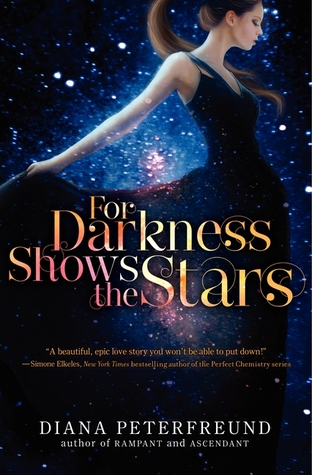
I loved Persuasion when I read it a couple years ago, so I thought this YA adaptation sounded fantastic. I looked at the cover, read the title, saw that the Wentworth character was a ship captain, and got really excited. What’s not to love about Persusasion in SPACE?!

…only it’s not in space. Malakai Wentforth is not a space ship captain, but rather an actual boat ship captain. While the blurb, cover, and title don’t explicitly state that it’s taking place in outer space, I think my assumption wasn’t completely out of the bounds of reason. I mean, look at the cover art!!! Needless to say, finding out the setting was in a post-apocalyptic agrarian dystopian society rather than THE FINAL FRONTIER was a little disappointing for me. But I got over it (mostly), and found the book to be quite enjoyable. It was full of Persuasion-y deliciousness, but was different enough to make it the author’s own. I liked the shout-outs to the original, such as Elliot being the protagonist’s first name rather than her surname and Wentworth becoming Wentforth, but the letter that is such an emotional lynchpin of the original felt a little phoned in to me in this one. Overall, though, it was a fun read, and the science vs. religion and genetic manipulation aspects of the story were an interesting sci-fi twist.

One subtle yet important difference I found between the two was that in Jane Austen’s book I never really found myself putting either Anne Elliot or Capt. Wentworth at fault for the tension between them (though there were times I wanted to shake them and tell them to stop being so silly!). You could say Anne’s at fault for allowing herself to be persuaded by Lady Russell to not marry Wentworth and his resentment is thus at least partially merited, but I never really felt like it was a “fault” thing—it was a decision, it happened, it had repercussions, and it wasn’t fun for anyone involved. By contrast, in Peterfreund’s adaptation, because Elliot is a good person she kind of had to refuse Kai—if she hadn’t, her estate and all the people on it would have suffered and probably died due to her father’s mismanagement. Which is a very valid (noble, even) reason for her to not marry him! It still sucks for both of them, but she had a responsibility to these people. Which is why it made me SO MAD when Kai was being a prime douchebag and generally jerky to her. Don’t take it so personally, dude—there were hundreds of lives at stake!!! So I spent a chunk of the book wanting to punch him in the face and for Elliot to run off with her neighbor Horatio, but this new slant to their relationship somehow ended up adding to my enjoyment of the book. I quite liked it, although I still wonder what it would’ve been like in space… Rating: 3.75 Genetically Enhanced Wheat Sheaves


And for our final entry, we have a historical spy adventure set in the royal court of Georgian England:

“A warning to all young ladies of delicate breeding who wish to embark upon lives of adventure: Don't.”

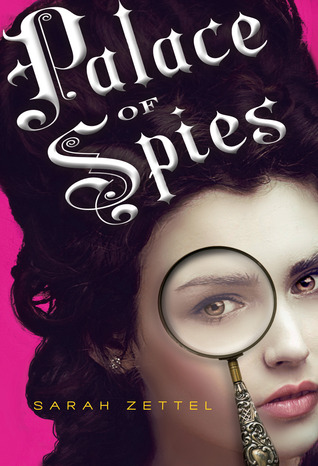
Sixteen-year-old Peggy is a well-bred orphan who is coerced into posing as a lady in waiting at the palace of King George I. Life is grand, until Peggy starts to suspect that the girl she's impersonating might have been murdered. Unless Peggy can discover the truth, she might be doomed to the same terrible fate. But in a court of shadows and intrigue, anyone could be a spy—perhaps even the handsome young artist with whom Peggy is falling in love...

History and mystery spark in this effervescent series debut.

Although it sounds like the sort of thing that would be right up my alley, this one was just…okay. The first person narration by Peggy is mostly enjoyable, but sometimes her flowery language and clever sentence structuring felt a bit overwrought. Though it was a little much for me at times, for the most part I found her distinctive voice to be an amusing and interesting perspective from which to see the workings of the Georgian court. It was clear that the author has researched the history and culture of Georgian England, but that research manifested itself at times in the form of slight infodumps. They didn’t completely eject me from the story, but I felt the info could’ve been woven in more smoothly at times. But then at other times, I was left wanting to know more of the history and culture! Okay, King George I is from Hanover, and there’s a pretender hiding out in France. Wait, how did a German become King of England?? Luckily, the ever-faithful Wikipedia was there to help me fill in the gaps in my knowledge of the history of the British crown.

I was also confused about Peggy’s place in the social hierarchy. Her uncle didn’t seem to be a nobleman, but had a high enough standing that he could marry off his niece to the son of a lord. Peggy’s mother was at court, but did not seem to have any title. So where does that leave Peggy? Was there a well-to-do merchant class at the time that was able to hobnob with the nobility? I don’t know if it’s just my lack of knowledge about the time period, but I thought that could’ve used some clarification to make the story seem more grounded in reality.

Unfortunately, one of my main problems with this book involved something that the entire story hinged on: Peggy’s ability to stand in at court for the deceased Francesca. I really had trouble suspending my disbelief that, even with makeup and a wig, Peggy would be able to impersonate her without anyone noticing. I found it very difficult to believe that she looked enough like Francesca that, especially with the dissimilarities in their personalities piled on top, even Fran’s close friends could not tell the difference.

Even taking these concerns into account, I was still pretty okay with the book until it got to the point where Peggy was jumping to some new, ill-reasoned conclusion every page about what was really going on with the intrigue. I found it to be tiresome, tedious, and a little exhausting to take the ride with her in arriving at each of these new conceptions mostly lacking in evidence. So I had a good laugh when on page 269 she said, “I listed my own proven inadequacies as a reasoner, and that list was depressingly long.” And how! At least she’s aware of it? Despite these criticisms, the book was still okay—I wasn’t shaking my fists and shouting at the heavens to get back the time I spent reading it, but I probably won’t be checking out any sequels. Rating: 2.5 Lace Fans

Have you read any good YA lately?


The Coldest Girl in Coldtown, by Holly Black
Published by Little, Brown Books for Young Readers (September 3, 2013)
Read in August 2013; Paper ARC from Book Expo America*

For Darkness Shows the Stars, by Diana Peterfreund
Published by Balzer + Bray (2012)
Read in September 2013; Bought it

Palace of Spies, by Sarah Zettel
Published by HMH Books for Young Readers (November 5, 2013)
Read in October 2013; eARC from publisher via NetGalley*

*As ever, much as we are grateful for the copies, our reviews are uninfluenced by their sources.

Friday, October 18, 2013

Code Name Heartbreak (Which is not a paperback romance novel, we promise.)

You may remember last month when we mentioned that our book club's September pick was going to be Elizabeth Wein's Code Name Verity, and that we would probably work on some sort of analyze-and-chat post after we finished the book so we could all collectively join in the book club fun. Well friends, that time has come. The book has been read, the feels have been felt, and we are ready to DISCUSS!


Three covers. Take your pick!

WE ARE COWARDS.

Or at least we were. And by we, we definitely mean just Susan, who REJECTED reading this book for our book club on the grounds that it would be TOO SAD (based on pretty much every review that said it was brilliant but heartbreaking). My God, we tried to avoid the waterfall of emotions we knew this book would bring, but we just couldn’t. Our book club picks of late were Not Living Up to Our Expectations, to say the very least. So it seemed petty to continue to avoid a book that made at least 15 Best Books lists in the last year just because we were gormless.

And now our earlier compunctions just seem SO EMBARRASSING. This book is wonderful in basically every way possible, and you have no excuse not to read it. (Okay, maybe one excuse, but it’s pretty lame. We assume it could be possible that everyone else in your town has realized this is a book that should be read and loved, and because of that all the copies in your library may be unavailable. But that’s a weak excuse; pony up the money to buy a copy for yourself. You’ll want to reread it. And then do research and then reread it again.)

We’re just floored. We are utterly and completely floored. WE LOVED SO MUCH OF THIS. Writing voice, narrative structure, characters, emotions, plot. Everything, actually.

Here’s the gist for those of you who are meeting Code Name Verity for the first time: Our narrator is Verity, a British Special Operations Executive who is confessing the details of her mission in Occupied France and her knowledge of airfields and planes to avoid an excruciating death at the hands of her Gestapo captors. It’s all a little disorienting because Verity writes about her feelings towards her collaboration deal, then starts telling the story from the point of view of her best friend, Maddie, whose papers got switched with hers when they flew into France weeks earlier. There are all sorts of twists and turns because Verity is very clever and Maddie is very skilled, but you know all along that it’s leading to the plane crash that left Verity in France, and the consequences of her capture by the Gestapo. We WILL NOT SAY MORE than that until after the jump.

In the spirit of the memorable lists that Maddie and Verity make of their top ten fears, we’ll make a list of the top ten things we want to tell you, and we’ll jump when the information is CLASSIFIED for people who have already read the book.

  1. Verity and Maddie as characters. Both are extremely talented and courageous.
  2. It’s a downer plot but not a downer book. Verity’s narration is funny at times, and almost always upbeat in spite of her being held in a secret Gestapo prison.
  3. Verity’s brother Jamie. He makes eggs for children and we basically fall in love.
  4. The structure of the novel is so inherently unreliable, but her friendship with Maddie is so lovely that you want the narration to have all been reliable, so you end up questioning EVERYTHING while hoping against hope that things are the way you want them to be.
  5. The Nazis are as well developed as the Allies we meet. It is clear that they are performing evil deeds, but it also comes across that their main flaw is their cowardice rather than an innate evil. Unlike in other novels, the Nazi characters have more motive (and internal conflict) than sadism.
  6. Maybe this is part of no. 5, but we can’t fully hate SS-Hauptsturmführer Amadeus von Linden.
  7. Did we mention how much we love Maddie and Verity’s best friendship?
  8. The Peter Pan allusions start on page 5 and carry through to the end, but the exact parallels of characters change.
  9. Everything carries through to the end, and it’s the symmetry and resolution that create the biggest emotional moments.
  10. We have book-overs. Or book hangovers. Whatever the word is to describe that we are having trouble reading other books because we can’t let go of this one.

Now we will jump, to leave in unspoiled condition those who haven't read the book yet and wish to remain spoiler-free. If you find yourself in this category, we leave you with the exhortation of GO READ THIS BOOK, and bid you a fond goodnight. For those who have read the book or really don't care about being spoiled (you know who you are...), click onward!

Sunday, September 8, 2013

The Docket: Code Name Verity

Hi everyone! For the month of September, the book club that we belong to has chosen to read Elizabeth Wein’s acclaimed YA WWII novel, Code Name Verity. We have heard great things about this book and could not be more excited to get into it! At the end of the month we’ll have some sort of post discussing it, so we thought it might be fun if you join us! We’d love it if you were able to locate a copy of the book, read it along with us in September, and then join in our discussion at the end of the month. Or, if you’ve already read it (we know we were a little slow to get to this one), feel free to skip that first part and go straight to the month-end discussion of all things awesome and Code Name Verity-y. Just no spoilers on the companion novel (out September 10th in the US)! Here's the book blurb found on Amazon and Goodreads:

Oct. 11th, 1943—A British spy plane crashes in Nazi-occupied France. Its pilot and passenger are best friends. One of the girls has a chance at survival. The other has lost the game before it's barely begun.

When “Verity” is arrested by the Gestapo, she's sure she doesn’t stand a chance. As a secret agent captured in enemy territory, she’s living a spy’s worst nightmare. Her Nazi interrogators give her a simple choice: reveal her mission or face a grisly execution.

As she intricately weaves her confession, Verity uncovers her past, how she became friends with the pilot Maddie, and why she left Maddie in the wrecked fuselage of their plane. On each new scrap of paper, Verity battles for her life, confronting her views on courage, failure and her desperate hope to make it home. But will trading her secrets be enough to save her from the enemy?

A Michael L. Printz Award Honor book that was called “a fiendishly-plotted mind game of a novel” in The New York Times, Code Name Verity is a visceral read of danger, resolve, and survival that shows just how far true friends will go to save each other.

Sounds pretty awesome, no? We are EXCITED! So please join us. Have you already read this one? What other historical fiction books have you enjoyed lately?

Tuesday, August 13, 2013

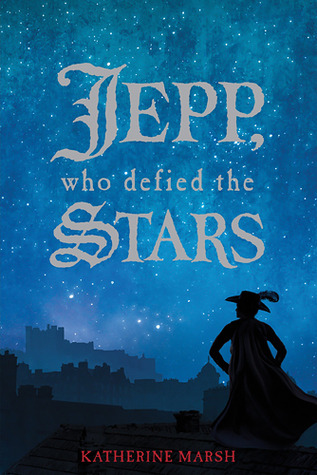
Book Review: Jepp, Who Defied the Stars, by Katherine Marsh

Title: Jepp, Who Defied the Stars
Author: Katherine Marsh
Publisher: Hyperion
Publication Year: 2012
Read: June 2013
Where It Came From: Library
Genre: YA-Historical
Rating: 4 Stars


Jepp, a teenaged dwarf at the close of the sixteenth century, leaves his quiet life at his mother’s inn to see the world and have a finer life at the palace of the Spanish Infanta. The promised finery, however, comes at the price of humiliating work aiding the court jester. Eventually Jepp finds himself sharing a room with a beer-drinking moose and reduced to picking up his master’s prosthetic nose. Although his horoscope promises many things, it isn’t until Jepp starts to take action that his stars can begin to make sense.

Jepp is a pleasing YA historical fiction novel. Author Katherine Marsh found several ideas in her research, and wove them together into an interesting story with multifaceted characters. The setting of the intermediate section offers the perfect transition for Jepp—the castle of Tycho Brahe, an early astronomer, has an unorthodoxy that can inspire Jepp, and a fascinating landscape of contradictions for readers: despite doing work in science, everyone takes their horoscopes seriously; Lord Brahe’s liberal enough to live with a commoner wife, but he makes his employed dwarf sit under the dinner table and eat only scraps; there are inventions like automatons and running water, however all their astronomy work must be done without a telescope.

Jepp is a particularly good character. He’s at point of life where he is beginning to question things and piece together his observations. He’s kind yet not self-sacrificing; smart yet not a prodigy; assertive yet largely cautious. When he falls in love, it’s cheer-worthy (plus his love interest is an imperfect, interesting and smart character in her own right).

To round out the good of the book, Jepp’s struggle to determine whether his star-chart controls his destiny is an extended consideration about the role of fate vs. self-determination. In some ways the question Jepp asks is a dated one—most people today do not commission astrological charts for their birthdays, or take them seriously if they do see one—but it speaks to the eternal question we ask about what makes us ourselves. To see beyond your role in your school/family/world and find who you are without the trappings is worth striving for at any age, and we can all hope for the clarity Jepp achieves.

Tuesday, July 23, 2013

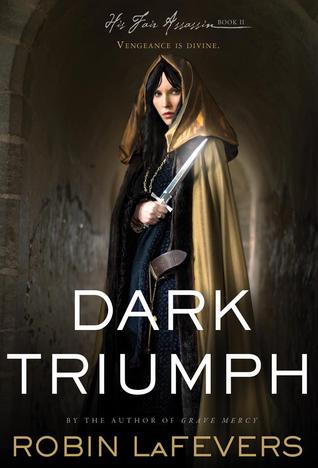
Genre-ally Speaking: Dark Triumph, by Robin LaFevers

Title: Dark Triumph (His Fair Assassin: Book II)
Author: Robin LaFevers
Publisher: Houghton Mifflin
Publication Year: 2013
Read: July 2013
Where It Came From: Library
Genre: YA-Historical Fantasy
Rating: 2.5 Daggers

The Quick and Dirty:

In a 1489 Brittany where Celtic-like gods are worshipped as saints, the Convent of Saint Mortain welcomes the daughters of Death, and sends them into the world on assassin/spying missions. In the first volume of the trilogy, initiate Sybella, seemed to be descending into madness from her mysterious mission. This volume picks up her story as she rescues one of the knights important to the Convent's work in preserving the independence of Brittany under its duchess, Anne. Sybella gradually learns to trust in love and to separate her tortured past from the promise of a brighter future. I fail to be emotionally invested in the plot. Probably because the character I wanted to read about was absent for 53% of the book. Or because there were three plots that couldn't all be fully developed in one book...

The Wordy Version:

“His Fair Assassin” is one of the oddest trilogies I can imagine: it sounds like a romance series, promises assassinations, yet is serious about its historical setting of the battles to keep Brittany independent of France at the close of the fifteenth century. The result is that I’m never quite sure whether to invest emotionally in the featured romance, the dark backstory of the main character, or the political intrigues in the setting. At least this is what I’ve come up with to explain why I haven’t completely enjoyed the series as a whole.

Because it doesn’t fully make sense that I don’t love these books. I imagine that Robin LaFevers composed a list of things that bother her in popular YA and made sure that she avoided them. Trilogies that drag out romances between couples that like each other from the middle of the first book? LaFevers has made a trilogy with different main characters so she can wrap her romances up before they need soapy disruptions! Teenage girl protagonists who need saving by paranormal boys? BAM! These girls are the ones with the powers, and they rescue boys! Love triangles between privileged and self-made suitors for the main character? Just one suitor!

But no matter how refreshing it is to see these deviations from the YA norm, the books don’t resonate with me, this failure being even stranger since I like the general premise. In case you missed the first volume, Grave Mercy, the trilogy tells the stories of three young women raised by the Convent of Saint Mortain to usher people to their true father, Death (i.e. be assassins).

Dark Triumph picks up the story with Sybella, who has been assigned to the household of the Breton Duchess’s traitorous noble suitor, D’Albret. Sybella’s latest mission is to free Anne’s loyal knight, the Beast of Waroch. Sybella’s mission goes awry, and as she and the Beast work together they fall in love with each other. The secrets that drove Sybella to the convent threaten to destroy Beast’s incipient love for her, and make her question her faith in Mortain.

Here’s the thing: this plot totally comes from a romance novel formula. Girl-too-damaged-for-love meets man who can break through her crusty personality and accept her for who she is. While they mutually kick some bad guys’ butts. Yet the romance is practically nonexistent. Since I am a nerd I made a spreadsheet of every page Beast appears in the book, and ranked the romance quotient of the page. It turns out that Beast is totally absent from the book 53% of the pages, and is merely present (but not furthering the romantic plot) another 28% of the pages. That means that all the romance of this romance plot is confined to 19% of the pages of the novel.

So what is the book ACTUALLY about, if not about the romance? It’s about Sybella separating her future from her seriously messed-up past, accepting love (in all forms), and killing people to keep Duchess Anne in charge of Brittany. For the first third of the book, Sybella’s convent-trained assassin skills are impressive and interesting. After that, they’re mostly used in battle settings instead of spy-work (not bad, but not quite as compelling as spying for me).

As for the historical setting, I’m obviously not the only confused reader. Things are so complicated that LaFevers has to provide a list of characters before the book begins (which would be much more helpful in the back, with page numbers to direct readers to the first description of the character). I could use a longer historical note reminding me about Anne’s suitors and wars. As it is, the story kind of jumps from Anne’s internal battles with D’Albret to welcoming the help of English troops for the fight against the French. But I think you’d be forgiven for being confused about this since it’s imbedded in the middle of Sybella’s own issues.

Which brings me to Sybella. Sybella was the coolest character in Grave Mercy —Ismae seemed like a fawn next to her, and Sybella seemed to be on the verge of going insane from her Serious Mission. Very interesting. By switching to Sybella’s point of view, the mysterious desperation around Sybella stops being so intriguing and starts getting tiresome. My notes on Sybella/Beast interactions are largely “S tells B a secret!” I realize now that it sounds like Gossip Girl, and if it does, it’s like what Gossip Girl would be if all the secrets were irrelevant to how the characters act. Beast is deeply in love within a few pages of interaction, and his position remains the same thereafter. Every secret that Sybella reveals makes her less mysterious and adds no tension to the S/B relationship.

So it turns out that my problem wasn’t that I wasn’t sure where to emotionally invest in the book; I was either too confused (historical wars) or too minimally involved (romantic lead absent for too long, Sybella’s dark backstory revealed to someone unconditionally in love with her) to be deeply invested.

Monday, June 24, 2013

Book Review: Plague in the Mirror, by Deborah Noyes

Title: Plague in the Mirror
Author: Deborah Noyes
Publisher: Candlewick Press
Publication Year: 2013
Read: June 2013
Genre: YA-paranormal / YA-historical / YA-contemporary
Rating: **

The Quick and Dirty:


Decent premise of a ghostly figure trying to trap a girl (who may be imagining it all) in the hellish world of the Florentine plague; actually about an insipid girl who deserves to be trapped and a crazy ghost figure who would be my #1 target in an Inquisition.

The Wordy Version:


May is spending the summer in Florence to avoid the shakeup of her parents’ divorce under the guise of helping a family friend research a travel guide. What seems like an interminably scholarly trip turns life-threatening when a doppelgänger from 1348 starts to haunt May and offer her a portal to Florence of the Middle Ages. As much as May tries to get involved with her present life, she is preoccupied by the harm her historical twin may be doing in 1348, and wonders if being trapped in the midst of the Black Plague would be as bad as it seems.

Time travel has been done so often that characters crossing into a world that ended before they were born doesn’t seem unusual. What is peculiar in Plague in the Mirror is that there is almost no logical impetus to engage in the time travel. 1348 is approximately the worst time in the second millennium to travel to Florence. Almost thirty years after the death of Dante and thirty years before the birth of Brunelleschi (whose famous dome is the modern image of the city), the only thing 1348 Florence has of interest it is its newly created republican government ...and the Bubonic Plague.

Middle Ages scholars may disagree with me, but I cannot figure out what appeal there would be in visiting a medieval city during a health crisis. As a writing convenience, setting up 1348 Florence as a hell if May were trapped is a good idea because it ratchets up the stakes for her to avoid being there. During May’s first visit we see “a young man in formfitting—that is, bulging—tights and a short, stained tunic…leering into her face. He has winey breath, and his bad teeth are bared, his head tilted like a curious dog’s.” There are “sinister towers” and “diseased-looking sausage links and sides of ham, swathed in flies,” “beds of filthy straw.” Everything about these descriptions convinces me of the undesirability of being there.

I would say “job well done” for setting up the stakes, except that the main character, May, seems to ignore all of the bad stuff that she is observing in those scenes! May has the choice to visit 1348 or stay in the present, and after her first visit she continues to return. For May, 1348 Florence is a previously living hell that contains one artist apprentice, Marco, who is every sort of Italian artist sexy May can imagine. Her one encounter with Marco (which involves about three sentences of broken dialogue because THEY DON’T SPEAK THE SAME LANGUAGE) convinces her that she has found her true love on the other side of time, and that he feels the same way. Because May’s look-alike, Cristofana, knows May likes Marco, Cristofana uses him as bait and then as a hostage, and instead of May doing the logical thing of telling herself that none of this matters because they already died hundreds of years earlier, May lets this go to her head.

“A lady’s imagination is very rapid; it jumps from admiration to love, from love to matrimony in a moment,” says Mr. Darcy early in Pride and Prejudice. I am convinced that even the self-satisfied Darcy of that point of the novel would underestimate May’s ability to jump from admiration to married life seven centuries before her birth. It’s astounding that May has no friends or interests that convincingly ground her in the twenty-first century. It is equally baffling that May doesn’t consider the language and culture differences that would separate her from Marco if she stayed.

(On the subject of languages, I am mystified at Cristofana’s ability to converse with May. Cristofana, living in 1348, says her mother was English and taught her the language. A word of linguistic context here: in the fourteenth century, people in England spoke Middle English, which is very different from what speak today. As an example, the dialect that Chaucer uses in the Canterbury Tales is the most accessible form of Middle English (http://www.youtube.com/watch?v=e0ybnLRf3gU) and I would be exhausted trying to figure out a conversation carried out in that. And chances are that Cristofana’s English could not have been so Chaucerian since he was only born in 1343.

I understand arguments for not using Middle English for Cristofana’s dialogue, including that the unfamiliar language would have made May’s time travel choices even weirder. But it would have given clarity to May’s potential mental problems if her twin could not have conversed with everyone in modern Florence while they switched places. Apologies for the side-rant.)

May’s imagination is certainly vivid when it comes to relationships, but it’s not clear if that creativity carries over to other parts of her life. According to her childhood friend (potentially with benefits), “[May] always had to invent these worlds and assign everyone names and make costumes. It was freaking exhausting.” This same friend suggests that May’s time travel could be psychological, and that May could use some help. The potential for Plauge to turn into a psychological thriller makes the middle section of the novel more palatable to read.

Unfortunately the thrills fail to come. May never seems to fully connect with the reader (or even with her own life), and when she finally is in a potentially exciting position, all she can muster is passive acceptance. If you need one reason to read this book, page 254/255 is it. On a page that should be the culmination of many of May’s dreams, May could be replaced by a board, and you might not be able to notice the substitution. Ugh, I have so many problems with this page that the next few paragraphs will be SPOILERS.

He's so intense she doesn't know what to do...until she does. The sleeping child has the bed, so they kneel together in a crouch, settling on the floor among coils of rope and oily stains and splinters and sawdust and chicken feathers.

It's hard to look at him as he eases her down, his eyes urgent and sorrowful while he undresses and lowers himself over, pulling her middle close in rough, paint-smeared hands, smoothing the sides of her crimson gown up. So she meets the blank stare of an unfinished sculpture beyond them, until at last he starts kissing her again, and she kisses back, a little fiercely, rolling on top of him in a bliss of rising away and falling and sliding and biting her lip as he moves inside her, moves and moves, and it's like reeling or flying apart.

...May feels sore and ripe and real and wonders did she really lose her virginity with...what? A man who no longer exists? An afterimage? How could something that physical not be real? She isn't sorry or disappointed, not at all, but there's something bittersweet because of Liam. She wouldn't change anything, May thinks, meeting Marco's dark eyes, wouldn't give this back or undo it, but part of her feels like a thief.

This is without a doubt the most disturbing depiction of consensual sex I've ever read. May "meets the blank stare of a sculpture" instead of the urgent eyes of her sexual partner, and after they're done she asks with what she lost her virginity. And yet she doesn't sense that not being able to communicate with the guy she's sleeping with, and not being convinced of his humanity, are major problems. May has extremely unreliable birth control available to her, but wouldn't that be a normal college-bound girl's first thought the next day? A little, "Holy F***. What if I'm preggers?" would make this scene (slightly) more palatable.

(SPOILERS END) Another thing that could make it more to my taste would be any point of view other than the third person present. I took years to get used to first person present, but the buck stops there. NO THIRD PERSON PRESENT. PLEASE. Let this book be a lesson, and examine the effect of changing the verbs to past tense.

To be fair, this was simply not my book. Even if everything I wished different had changed, I might still not have been enamored...I would just be less able to pinpoint things that made it not my book.

Thursday, May 16, 2013

Genre-ally Speaking: Out of the Easy by Ruta Sepetys

Title: Out of the Easy
Author: Ruta Sepetys
Publisher: Philomel Books
Publication Year: 2013
Read: May 2013
Genre: YA-historical
Rating: **** (4 stars)

The Quick and Dirty:

Josie lives in the bustling world of prostitutes, gangsters and booksellers in the 1950 New Orleans French Quarter. Over the course of half a year she explores a way to get away, but the pressures of her world threaten to trap her there. Exciting reading, but could have had better character development.

The Wordy Version:

Josie’s mother is a prostitute in the French Quarter of New Orleans in 1950, but Jo craves respectability. Visitors to the bookstore where she works and lives start to assume that she’s a college student, so she sees applying to Smith College as a way to leave the town that knows she’s connected to a brothel, and escape from the trouble her mother makes. As her acceptance to Smith begins to look more improbable, Jo’s need to get away increases—she may have implicated herself in a murder, gotten mixed up with the mob, and alienated her only friends.

Considering how hard it was to pull away from the book while I was reading it, I’m a little surprised that my feelings towards the book a few weeks later are mixed. There was a lot of crazy drama in the story—mobsters, prostitutes, blackmail, theft, secrets, guns, murder—and a lot of more normal drama—parent/child relationships, coming-of-age, gentle romance, college applications. With so much happening in the story, it was far from a dull book. Towards the end it was almost impossible to put the book down.

And it’s not just the elements that grab you; Sepetys has a great sense of suspense. The first sentence is, “My mother’s a prostitute.” It’s short, direct, tonally neutral, and pulled me straight into the book. The second chapter introduces some of the foreboding that will overtake the story later. Everyone begins to warn Josie of the return of “Cincinnati,” the dangerous low-level mobster Jo’s mother loves. Josie locks down her room, but closing the drapes can’t block out the ominous “CINCYNATTY” written on a note for her.

There is so much excitement that I think character development is short-changed. Cincinnati is bad, but in a boogeyman sort of way; Josie’s mother is stupid but still has some hold on her that isn’t fully explained; Patrick is a devoted son struggling with his romantic feelings, yet Jo doesn’t figure it out until after Patrick leaves so that aspect of his character essentially goes nowhere. The guy trying to get Josie to pimp herself to him is gross. Jesse, the too-attractive-for-me, smart motorcyclist, is basically just those adjectives. I wanted to cheer him on in his romancing efforts, but I didn’t think he was developed enough to make chemistry.

The characters that are most successfully rendered are Willie, the madam, and Cokie, the brothel’s driver. It helps that these are the closest people to parents that Jo has, and so the only development that truly has to occur for them is for Josie to see, through her teenage parent bias, the depths of their love for her. The book could have used more Willie instead of one of the other supplemental characters.

Josie is half cool and half irritating as can be. She’s a hard-worker, realistic but hopeful about the future, and her seven-year-old self was very spunky. But she’s so immature in her dealings with Willie in the second half of the book that I just wanted to shake her. This is probably just some facet of naturalism about rendering a teenager, but Jo handles many things so well that when she starts to get tunnel-vision, it’s jarring.

So, great plot populated by flat characters = exciting reading but a little disappointing in retrospect.

Related Posts Plugin for WordPress, Blogger...