Showing posts with label romance rubric. Show all posts

Thursday, July 3, 2014

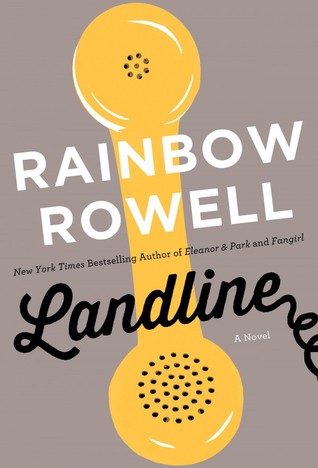
Book Review: Landline, by Rainbow Rowell

Title: Landline
Author: Rainbow Rowell
Publisher: St. Martin's Press
Publication Date: July 8, 2014
Read: June 2014
Where It Came From: BEA
Genre: General fiction
Rating: 4.5 Metallica T-Shirts

The Quick and Dirty:


Landline is a perfect beach read, a novel that is gripping, affecting, and page-turning. This isn’t a surprise, seeing that it is written by Rainbow Rowell, whose 2013 YA releases proved she has a style that is easy-to-read and content that is equally funny and tender. In Landline Rowell takes her skill at focusing on the little moments of relationships—dialogue that has ellipses from awkwardness, half smiles, hand holding, and where eyes are looking—and seamlessly applies it to a 17-year relationship from its first date to a time when there are children and careers to balance.

The Wordy Version:


When Georgie McCool gets an opportunity to pitch her dream show, she has to cancel her family Christmas plans to get scripts written by their deadline. Her husband, Neal, says he understands her need to work through the holiday, but takes their two young daughters to his mother’s home in Nebraska for the week, and then never picks up his cell phone when Georgie calls. Panicking because she hasn’t spent more than a day without talking to Neal in 15 years, Georgie resorts to dialing her mother-in-law’s landline from her own mother’s house phone, and Neal comes on the line.

It takes only a few conversations for Georgie to realize that she’s not talking to her husband Neal, but to her college boyfriend Neal, a younger, perhaps more affectionate version of himself with dreams for the future that she knows he won’t realize once he marries her. As Georgie becomes useless at work, she talks longer and longer with Neal of her past, trying to figure out if she should encourage him to break up with her before he ruins her life, and simultaneously desperate to heal her relationship with her husband.

I could absolutely see why Georgie is so torn about whether love means encouraging Neal to choose a Georgie-less direction for his life. Neal is amazing: he’s patient, accepting, encouraging, self-sacrificing, creative, funny, honorable. When Georgie realizes that he’s also been miserable for years, she thinks that she has gotten far more from their relationship than she’s given to Neal in return. I love that Georgie, even while listening to her mother claim that the marriage is over, has no regrets for herself in the marriage. I love that she loves Neal the way he deserves based on the scenes we see of him. I love that there was another romantic direction she could have gone as a college student or recent alum, and she doesn’t really pause to believe that that would have been a good idea. But mostly I love Neal.

I’ve already listed adjectives that describe Neal in the most flattering of terms, so it may seem redundant to dwell on how great he is here. But Neal was more swoon-worthy than any hero of a romance novel, and I’m not sure how you’ll believe me if I don’t keep saying it. Young Neal is the guy I wish I had met in college. He goes to a party he knows he won’t like just so he can talk to Georgie. He banters. He’s solid and appreciates Georgie’s dreams. He talks to Georgie on the phone for hours. Furthermore Neal is the husband I dream of having. He’s a stay-at-home dad who lets his preschooler pretend to be a cat to the point that there is a bowl of milk on the floor for her. He cooks kale for dinner. He paints murals on all their west-facing walls. I’m totally in love with him.

And I’m basically in love with Rainbow Rowell too, because it takes skill to make characters seem perfect and yet human (in Neal fairness, Neal does give Georgie the silent treatment, and he sulks at parties), and even more skill to make me willing to relinquish my dream husband to the character he actually married. Plus she manages to make her books almost impossible to put down. Yet another thing to love.


Sunday, May 18, 2014

Romancing the Rubric: Georgians vs. Vikings

Though it may turn out to be futile, I am dogged in my pursuit of a 2014 Reading Bingo blackout. The square I most recently had in my sights was “a book you could bring up at a bachelorette party,” which led me to some fantastic (read: not fantastic) romance novels found in the truly gargantuan collection of such at my local digital library. (It also occurs to me that my co-blogger and I are possibly the only weirdos in the world who think that book discussion at a bachelorette party is a thing that actually happens.) I found many that were enticing, but settled on these two for starters (and also because they had copies available for immediate download):

“Reynaud St. Aubyn has spent the last seven years in hellish captivity. Now half mad with fever he bursts into his ancestral home and demands his due. Can this wild-looking man truly be the last earl's heir, thought murdered by Indians years ago?

Beatrice Corning, the niece of the present earl, is a proper English miss. But she has a secret: No real man has ever excited her more than the handsome youth in the portrait in her uncle's home. Suddenly, that very man is here, in the flesh—and luring her into his bed.

Only Beatrice can see past Reynaud's savagery to the noble man inside. For his part, Reynaud is drawn to this lovely lady, even as he is suspicious of her loyalty to her uncle. But can Beatrice's love tame a man who will stop at nothing to regain his title—even if it means sacrificing her innocence?”

(Note: This book is the final volume in a quartet, but I was able to follow everything just fine without having read the previous three.)

So…let’s talk about this. Aside from some deplorable French in the early pages, it had a really promising start. Beatrice seemed like a heroine with a good head on her shoulders—level-headed, not afraid to stand up for herself, has a cool book-binding hobby, and affection for her family. Reynaud was also interesting—after years of captivity by Indians in the colonies, he has returned home ready to claim his place as Earl of Something-or-Other, while dealing with some understandable PTSD issues. He may be rough and quick to temper, but he is also loyal to his friends and takes up the mantle of responsibility for those he considers in his care.

The writing is smooth and engaging, pulling you along into the story, and I really enjoyed it for the first half of the book. Beatrice’s awkward position between her uncle the current earl and Reynaud the should-be earl created good tension—she feels Reynaud deserves the earldom, but is worried how her uncle will take having their current lifestyle revoked, and is torn between her loyalty to him and her attraction to Reynaud. Reynaud, for his part, is simultaneously trying to solve the mystery of who betrayed his military unit 7 years prior that resulted in his capture by Indians, and trying to prove he is sane enough to retake the earldom (he thinks marriage will help his cause, and that Beatrice would be a convenient match). The side characters and plots were also engaging, with Beatrice’s friend Lottie dealing with marital strife in what had originally been a love match, and her childhood friend Jeremy, crippled in war and in poor health.

Then things took a turn for the worse. Reynaud’s hardened, though still-mostly-respectful character morphed into a coerce-y, take-advantage-y blob, which I’m sure you can imagine did stellar things for the romance. Beatrice’s best friend from childhood has just died and she’s inconsolable with grief? I know JUST the thing to cheer her up—roughly divesting her of her virginity while she’s grief-stricken and in no state to be making important life decisions! That’s romantic, right? Or at least sexy? Jeez. I mean, I know most people don’t read bodice-rippers because they actually want to have their clothes literally torn off their bodies during their own intimate encounters, but there is a line between titillating and distasteful, and that scene was firmly in the latter category. Ugh.

It was mostly downhill after that. Everything that made Beatrice cool to begin with sort of faded away until she was mostly, “Oh! I love him, but he doesn’t love me!” without much of her original personality intact. Reynaud continued on his path of domineering selfishness and disrespect, largely dismissive of Beatrice’s concerns and opinions both in and out of the bedroom. I think there was only one sex scene that showed genuine, mutual tenderness.

The two get married well before the climax of the story, but don’t realize how the other person feels about them (in Beatrice’s case) or that what they’re feeling is indeed love (in Reynaud’s case) until the end of the book. I guess that was supposed to be the emotional payoff, but I didn’t really buy it. Everything else gets tied up, too—the earldom situation is handled to everyone’s benefit, the mystery of the betrayal in the colonies is solved, and the subplot involving Lottie and her husband is resolved without much actually happening. Even the writing, which was quite good to begin with, became less so as the book went on, with inconsistencies and convenient resolutions to many of the conflicts. All in all, I was disappointed that a story that had started off so strongly devolved into something less compelling with an often uncomfortable relationship at its heart.

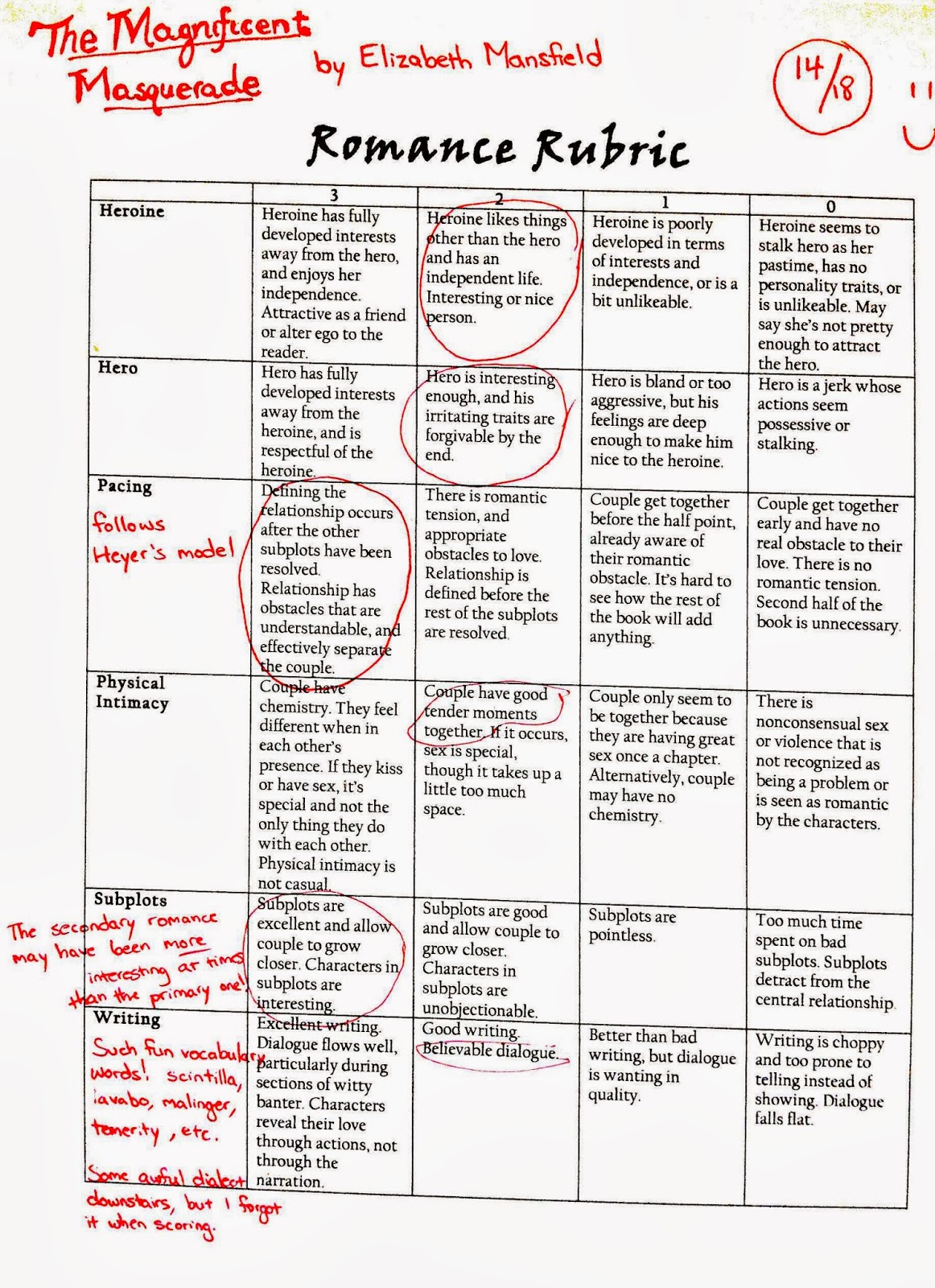
Clearly, a romance rubric was in order.
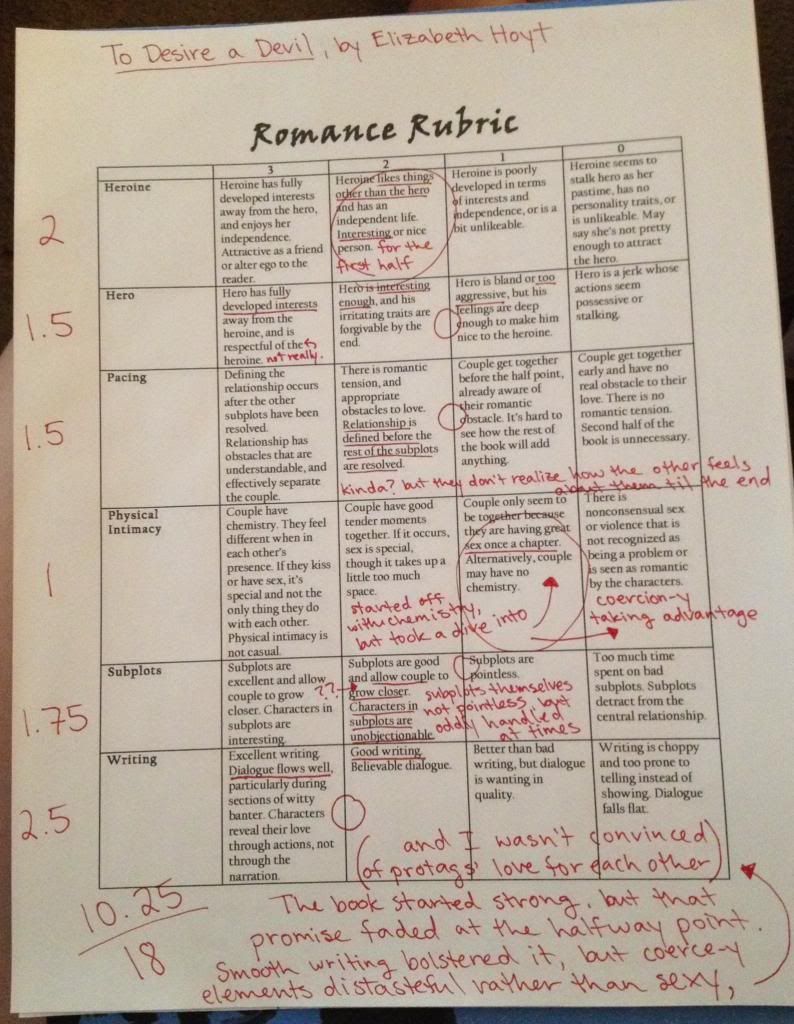
 photo photo1_zps9517ae5b.jpg


“Dangerous warrior Ivar Gunnarson is a man of deeds, not words. With little time for the ideals of love, Ivar seizes what he wants--and Princess Thyre will not become the exception to his rule! Mysterious and enchanting, Thyre rouses Ivar's desire the moment he lays eyes on her. With Viking factions engaged in a bloody feud, Thyre is yet another captive this hardened warrior conquers--but to be king of Thyre's ‘heart’ will entail a battle he has never engaged in before…”

This book kind of ended up being the inverse of the previous one—largely bad writing, but the relationship at the heart of it was actually kind of sweet. The tender moments between Thyre and Ivar were really the only times I was able to get caught up in the reading—the rest of the time the writing was so flawed that I found it difficult to take the book seriously.

That plot blurb from GoodReads does a pretty crappy job of explaining the (admittedly somewhat convoluted) plot, so I’ll try to sum it up with a bit more detail. Thyre lives with her stepdad and half-sister in a viking kingdom called Ranriken. Her mother, Sainsfrida, is dead, but was actually a princess of Ranriken once upon a time. Back then, something happened and the king (Sainsfrida’s brother, I believe) sent her as a hostage to the ruler of a nearby viking kingdom called Viken. The princess eventually got knocked up while at the Viken court, and was rescued by her friend Ragnfast and taken back to Ranriken. The Viken ruler supposedly told her to kill the baby if it was a girl and send it back to him if it was a boy, and the princess’ brother/king was upset that she got knocked up by an enemy and exiled her to live in the boonies with Ragnfast and illegitimate baby Thyre, whom she did not kill. AND THAT’S JUST THE BACKGROUND INFORMATION.

So Thyre’s mom is dead, and she’s living with Ragnfast and her dopey half-sister. Thyre pretty much runs the steading, and then one day some Viken trader/warriors wash up on her shores after a storm. They’re supposed to show the sailors hospitality while they fix up their ship, and shenanigans ensue, with the result being that their leader, Ivar, claims Thyre as his concubine and takes her back to Viken with him. This part is not actually as creepy as it could be—after Ragnfast commands the sister to sleep with Ivar (which is apparently part of the whole hospitality thing), Thyre tricksily plots with her to switch places to a) protect her sis, who has sworn herself to another man, and b) have a say in who she herself sleeps with before she’s married off to the abusive neighbor. Ivar, for his part, realizes it’s not the sister, preferred Thyre anyway, and was set to just sleep. Like I said, convoluted, but it actually kinda made sense in the context of the story.

So Ivar and Thyre continue to alternately vex and beguile each other as they head back to Viken together with the rest of the crew. There’s a plot involving people from Ranriken trying to rob the Viken on the high seas, and another with Thyre deciding whether or not to reveal her true identity to both Ivar and her father, the ruler of Viken, and yet another with Thyre being antagonized by the Viken ruler’s current wife. Thyre and Ivar are forced to marry, though neither of them really minds, even if they haven’t confessed their true feelings to each other yet. Somehow the high seas attack has endangered Thyre’s family and the steading, and she sneaks on Ivar’s ship when he sails back to help them. All plots points swirl in convergence as Ivar and Thyre realize they love each other, save Ranriken from her uncle’s evil rule, and ease tensions between the two kingdoms!

Whew. This one clearly had a lot of other-plot going on in addition to the romance, which became problematic for me due to the shoddy writing. The writing issues were distracting to the point that I lost a lot of interest in even trying to follow the story and the conversations people were having (seriously, most of the time characters spoke to one another it felt like an exchange entirely of non-sequiturs). Dialogue that didn’t flow, research into the time period not smoothly incorporated, side characters who were flat or whose motivations were difficult to follow…there was a lot that made my inner editor’s fingers twitch toward the red pen.

And yet, I will give credit where it’s due—the majority of interactions and moments shared by Thyre and Ivar were sweet. Thyre is fiery and doesn’t take crap from anyone, and Ivar is alpha-male without being a dick about it. He is respectful of her and appreciates her for who she is, and Thyre feels/treats him in the same way. There were some moments when one or both of them would have a less-respectful thought about the other after some clash of their personalities or wills, but these seemed out-of-character from everything else we knew about them and I ignored them as writing wonk.

One thing that would hit me every so often while reading was how much I would rather be reading the story of Thyre’s mom, Ragnfast, and what went down at the Viken court all those years ago. Did Sainsfrida and the Viken king love each other? What about her friendship with Ragnfast, which was strong enough to compel him to rescue her alone? And then the two friends ended up married (forced by the Ranriken king, but married nonetheless) and exiled, so did they come to love each other eventually? This sounds like a much more absorbing story. I need answers!

Overall, I can’t really say I recommend it, but I felt surprisingly less twitchy about the writing problems than usual, thanks to the central relationship that managed to develop with tenderness and respect, as well a bit of fire and personality conflict. This one’s romance rubric, for comparison purposes:
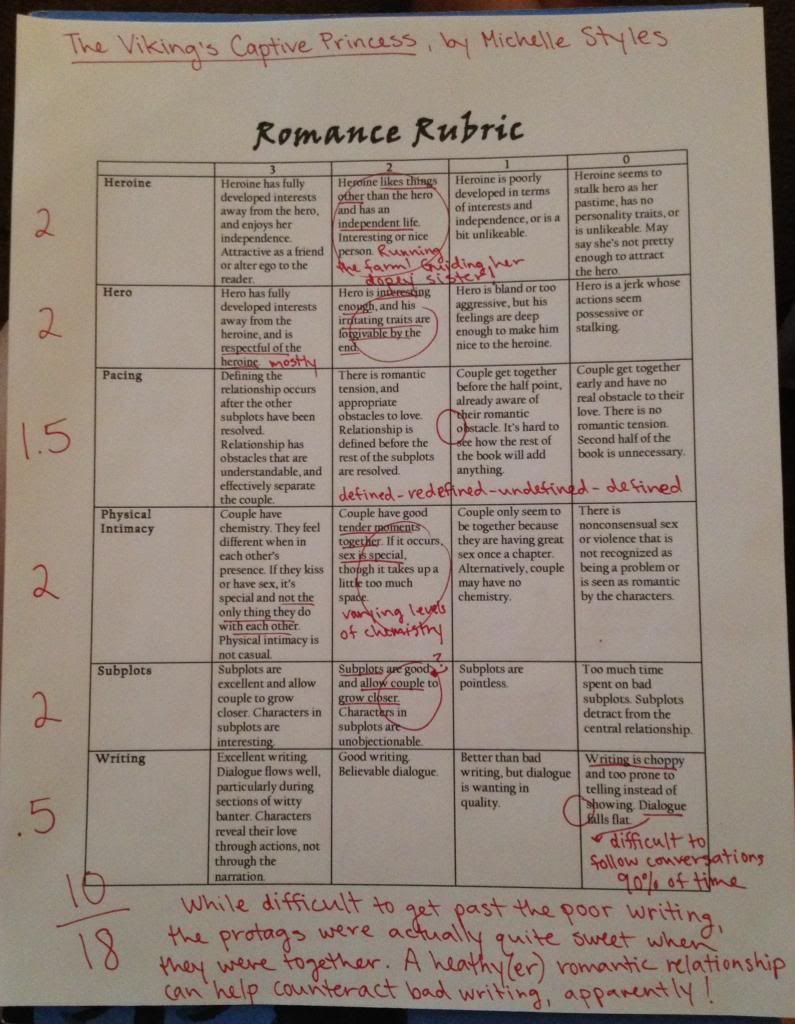
 photo photo2_zps597b0a5f.jpg
(Apparently I was so irritated by rubricking these less-than-awesome books that I forgot how to spell “healthy.”)

So which book comes out on top in a battle between good writing/uncomfortable relationship and bad writing/better relationship? Per the incontrovertible rubric, it looks like in this case it’s too close to proclaim either a definitive winner. To Desire a Devil gets a nod for (mostly) smooth writing, while The Viking’s Captive Princess takes the cake (well, maybe just a bite of it) for a relationship that was (mostly) more pleasant to read about, but neither gets my full endorsement.

To Desire a Devil, by Elizabeth Hoyt
Published by Vision (2009)
Read in May 2014; from the library

The Viking’s Captive Princess, by Michelle Styles
Published by Harlequin Historical (2009)
Read in May 2014; from the library

Wednesday, October 23, 2013

Genre-ally Speaking: Romance and Regency

Can this be true? Has it been months without any read-in-bed-all-night romance novel reviews?

Evidently it is true. The closest I came was the “New Adult” Left Drowning, which was so problematic that I couldn’t pick up another pure romance for ages. That is, a few months. But I went to my library book sale this past weekend and found a Regency romance from 1987 among the mass-market paperbacks, and instantly snatched it from a pile of brittle Harlequins.

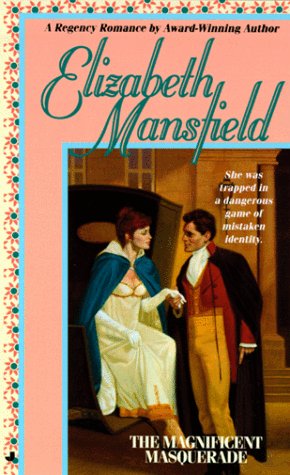
The Magnificent Masquerade

Title: The Magnificent Masquerade
Author: Elizabeth Mansfield
Publisher: Charter Books
Published: 1987
Read: October 2013
Genre: Regency
Where It Came From: Used book sale
Rating: 3.5 out of 5 Coach Rides

Years ago, in the midst of a much more time-consuming romance novel habit, I happened upon a novel by Fiona Hill, and when I searched for more of her books I found an article she wrote for the New York Times complaining about how tedious it was for an ambitious author like herself to spend her time writing fluffy Regency romances. Far more useful than her message of “I AM A SERIOUS WRITER” was her clarification of what makes a Regency novel different from the standard dime romance: in a Regency, the central characters agree to marry each other after falling in love over banter; consummation is a kiss.

Since the article’s publication in 1989 the Regency has died out as a separate genre, but seeing The Magnificent Masquerade at the book sale reminded me that there once was a time when there were many Regency writers, and many of these books presumably on the shelves of libraries.

I headed home eager to read, and you know what? It was as cute as I had expected. Not brilliant, but completely pleasant like the book equivalent of an ice cream cone.

Here’s our plot: Miss Kitty Jessup, on the verge of adulthood, is a charming jokester who cannot wait to enter society in a few months and dance and flirt with hundreds of eligible young men. Her father, Lord Birkinshaw, isn’t so sure that his daughter’s behavior outside of the schoolroom will be any better than it is inside, and when he hears the Earl of Edgerton complaining about his raucous younger brother, he hits on an excellent idea: Kitty should skip the parties and marry Edgerton’s younger brother because marriage will be a calming influence on both the young people. Kitty, upset that this will ruin all her fun, concocts a plan of her own: on the way to meet her prospective family, she will trade places with the young maid, Emily, who is supposed to be her abigail, and when her unwanted fiancé discover the deception, his family will quickly dissolve the arranged engagement. Having switched places, Kitty and Emily both start to change and desire new things, including husbands neither one of them initially planned to like.

One of the most enjoyable aspects of the book was that I couldn’t figure out which way the pairing was going to work until halfway through. Two young ladies, two brothers: is it opposites attract or like goes to like? Maybe you’re a better reader than I am, and wouldn’t have those pages of slight suspense, but I hope if you read it you have the same thought process as I did.

I also liked the characters, not for any complexity they may have had, but for their ability to fill their roles pleasantly. Basically they’re nice people (even if half are initially self-centered) discovering that they get along well with other nice people. There’s a little servant drama, which should amuse any Downton fan because (a) the butler has the same dialogue downstairs that you’d expect from Carson, and (b) a major confrontation is over the propriety of having a woman wait at the table upstairs.

In all the book is sweet, and makes me wish the fluffy Regency novel still flourished.


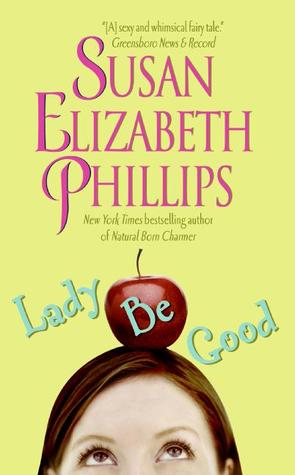
Lady Be Good

Title: Lady Be Good
Author: Susan Elizabeth Phillips
Publisher: Avon
Published: 1999
Read: October 2013
Genre: Romance
Where It Came From: Used book sale
Rating: 4 out of 5 Golf Balls

Because mass-market paperbacks were three for $1 (and no fraction for a single book), I scoured the rows until I could find two more. JACKPOT. A Susan Elizabeth Phillips romance not on my library’s shelves! Susan Elizabeth Phillips is probably my favorite contemporary romance author, but her work ranges from uncomfortable (the early Glitter Baby) to delightful (basically all the ones written between 2005-2011). Lady Be Good, fortunately, is one of her more enjoyable ones.

Lady Emma Wells-Finch is the devoted headmistress of a small English academy whose patron is a sleazy twice-married duke desperate for an heir, and willing to coerce Emma into marrying him. Claiming research obligations she travels to Texas, where she is met by a friend of a friend, Kenny Traveler, and promptly plans to sully her reputation enough to make the duke reconsider his choice of bride. Kenny, a suspended pro-golfer escorting Emma as a personal favor to get him back on the PGA tour, finds keeping Emma out of trouble is more amusing than he expected, but his real wish is to get back to the understandable world of golf.

Susan Elizabeth Phillips generally works this successful formula: spunky woman on a break from her life travels or lives with a pro-athlete or actor long enough for them to fall in love and heal their childhood scars and get past their insecurities. I think there’s usually a secondary romance as well; I remember a few with the hero’s mother getting some action. Lady Be Good completely fits into the formula, and that’s a good thing because that means that if you like any of her others that fit the formula, you’re guaranteed to like this one. Conversely, if you enjoy this one, there are more for you to read after!

More than variations of the same cheerful plot, Phillips is particularly good at hooking readers from the first chapter. Unlike Georgette Heyer (and her school of Regency writers), Phillips wastes no time on exposition. Literally we get three pages to establish that Kenny is a pro-golfer with an easy manner before he meets Emma and decides she’s a nuisance, but a nuisance he’d like to sleep with because it’s a romance novel and that’s how these things go. Once we know all that, all that’s left to do is keep flipping pages to figure out how two commitment-phobic people will persuade themselves to be in a serious relationship.

Along the way there are funny-awkward situations, awkward-awkward situations, a welcoming and supportive family (albeit with some issues from decades earlier), and the romance of Kenny’s sister with her father’s business rival’s son. (Everyone in Phillips’ world is related to someone else anyway, so don’t be put off by the multiple possessive apostrophes here.) Frothy fun.

To get to frothy fun you almost always have to have an inconceivable plot premise, and this one feels a little more unrealistic than usual. One arranged marriage with English nobility in 1999 raises eyebrows, a second arrangement in Texas in the same book is just silly. I think Phillips figured out a much more plausible way for modern arranged marriage to enter the plots of her more recent Natural Born Charmer and What I Did for Love, but as long as you can get past the set up here, it's hard to stop reading.

Tuesday, August 6, 2013

Not-a-Genre-ally Speaking: Left Drowning, by Jessica Park

Title: Left Drowning
Author: Jessica Park
Publisher: Amazon Skyscape
Release Date: July 16, 2013
Read: July 2013
Genre: "New Adult"
Where It Came From: ARC from the BEA
Rating: 2 out of 5 Bedrooms


The Quick and Dirty:


College senior Blythe McGuire meets Chris Shepherd and his fun-loving siblings as she begins to heal from the trauma of surviving the house fire that killed her parents. Blythe discovers that she loves running, sex and the Shepherd siblings (not necessarily in that order), but that love is complicated between emotionally damaged people. It's melodramatic erotica with a side plot of marathon running. The author tries to make more of a character-growing plot, but I am too distracted for this to resonate. I learn that this genre makes me feel somewhat uncomfortable and confused about human interaction.

The Wordy Version:


After this paragraph, this is a super-spoiling post. Sorry about that. I entirely agree with the New York Times critic A.O. Scott about genre stories and knowing the ending in advance. If a contemporary erotic late young adult novel is your type of book, you’ll like it no matter how much you hear from me ahead of reading it. As for me, the more frustrated I get while reading a book, the more I feel like telling you what crazy things happen in the story. Today I'm also in a life lesson mood.

Senior year of college is beginning, and Blythe realizes that she has been in a depressive and alcohol-fueled fog for the last four years, ever since her parents died in a house fire. Waking up one day, she decides to spend 24 hours without any booze, and within that time she independently meets Sabin, a junior who steals her coffee and decides in that second that they will be besties, and Chris, a senior who is built and can skip rocks. To make matters better, Sabin and Chris happen to be brothers, and their twin younger siblings go to the college too, and LOVE Blythe right away.

Romance book life lesson: when you think you are out of shape, wretched-looking and unused to social interaction, people will FALL IN LOVE WITH YOU. Also, when you make friends, make sure they come from the same family. Diversifying your friend group is needlessly complicated.

In Blythe’s relief about being sober, meeting friendly people, and having a sweet crying session that doesn’t weird anyone out, she starts to go running to deal with her flabby yet bony legs. (Life lesson: do not be content with being thin because EWWW celluloid.) Blythe has had no focus for however many years, but now she is ready to do a 45-minute run her first time out. As anyone who has ever exercised before may predict, she gets tired and does the normal thing of rushing to her brand new friend, Chris, to complain about her physical unfitness and her family problems. Chris can’t solve the aunt issue (although he is a great listener and affirmer of Blythe’s feelings), but he can make Blythe a new playlist. Blythe thanks him by pulling him close for a sweaty kiss. Chris eventually pries her off and Blythe is MORTIFIED.

Life lesson: Complain to new acquaintances about things. It’s a huge turn on.

Blythe avoids Chris for a little, even while she uses his playlist to get her through her full work-out. Things between the two get even more complicated when he shows up at her room one day to help her masturbate (Blythe’s second favorite thing to do after running). Meanwhile she continues to grow closer to Chris’s whole family. She even invites his little sister to move into her dorm room.

Life lesson: When you find the right guy, his whole family will adopt you as one of their own within weeks.

As Blythe and the Shepherd siblings celebrate Thanksgiving together, Blythe begins to see that the Shepherd family is kind of dysfunctional after Sabin drunkenly tries to ride a cafeteria tray off a third floor roof. In Sabin’s belligerency he makes fun of his sister’s religious beliefs and his brother’s unwillingness to hook up with Blythe within a month of meeting her, and then Sabin thrusts his tongue down Blythe’s throat. Blythe forgives him because he’s so drunk he’s just not himself. The boy Shepherd twin and his boyfriend dampen Chris’s mattress while they’re waiting to see if Sabin falls off the roof.

Life lesson: Belligerent drunks shouldn’t be held to high standards. And don’t trust people not to mess up your mattress in a life-or-death situation when you’d expect them to be too worried to be hooking up.

By Christmas, Blythe is doing great and starting to reconcile with her little brother (who has never followed the above life lesson, and has been pretty upset with Blythe for drunk dialing him at all hours). She and Chris manage to spend forty pages a week in bed together with no expectation of commitment. Blythe and Chris both realize they’re in love with each other, but that is too serious for Chris, who not only bails but gets engaged to the next girl he sees.

Life lesson: Guys don’t buy the cow if they can get the milk for free? Don’t date severely emotionally damaged guys.

There is more than another third of the book after this point, and I will stop plot summarizing so as to avoid any more major spoilers.

You may have guessed already that I was not swept away by this read. I had no wish to hang out with the Shepherd siblings (who sound horrible, taunting her for loving their brother, assaulting her drunk, and involving her in awkward sibling fights), and I stopped caring about Chris and Blythe in bed after her first orgasm (which doesn't even physically involve him). Credit to the author for making Blythe find herself before she settles down in a romance, and credit to her for mentioning a condom every few pages and sending characters with issues to therapy. Even with those credits, though, this left me dissatisfied and filling out a pretty harsh romance rubric:

Romance Rubric: Left Drowning

Monday, May 13, 2013

Genre-ally Speaking: The Selection, by Kiera Cass

Title: The Selection
Author: Kiera Cass
Publisher: HarperTeen
Publication Year: 2012
Read: May 2013
Genre: YA-dystopian
Rating: ***.5

The Quick and Dirty:


In a dystopian future North America where life is dictated by a strict caste system, America is chosen as one of 35 girls to go to the royal palace and participate in the Selection, a reality TV The Bachelor-style competition to choose the girl who will marry Crown Prince Maxon and become the future queen of Illéa. I expected dystopian fatigue, and was pleasantly surprised by compulsively readable fun.

The Wordy Version:


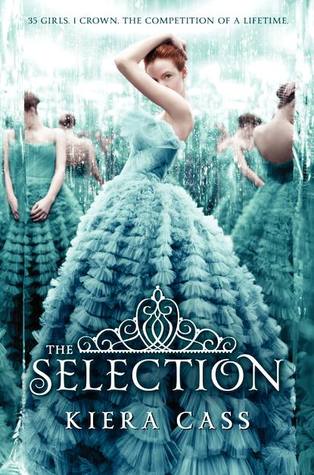
I was not expecting all that much from this book, to be honest. There’s so much dystopian fiction out there right now, and not all of it can be good. The cover is pretty, and seems to be going along with the recent trend in YA book covers--girls in pretty, foofy dresses! From what I’d heard about the book beforehand, I was expecting a dystopian fairy tale. It turned out to be more just straight up dystopian, with the monarchy prince-princess thing being less fairy tale, and more just the form of government employed in the society. Which was fine! (I’m still intrigued by the idea of a dystopian fairy tale. Does this sort of book exist, to anyone’s knowledge?)

Anyway, Susan mentioned this book to me as one of those books that at the beginning you’re like well, this isn’t that great, but then as you keep reading it becomes enjoyable frothy fun, which is precisely the experience I had. At the beginning of the book, I was pretty okay with the world building. The existence of TVs and phones and electricity and other trappings of modern real-life life laid to rest any ideas I’d had about this being traditional-fairy-tale-like, and the numerical caste system was okay. I liked that teachers were as high as being level 3, but had to suspend my disbelief that artists and musicians would be down at level 5 (given the high status of entertainers in our own society). It isn’t the kind of dystopian society where it’s horrible but everyone seems to be tolerating it, but rather the people seem to be pretty okay with the current system of government, although they acknowledge there are some flaws to the system. There are mentions of rebels, but the characters see the rebels as the enemy of the monarchy, the state, and themselves, rather than a revolution that they’re hoping for. I thought this was an interesting change from the usual set up.

Tuesday, April 16, 2013

Romance Rubric Smackdown #1

Among our group of college friends, Susan is the romance novel expert. If you look at what she’s read in the last year, you’d be disappointed to see that she’s really only read about two, but you’ll have to trust us when we say that five years ago, the only pleasure reading she did was romance novels, and she could write peer-reviewed papers on the subject.

Several months ago our book club had a question about why romance novels treat sexual harassment as though it were the sexiest form of flirtation, and that got us all thinking about what really makes a successful romance.

Well, wonder no more. We present Susan’s carefully considered Romance Rubric, which we have begun to use in our recommendations to each other. As you can see, a superb romance will garner 18 points, and an awful romance will hover around 6. (There is no good reason to be reading a romance novel that looks like it will get below a 6. Honestly. Put the book down, and find some Austen fanfic instead.)

To show you how much fun it is to grade books with a rubric (and to test how much variation we can get between our scores), we’re taking on some of the most buzzed-about YA sequences out there, starting somewhat arbitrarily with:

Daughter of Smoke and Bone and Cinder were book club picks for us recently, and just like you can’t have a conversation about wizardry without arriving at Harry Potter, it’s impossible to start comparing YA romance-driven series without Twilight. Congratulations to Cinder for squeaking out a win over Daughter of Smoke and Bone in the romance department! Tough cookies, DoS&B, since Alyssa had a much more positive reaction to you. And soggy vegetables, Twilight Series, on your low score. (If you are at all interested in our snarky remarks written on the rubrics, you should be able to click on the photos and be linked to bigger, more readable versions of them.)


Daughter of Smoke and Bone

Karou studies art in Prague, but increasingly she is called to run errands for her foster father, a chimera who trades teeth for wishes. Although Karou doesn't know anything about chimera other than the kindness of her family, chimera are eternal enemies of angels, who have a new plan to win. The angel Akira means to kill Karou as he closes the doors through which the chimera obtain teeth, but something about Karou fascinates him and starts to bring life back into his otherwise dead personality.

Mixed bag from the book club on this one, with Alyssa's cooler urban fantasy taste finding it good and Susan's hang-ups over bloody teeth and POV changes much less forgiving.

Alyssa on Daughter of Smoke and Bone photo photo5_zpscae7eb00.jpg Susan on Daughter of Smoke and Bone photo DaughterofSmokeandBonesSusan_zpse8c0c2db.png

Cinder

Cinder is a young mechanic living in New Beijing with her adoptive father’s widow and daughters. When Crown Prince Kai asks her to repair his trusted old android, Cinder and Kai find they have mutual respect for each other, but Cinder fears what will happen when Kai finds out that she’s cyborg (having several mechanical body parts and some adjustments to her nerves). Meanwhile the country is facing a mysterious and deadly plague, and Kai’s under pressure to marry the beautiful but cruel moon queen.

We tried to have a book club discussion about this book, and it came down to our agreeing that the book was fun to read, very similar to Sailor Moon, and not particularly thought-provoking.

Alyssa on Cinder photo photo5_zpsfe874096.jpg Susan on Cinder photo CinderSusan_zpsd0bdd2f8.png

Twilight

We had relatively positive feelings towards Twilight back in 2006 (before some of today’s Twihards could read...maybe even before some were born). Sure, New Moon was silly and pointless, but it seemed like a fluke publishing, kind of like sequels to rom/coms making it to movie theaters (Legally Blonde 2, Miss Congeniality 2, etc.). Unfortunately the books kept coming, and now we’re part of that hip group that talks about the death of feminism in the age of Edwardian vampires. As you may guess, that doesn’t make for high romance rubric scores:

Alyssa on Twilight photo photo6_zps6d7c89d5.jpg Susan on Twilight photo TwilightSusan_zpsef006120.png

Related Posts Plugin for WordPress, Blogger...