Tuesday, August 6, 2013

Not-a-Genre-ally Speaking: Left Drowning, by Jessica Park

Title: Left Drowning
Author: Jessica Park
Publisher: Amazon Skyscape
Release Date: July 16, 2013
Read: July 2013
Genre: "New Adult"
Where It Came From: ARC from the BEA
Rating: 2 out of 5 Bedrooms


The Quick and Dirty:


College senior Blythe McGuire meets Chris Shepherd and his fun-loving siblings as she begins to heal from the trauma of surviving the house fire that killed her parents. Blythe discovers that she loves running, sex and the Shepherd siblings (not necessarily in that order), but that love is complicated between emotionally damaged people. It's melodramatic erotica with a side plot of marathon running. The author tries to make more of a character-growing plot, but I am too distracted for this to resonate. I learn that this genre makes me feel somewhat uncomfortable and confused about human interaction.

The Wordy Version:


After this paragraph, this is a super-spoiling post. Sorry about that. I entirely agree with the New York Times critic A.O. Scott about genre stories and knowing the ending in advance. If a contemporary erotic late young adult novel is your type of book, you’ll like it no matter how much you hear from me ahead of reading it. As for me, the more frustrated I get while reading a book, the more I feel like telling you what crazy things happen in the story. Today I'm also in a life lesson mood.

Senior year of college is beginning, and Blythe realizes that she has been in a depressive and alcohol-fueled fog for the last four years, ever since her parents died in a house fire. Waking up one day, she decides to spend 24 hours without any booze, and within that time she independently meets Sabin, a junior who steals her coffee and decides in that second that they will be besties, and Chris, a senior who is built and can skip rocks. To make matters better, Sabin and Chris happen to be brothers, and their twin younger siblings go to the college too, and LOVE Blythe right away.

Romance book life lesson: when you think you are out of shape, wretched-looking and unused to social interaction, people will FALL IN LOVE WITH YOU. Also, when you make friends, make sure they come from the same family. Diversifying your friend group is needlessly complicated.

In Blythe’s relief about being sober, meeting friendly people, and having a sweet crying session that doesn’t weird anyone out, she starts to go running to deal with her flabby yet bony legs. (Life lesson: do not be content with being thin because EWWW celluloid.) Blythe has had no focus for however many years, but now she is ready to do a 45-minute run her first time out. As anyone who has ever exercised before may predict, she gets tired and does the normal thing of rushing to her brand new friend, Chris, to complain about her physical unfitness and her family problems. Chris can’t solve the aunt issue (although he is a great listener and affirmer of Blythe’s feelings), but he can make Blythe a new playlist. Blythe thanks him by pulling him close for a sweaty kiss. Chris eventually pries her off and Blythe is MORTIFIED.

Life lesson: Complain to new acquaintances about things. It’s a huge turn on.

Blythe avoids Chris for a little, even while she uses his playlist to get her through her full work-out. Things between the two get even more complicated when he shows up at her room one day to help her masturbate (Blythe’s second favorite thing to do after running). Meanwhile she continues to grow closer to Chris’s whole family. She even invites his little sister to move into her dorm room.

Life lesson: When you find the right guy, his whole family will adopt you as one of their own within weeks.

As Blythe and the Shepherd siblings celebrate Thanksgiving together, Blythe begins to see that the Shepherd family is kind of dysfunctional after Sabin drunkenly tries to ride a cafeteria tray off a third floor roof. In Sabin’s belligerency he makes fun of his sister’s religious beliefs and his brother’s unwillingness to hook up with Blythe within a month of meeting her, and then Sabin thrusts his tongue down Blythe’s throat. Blythe forgives him because he’s so drunk he’s just not himself. The boy Shepherd twin and his boyfriend dampen Chris’s mattress while they’re waiting to see if Sabin falls off the roof.

Life lesson: Belligerent drunks shouldn’t be held to high standards. And don’t trust people not to mess up your mattress in a life-or-death situation when you’d expect them to be too worried to be hooking up.

By Christmas, Blythe is doing great and starting to reconcile with her little brother (who has never followed the above life lesson, and has been pretty upset with Blythe for drunk dialing him at all hours). She and Chris manage to spend forty pages a week in bed together with no expectation of commitment. Blythe and Chris both realize they’re in love with each other, but that is too serious for Chris, who not only bails but gets engaged to the next girl he sees.

Life lesson: Guys don’t buy the cow if they can get the milk for free? Don’t date severely emotionally damaged guys.

There is more than another third of the book after this point, and I will stop plot summarizing so as to avoid any more major spoilers.

You may have guessed already that I was not swept away by this read. I had no wish to hang out with the Shepherd siblings (who sound horrible, taunting her for loving their brother, assaulting her drunk, and involving her in awkward sibling fights), and I stopped caring about Chris and Blythe in bed after her first orgasm (which doesn't even physically involve him). Credit to the author for making Blythe find herself before she settles down in a romance, and credit to her for mentioning a condom every few pages and sending characters with issues to therapy. Even with those credits, though, this left me dissatisfied and filling out a pretty harsh romance rubric:

Romance Rubric: Left Drowning

Sunday, August 4, 2013

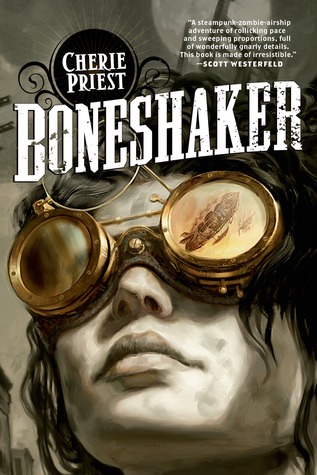
Genre-ally Speaking: Boneshaker, by Cherie Priest

Title: Boneshaker
Author: Cherie Priest
Publisher: Tor Books
Publication Year: 2009
Read: July 2013
Where It Came From: Bought It
Genre: Steampunk
Rating: 4 Gasmask Filters

The Quick and Dirty:


Briar Wilkes is scraping by in the outskirts of 1860s Seattle outside the walled up city, trying to raise her teenage son Zeke. Unfortunately, she is also living with the aftermath of her long-gone husband Leviticus Blue’s mining machine invention, the Boneshaker, tearing through downtown Seattle 15 years past and opening up a vein of gas that turns those who breathe it into zombies. People blame her and Zeke for Levi’s follies, but she’s never talked much about the past to her son, until one day he takes off with a gasmask and gun to break into downtown Seattle in search of the facts. He doesn’t know what he’s in for in there, so Briar will have to head in after him, relying on drug-running sky pirates and Seattle’s remaining living denizens to avoid the rotters and also a power-hungry inventor expanding his empire over the walled city, who sounds eerily similar to old Leviticus Blue… A bit slow for the first half of the book, but things really picked up in the second half, and it became an action-packed adventure full of great characters. I look forward to reading more books set in this world!

The Wordy Version:


I saw Cherie Priest back in May on various panels at Phoenix Comicon. Much like John Scalzi, her books had been on my mental TBR list for quite some time, and hearing her talk about this one and her other books was the push I needed to bump them up to the top of the list. I honestly don’t know why I didn’t read this one sooner—I’ve been on a mild steampunk kick since 2011, and this is one of the seminal classics of the genre.

So now here I am two months later, and I’ve read it! It was a really fun read, although I was a little apprehensive at the beginning. The first half of the book felt kind of slow to me, like not much was happening. Which was very confusing, because there was lots of stuff happening! I would say to myself, gee, I hope we get some action in this story soon. And then I would have to fire back, what do you mean? There’s plenty of action! Sons running away, Briar jumping down an air tube into Seattle, zombies attacking, people with guns in their walking sticks! How can this not be exciting? And I would miserably reply to myself, I don’t know. It just doesn’t make any sense. (To clarify, the me feeling like nothing was happening was what didn’t make sense—the story itself made perfect sense.) So I really can’t pinpoint why I felt that way—maybe it had something to do with that for the first half of the book it felt like Zeke and Briar were just bobbing around the city from people to people and place to place without really accomplishing anything or furthering the plot much? I don’t know. That’s just how it felt to me, and I was afraid the whole book would be like that and then I would be disappointed because I was so psyched to read this one…but happy to say, things picked up and I was able to forget I’d felt that way early in the book and have a lot of fun reading it.

I enjoyed the alternate history, prodded and nudged until it was able to not only accommodate this steampunk imagining of a world, but also make it almost seem like a natural progression of events. The Civil War has been drawn out longer due to a train line being built in a different direction than it was historically, the development of war machines, and I think Europe getting involved, if I’m remembering correctly. As for Seattle, Washington is just a territory at the time, but the Klondike Gold Rush being moved up in history allows Seattle to have a greater population than it truly did at the time. It all fits together very neatly, and it’s clear that the author put a lot of thought into the creation of a world where readers wouldn’t have to suspend their belief too much to make a steampunk 19th century America seem convincing. On a related note, I also appreciated how she created reasons for all the steampunk trappings, instead of just using them to give flavor to the world. Poisonous gas in the city? Of course they’ll need gas masks! Zombies attracted to the sound of guns being fired? Then someone will have invented a sort of sound wave gun to stun them! I remembered her talking about that a bit at Phoenix Comicon, and so I was able to appreciate it while I was reading.

As for characters, Briar was the one I connected with most, although at first it was a little difficult. That was mostly because she shields her thoughts regarding the past she so clearly wants to forget from even herself, and so it was difficult to get a read on what had really happened with her father Maynard, and her husband Leviticus Blue, and other important things that happened before the events of the book. But I can see the intention behind that, and I enjoyed the way these plot threads unfolded over the course of the book. Especially awesome was the skillful way Briar’s complex relationship with Leviticus was laid out bit by bit, feeling by feeling, until it coalesced into a whole that the reader was able to grasp, without explaining the heck out of it. Briar herself is great—tough, brave, a survivor. She may not be the type to…I don’t know, bake cookies and crochet booties for her son, but it’s clear how much she loves him. Zeke I didn’t connect with right away, but that’s probably because I’ve never been a 15 year old boy. He seemed to bounce around the city in a more hapless fashion than Briar did, but he was young, naïve, inexperienced…and by the end he’d done a lot of growing up.

The side characters were fantastic—the air pirates, Jeremiah Swakhammer, Lucy the mechanical armed woman…it would be easy to stray into caricature territory with characters like these, but she never does. They are always grounded, interesting, and real.

The writing was good—by turns humorous and suspenseful, and full of Western Territory flavor. Eminently readable! Which is unfortunately not always the case in published novel things these days, so I’m always happy to read a book where the writing is smooth and natural and good, with nothing sticking out that makes you feel like you’re reading a draft or need to suppress the urge to grab a red pen. When Briar finally meets Dr. Minnericht, the villainous inventor running the show in Seattle, the tension and suspense were thick enough to be sliced up like cheese. From about that point on I couldn’t put the book down until I’d finished.

On a final nerdy note, I enjoyed the framing device for the story. At the beginning I wasn’t sure how it was going to tie in, but when it did it was a nice and satisfying way to tie the story up.

Overall, a fun adventure that put checks in so many of my geek boxes it’s not even funny. Zombies, airships, mad scientists, history…it’s a veritable crock pot of geeky goodness! It will be joining my pantheon of steampunk favorites, along with Scott Westerfeld’s Leviathan trilogy, Cassandra Clare’s Infernal Devices trilogy, and Gordon Dahlquist’s Glass Books of the Dream Eaters trilogy (although that one may by more gas lamp fantasy, now that I know what that means). I’d recommend it for tried and true steampunk fans, those looking to test the genre waters, general SFF fans, Seattle fans, zombie fans…the list goes on and on.

Have you read anything by Cherie Priest before? What’s next on your to read list? As soon as I finished this one I had a strangely powerful hankering to read Catherynne Valente’s The Girl Who Circumnavigated Fairyland in a Ship of Her Own Making, and I couldn’t figure out the connection between the two in my brain that made me want to read that one next. Could it be genre? This one’s steampunk, and that one’s a sort of modernist fairy tale, so probably not. Time it takes place? This one’s Civil War era, and that one’s WWII/Fairyland, so dead end there, too. The writing styles are quite different as well, so I was stymied until I realized…it takes place in historical Seattle! And Cat Valente’s Six-Gun Snow White takes place in historical San Francisco. Does that count as the Pacific Northwest, too? I think it did, at least for connection purposes in my brain. Mystery solved, yay!

Thursday, August 1, 2013

Doctors, Meet the Doctor: Graphic Novels

I’m not much of a graphic novel reader, but when I saw Health Care Reform at my library I instantly picked it up. After all, nothing is worthier of graphic art than the Affordable Care Act. Obvi.

As odd as I will admit that sounds, it turns out the graphic novel format was the right way to go in explaining the ACA to a large audience. Yes, I could have gotten most of the information from a well-written newspaper feature, but I probably would not have finished a more text-dense piece. This, on the other hand, was easy to understand and finish in an afternoon. Written by economist Jonathan Gruber, who consulted on the ACA, the book never struggles to explain the intentions of the legislation. The artist, Nathan Schreiber, uses a firm black/white style as though to hammer in the clear logic of the ACA, and he also cleverly suggests that the economist is a superhero in the scenario. Considering how messed up the US health system has been, putting a new plan in place isn’t far off from the actions of a superhero. Definitely a recommended read for anyone confused by “Obamacare.”

After reading Health Care Reform the next book on my list was a coincidentally a Doctor Who graphic novel. Nothing like going from an economist saving the country from medical care to an alien saving innocents in the universe from untimely death. Both have pictures and at least one doctor and nurse, though!

Doctor Who Series 3 Volume 1 has two complete stories, “The Hypothetical Gentleman” by Andy Diggle and Mark Buckingham, and “The Doctor and the Nurse” by Brandon Seifert and Philip Bond. As an occasional Who-watcher (not even at the level of a casual Whovian, I’m afraid), I had no idea that people wrote Who comic books. I suppose I should have guessed, but as Doctor Who is celebrating 50 years of being on TV, I kind of figured fans already had enough material without comics. Clearly that was silly of me to think.

And I’m glad I was wrong! These comic story lines are actually more fun than most of the episodes of Doctor Who I’ve seen in recent series. (Apologies to Steven Moffat, but let this be encouragement for him to return to Jekyll sometime.) Unlike recent episodes, these stories are stand-alone tales. Even when threads of the bigger plot of the series come in, they’re treated as common knowledge rather than as Deep Foreshadowing. The result is a pair of adventures that are thoroughly amusing.

“The Hypothetical Gentleman” is a typical Who story: a Victorian woman believes she has psychic powers, but the Doctor determines that she is really communicating with a sinister alien. The illustrations are good, with obvious care taken in rendering the Eleventh Doctor and the creases of everyone’s clothing. Essentially it reads like a more concise episode of the TV show.

The second story, “The Doctor and the Nurse,” leaves Amy at the London Beer Flood of 1814 while Rory and the Doctor get lost trying to fast-forward the hours Amy has ordered them to spend together. Along the way there is a sabre-tooth tiger, Ian Fleming, and a giant gorilla (or extremely small NYC). Everything in this story, from the writing to the illustration, is done with a comic touch. The style is very different from the Diggle/Buckingham, and it takes a few pages to get used to the new appearance of the Doctor in particular. But the zany story, with its dialogue complaining about what a curmudgeon Rory can be, and how skewed the Doctor’s sense of relaxing vacation spots may be, is like a breath of fresh air. It’s the sort of thing that could never work on the TV show (except perhaps as a Red Nose Day sketch), but is exactly what a comic book can do.

And, as I'm sure legions of graphic novels fans have been saying, graphic novels can do many things that text-only novels cannot. Now the question...what should be my next pick from the graphic novel section?


Health Care Reform: What It Is, Why It's Necessary, How It Works
by Jonathan Gruber with H.P. Newquist; Illustrated by Nathan Schreiber
Published by Hill and Wang (2011)
Read in August 2013; Copy from library
Rating: 3.5 Stethoscopes

Doctor Who Series 3 Volume 1
by Andy Diggle and Brandon Seifert; Illustrated by Mark Buckingham and Philip Bond
Published by IDW Publishing (2013)
Read in August 2013; Copy from publishers through NetGalley*
Rating: 3.5 Sonic Screwdrivers

*Much as we are grateful for the copy, our review is uninfluenced by its source.

Wednesday, July 31, 2013

Adventures in Literature: Mankato, Minnesota, USA

Who knew Minnesota had such a strong literary history? I certainly didn’t. (If you are a resident of Minnesota, I imagine you to be waving your hands at me saying, “I did, I did!”) But during my cousin’s and my internet explorations to find stuff to see and do near her new place of residence, we kept on coming across these sorts of things, as you saw with our previous report on Laura Ingalls Wilder’s home in Walnut Grove. During one of these searches, when my cousin drew up a page on the Betsy-Tacy houses, I knew I recognized the name although I myself had not read these books. It took a bit of reconnoitering before I confirmed that is was not a relative, but instead Susan who I must’ve heard talking about these books once in passing! She was very excited about the coincidence of me being so close to this book pilgrimage site, so excited in fact that she went on their website to explore and ultimately choose some items for me to pick up for her as her proxy at the gift shop. I knew I needed to take the opportunity to visit and report on this place even if I hadn’t read the books—when in Minnesota! (…do as the Minnesotans do? No, that’s not right…)


Not the first Betsy-Tacy book, but I like this cover, illustrated by the famous Lois Lenski.

So, since she is the authority at this blog on all things Betsy-Tacy, here is a blurb that Susan has so kindly provided for your edification regarding the substance of the books:

“O tempora! O mores!” groaned Betsy and Tacy, taking Cicero’s classic cry for their own. (Betsy Was a Junior, 182)

If anything can sum up the appeal of the Betsy-Tacy series by Maud Hart Lovelace, it is this quote. What times! What customs! Betsy and Tacy may have quoted Cicero to exaggerate their own misery in studying for midterms, but I don’t think Maud Hart Lovelace would be unhappy to hear the phrase in a nostalgic instead of disgusted sense.

Betsy-Tacy books are the largely autobiographical accounts of young girls playing make-believe and telling stories at the turn of the twentieth century, and later of young ladies navigating high school society and looking towards their futures. Reading them gives the impression that these were the best years to grow up, that things were never so rosy as they were in those decades in Minnesota. What times Betsy and Tacy have! They play in piano boxes, dress up in their mothers’ long gowns to pay calls on neighbors, meet opera stars, and have endless socials with their friends in high school. What customs! It is très chic to put your hair in a pompadour. A sure-fire way to have a successful party is for your girlfriends to come with their fathers’ old suits (!), and an equally safe bet for a good time is to have an unironic night of singing (very different from karaoke parties today).

Basically Betsy and Tacy have adolescences where imagination and friendship are the most important things. How can you not wish you lived in those times and with those customs?

Friday, July 26, 2013

Aunt Molly’s Blueberry Kuchen

 photo photo3_zpscb51f19d.jpg

I had the pleasure of tasting this delicious tart-like concoction for the first time about a week ago, when my aunt made it for my cousin and me while we were in Minnesota (for more info regarding those adventures, explore here!). It was so delicious—sweet and mildly tangy blueberries atop a buttery, lightly sugared crumbly crust taste just the way summer should. My aunt doesn’t remember where she originally came across the recipe, but I am very grateful to whomever and whatever was involved in the chain of recipes, people, and events that led to this one appearing in my family cookbook. So stop by the farmer’s market or you-pick patch and take advantage of the blueberry bumper crop, if you can! This one’s a real crowd-pleaser.

In my recreation of the recipe I did a few no-nos (which you will see in the photos and instructions below)… But it still turned out tasty, so it must be a recipe that’s difficult to truly mess up! Woot!

Aunt Molly’s Blueberry Kuchen

Dough
1 C. all-purpose flour
2 Tbsp. sugar
Pinch of salt
1 stick butter, softened
1 Tbsp. white vinegar

Filling
1/2 C. sugar
2 Tbsp. all-purpose flour
Dash of cinnamon
3 C. blueberries
Powdered sugar (optional)

  1. Preheat the oven to 400° F.
  2. Combine the flour, sugar, and salt for the dough in a medium bowl.

     photo photo_zps51879623.jpg
  3. Then, work in the softened butter. No-No No. 1: I was in a hurry and had to soften my butter in the microwave, and ended up melting half of it. As a result, my dough was more dough-like and less crumb-like, but it tasted fine, so I guess all’s well that ends well.

     photo photo6_zps66a11937.jpg
    Sad melted butter.
  4. Add the vinegar to the dough, and mix well.

     photo photo5_zpsb1ddb3de.jpg
  5. Spread the crumbs (if you softened your butter correctly) or dough (if you’re no-no prone like me) in the bottom of a 9” springform pan, tart pan, or casserole dish. As you’re pressing it in, press it a little bit up the sides of whatever baking dish you end up using.
  6. In another mixing bowl, combine the sugar, flour, and cinnamon for the filling, and then stir in 2 cups of the blueberries. No-No No. 2: Perhaps not technically bad kitchen technique (I really don’t know), but I dumped in some fresh berries that had been frozen the day before and put them in the oven without defrosting. But they burst and got all gooey and delicious, so it turned out fine. Yay!

     photo photo4_zps1828b191.jpg
  7. Pour the filling over the crust and spread it out evenly with the back of a spoon. Bake it in the oven for 45-60 minutes.

     photo photo2_zps4f8bd224.jpg
  8. When the edges of the crust start to brown, you can take it out of the oven and top with your last cup of blueberries before letting it cool.
  9. After it has cooled, you can dust it with powdered sugar, which looks really pretty and I imagine tastes particularly good if you have a tart batch of berries. Alas, I had no powdered sugar, but the kuchen was sweet enough on its own. Slice and serve, and be the envy of your friends!

 photo photo3_zpscb51f19d.jpg

Thursday, July 25, 2013

Fava Bean and Zucchini Soup

Bowl of Soup photo IMG_0532_zpsf5750ce6.jpg

Today is supposed to be rainy and cool in New York, not even approaching 80F. Hurrah! With such weather, it's the ideal day to put up a small pot of soup!

I love soup. I love how its smell tiptoes out of the kitchen until it’s hiding in all parts of my house. I love how the steam tickles my eyes and tantalizes my mouth when its on the stove—and then when its in my bowl at the table. I don’t just have a personal love for soup; I believe soup is a perfect food. Soup forgives vegetables with no flavor, and it showcases herbs. There are light broths and hearty stews, and some type of soup for every mood in between. And soup will accept dietary restrictions easily—gluten free, meat free, peanut free, soggy cabbage free—you can still find a delicious soup recipe.

Today I am making a surprisingly filling fava bean and zucchini soup from the Riverford Farm Cookbook by Guy Watson and Jane Baxter (completely appropriate since the weather here is essentially English Summer weather). Guy Watson is the two-time BBC Farmer of the Year and 2012 Food Hero of the Devon Life, and his farm and veg-box distribution business has won a slew of other awards for having delicious organic and ethical food. He thinks about sustainability and ethics in food more than anyone else I’ve encountered. Here are excerpts from his “Ode to Dirt” in the cookbook:

The problem with soil is that, to the casual observer, it is an inert, uninteresting inconvenience that sticks to your shoes and threatens to pollute and infect your food. Few appreciate that this is where terrestrial life begins, that it supports myriad organisms, that it is being destroyed by modern farming and that it needs our stewardship every bit as much as the giant panda.

Soil sterilisation, as practised in greenhouses and strawberry growing, is one of the most hideous abuses of modern farming, virtually akin to Nazi book burnings in its reflection of the narrow-minded ignorance of its perpetrators.

A handful of healthy soil can contain millions of life forms from tens of thousands of different species, almost all benign or beneficial to us and our crops. Not only do they recycle organic matter, making nutrients available to plant roots, they also out-compete and even attack pathogenic bacteria, fungi, eelworms and slugs. Pesticides, fertilisers, animal wormers, excessive and poorly timed cultivation, compaction and poor drainage can all drastically reduce these populations, not by just a few per cent but by 10 or even 100 percent. Imagine the outcry from WWF if anyone could see the damage.

So often when you read about major problems in the world, the resolution seems impossible. But soil sterilization HAS a solution. Guy Watson and other conscientious farmers produce food every year without resorting to eliminating the variables in soil that they don’t fully understand. Even if you are still trying to find your own Guy Watson-level supplier, knowing that there are farmers considering themselves stewards of soil rather than as eradicators of pests is as comforting as eating soup.

Fava Bean and Zucchini Soup (Adapted from Guy Watson/Jane Baxter's Recipe)

Serves 4 (3 in my house as the main course)
1 onion, chopped
2 garlic cloves, crushed
2 Tbsp. olive oil, plus an extra splash to serve
2 medium-sized zucchini, grated
2 cups vegetable stock
+/- 14 oz. fava beans (I buy the 28 oz. frozen Goya packages)
small bunch of mint
small bunch of basil
salt and pepper, to taste
grated Parmesan cheese, to serve (I substituted Asiago to good effect)
If you are using frozen fava beans, boil a small pot of water first. After the water has reached a rolling boil, add the fava beans. When all the beans float to the surface, drain the water off in a colander, and run cold water over the beans to keep them from cooking longer. Peel the coats off the beans while your other vegetables sweat in the next steps.

Frozen Favas
Frozen fava beans, just after being added to boiling water

Floating Favas
When the beans rise to the surface, they're ready to be shelled

Drained Fava Beans
Another way to tell they'll be easy to shell is when you can see the bright green bean pushing through its coat

Shelled Fava Beans
Once the coats are off, fava beans look much more appetizing

If you are using fresh fava beans, simply shell and de-coat them while you're following the directions for vegetable sweating (below).

In a saucepan, sweat the onion and garlic in the olive oil for 10 minutes until the onions are soft. (Medium low heat, stir everything enough so nothing browns.) Add the grated zucchini to the pan, stir a bit, and then cover for another 10 minutes of sweating.

Onions Grated Zucchini

Add the vegetable stock and fava beans, and simmer for 10 minutes until the beans press apart when you press them against the side of the pan.

Using an immersion blender, purée the soup to your desired consistency. The Riverford Cookbook recommends keeping two thirds of the soup solid; when I made the soup last I made mine all liquid.

When you are ready to serve the soup, chop the leaves of both herbs (there will be edge browning if you do this too early). Drizzle some olive oil in each bowl, and add the herbs and hard cheese. I prefer the soup warm, but it tastes good at room temperature as well. Fava Bean and Zucchini Soup

Wednesday, July 24, 2013

Adventures in Literature: Walnut Grove, Minnesota, USA

 photo photo19_zps98ff1b52.jpg

When I was a kid, I was completely obsessed with pioneers. Oregon Trail? My favorite computer game, easily. Kirsten Larson? My favorite American Girl character, naturally. Conestoga wagon? My transportation mode of choice, theoretically. My mother even sewed me a pioneer girl’s green cotton dress and yellow bonnet for Halloween one particularly awesome year. So it might come as a surprise that I did not manage to complete a reading of the entire Laura Ingalls Wilder Little House series. I have the series, which may or may not have been “borrowed” from my grandmother’s vast basement library, but I don’t think I ever managed to finish all the books. I know for sure that I read the first two, Little House in the Big Woods and Little House on the Prairie, and I must’ve read at least the next one, On the Banks of Plum Creek, because I remember reading about (spoiler alert?) Mary going blind, which occurs in that book. Technically I think Farmer Boy is the second one, but I don’t recall reading it, and anyway, I digress.

While visiting my cousin in Minnesota recently, I noticed “Laura Ingalls Wilder Historic Highway” or something to that effect written on signposts all along the country roads that we were traversing. Pure curiosity bolstered by my love of all things Manifest Destiny drove me to Google, where I discovered that Walnut Grove, MN, the setting of On the Banks of Plum Creek, was a mere hour’s drive from my cousin’s residence. Further Googling showed a museum located there, and—wonder of perfect timing!—the Wilder Pageant, a dramatic outdoor performance based on On the Banks of Plum Creek, being performed that weekend.

Related Posts Plugin for WordPress, Blogger...