Showing posts with label book nerding. Show all posts

Monday, January 30, 2017

Some of My Favorites From 2016

2017 may be well and truly underway by now, but since it’s been a while since I last posted, I thought I’d take a moment to look back on some of my favorite reads from last year.

New Favorite Series: The Amory Ames books, by Ashley Weaver
These books are so much fun. Amory Ames, a well-to-do uppercrust-y British lady in the ‘20s-’30s, solves murder mysteries and contends with her flirtatious and flighty husband, Milo. Though by the third book the romantic tension that came from her estrangement from her husband has been mostly resolved, the mysteries are interesting enough and her and Milo’s relationship sweet enough that I stuck around. Three books out so far, and I can’t wait for more! Thanks to Susan for turning me on to this series!

Best Non-Fiction Book: All the Single Ladies: Unmarried Women and the Rise of an Independent Nation, by Rebecca Traister
Everyone should read this book, regardless of their sex, but especially, DEFINITELY if you are female. It doesn’t matter whether you are single or attached, gay or straight (this is starting to ring a bell—I feel like I’ve written this for the blog before), rich or poor—it’s a book about feminism and what it’s like to be a woman in the world, what it’s BEEN like to be a woman in the world since time immemorial. It seems to go without saying in our current political climate that there are those who feel threatened by the titular “rise of an independent nation” of females, and this book will empower you to fight back.

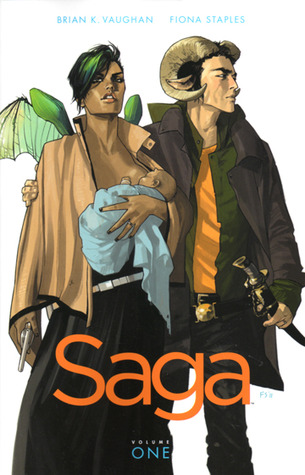
Best Graphic Novels of the Year: Too Many to List, Nearly
I read a *lot* of graphic novels last year, and loved most of them. I’ll try to limit myself to one line about each that I’m featuring here.
• Lumberjanes: Female friendship and the fun adventures of summer camp, with a delightful dose of the supernatural and humor added to the mix.
• Bitch Planet: Just what the doctor ordered for reading on 11/09/2016. That was probably the only day in my life when I have seriously (and I mean seriously) considered getting a tattoo, and it was going to say “non-compliant.”
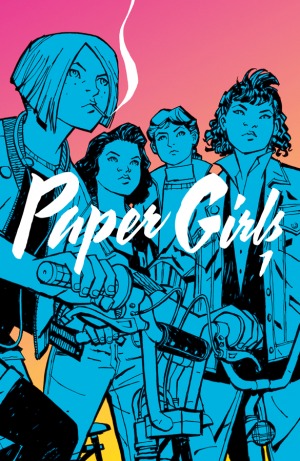
• Paper Girls: More female friendship + supernatural, but with more of a sci-fi bent and some good old fashioned ‘80s fun. It’s kooky! It’s crazy! I loved it! (Also, it seems to live in the same ballpark of my brain as Stranger Things, for what it’s worth.)
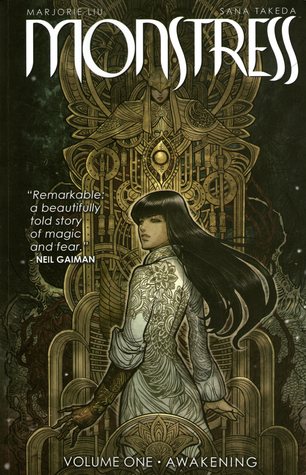
• Monstress: Scary/sad/icky-at-times ruminations on war in a fantasy world, but with truly stunning art and an ever-deepening world that continues to draw me in. It’s kinda like a blend of manga and American comic traditions, and the result is completely unique.
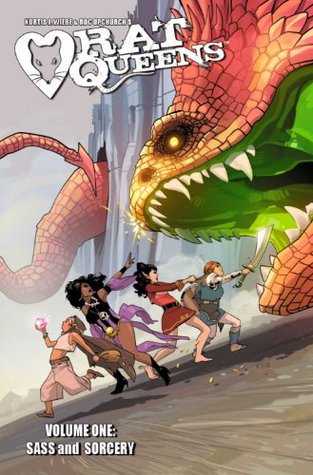
• Rat Queens: I just discovered this series in 2016, and I really, really love it. The female friendships (which seems to be a theme for my 2016 graphic novel readings) are hilariously real, and the good-natured pokes at the fantasy genre made me laugh out loud while reading. I know there has been some weirdness regarding the continuation of the series, but I really hope it does continue.

Best Series Ender: Morning Star, by Pierce Brown
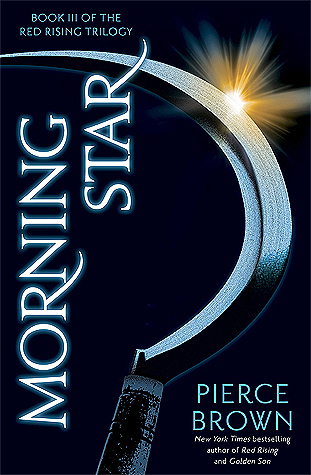
The Red Rising series has been one of my absolute favorites of recent years, and though this final entry may not have eclipsed Golden Son as my favorite of the series, it was very, very good. There’s one thing that came up at the end that I’m still ambivalent about that I’m not going to talk about here because spoilers, but it was a sweeping, emotional end to a fantastic trilogy. I’m looking forward to seeing what the author does with this world next.

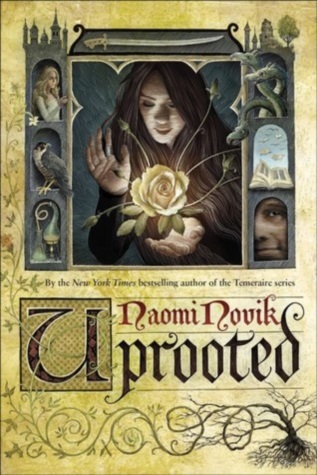
Best Soul-Nourishing Heart-Book: Uprooted, by Naomi Novik
Starting this book felt like sinking into a feather bed. I felt the same way reading it that I did reading some of my favorite books from my childhood—Ella Enchanted, especially—but in a more mature way, if that makes sense. I’m sure it’s already been said in the jacket blurbs for the book, but it is fairy tale for grown-ups, and perfect. I can’t think of one thing I would change about it. The engagement I felt while reading it, the intense need to just not.stop.reading, and the happiness I felt after finishing it—I just haven’t felt that way about a book in a long while.

Best New-to-Me Series: The Shades of Magic Series, by V.E. Schwab
If Uprooted nourished the historical fairytale side of my reading personality, The Shades of Magic books nourish the slightly darker, sharper facet of said personality. These books are witty, and wise, and harrowing, and FUN. I love them. A Darker Shade of Magic and Uprooted are the two books I bought for everyone for Christmas, and everyone knows that when I get militantly insistent about reading a certain book, I must really, REALLY adore it.

Best Book That Nourished Yet Another Facet of My Literary Personality: The Singular and Extraordinary Tale of Mirror & Goliath, by Ishbelle Bee
So, if I had to pick a couple authors to typify these various sides of my literary personality, one might be the Gail Carson Levine/Megan Whalen Turner/Elizabeth C. Bunce side (the side Uprooted appeals to). Another might be the Holly Black/Neil Gaiman side (where The Shades of Magic gets mentally filed for me). And yet another, the present one, would be the Catherynne Valente side. I love books that are magical and poetic and feel like they speak directly to me, touch my heart, in the way that art can. Mirror & Goliath has that sort of sensory language and intense imagery, and at times feels almost stream-of-consciousness (though the storytelling is still quite clear!), similar to some of my favorite Cat Valente stories. It is a beautiful book, and I loved it.

So those were some of my favorites from last year, and here, very quickly, is a preview of the books I’m most looking forward to in 2017!


What were some of your favorite reads of 2016? What are you looking forward to reading in the year to come? Hit up the comments and let us know!

**Where did the books come from? Glad you asked! Purchased: Rat Queens, Morning Star, A Darker Shade of Magic (well, library, then purchased a copy), and A Gathering of Shadows. Library: The Amory Ames books, All the Single Ladies, Bitch Planet, and Paper Girls. ARC from publisher: Lumberjanes (physical copy) and Monstress (digital copy). ARC from publisher, then either purchased or checked out from library: Uprooted (ARC, then purchased) and Mirror & Goliath (ARC, then libraried). As ever, much as we are grateful for review copies, our reviews are uninfluenced by the source of said copies, or by anyone else, for that matter.

Thursday, June 30, 2016

Holland, Holly Black, & Brown Sugar: A Conversation with V.E. Schwab

So, if you’ve frequented RTET or its attached social media accounts with any regularity of late, you probably know of my recent tumble into love with the Shades of Magic series. I don’t stop talking about it. I hardly stop tweeting about it. I keep pushing it on friends and strangers. I’ve become a book-pusher—a book-pusher, I tell you!!

But anyway—when I found out V.E. Schwab, the author of the series, would be coming to Phoenix Comicon this year, I was beyond excited. Like, super beyond excited. Geeking out about Kell, Lila, Holland, Rhy, Red London, White London, OHMYGODEVERYTHING with not only strangers who also love the series, but the author, too?! Huzzah!!! And when the opportunity to interview her at said event came about, I was absolutely delighted (and okay, maybe a little bit terrified) to have the chance to pick her brain about the series, writing in general, and even just a bit about culinary escapades. She was kind enough to meet me one morning before the con ratcheted into full gear for the day, and fielded my (sometimes vague, sometimes oddly specific) questions about her books and the writing life.
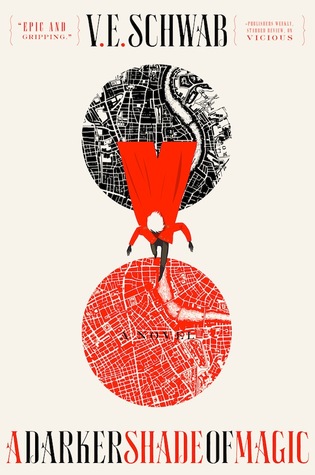
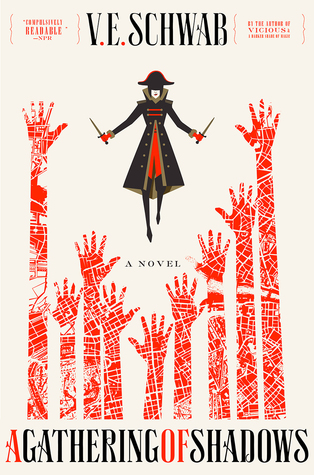
Disclaimer: Things that could be considered spoilery for all published books of the Shades of Magic series are contained herein. If you haven’t read A Darker Shade of Magic and A Gathering of Shadows yet, proceed at your own risk!

Me: So, I kind of just don’t shut up about your books. I was telling one of my friends about them, and what she took away was, “Oh, so it’s like Regency fantasy? That kind of seems to be a genre.” And I said, “Well, I don’t know—I don’t think that’s the thing that really defines the Shades of Magic.”

V.E. Schwab: Yeah, especially because only one of the Londons is based in our world. I think it’s definitely more of a secondary world fantasy. Three of the four Londons have nothing to do with our world whatsoever. I got to really build them from scratch—they just have an anchor point in 1819 London, and that’s one of the settings, but I definitely wouldn’t say that’s the primary setting.

Me: What made you choose that late Georgian Regency period? Was it because there was a crazy George?

V.E. Schwab: That was part of it. I really did want to play with a version of the world that had Crazy George, but also I really wanted pre-electricity. I wanted the pre-Industrial Revolution because even though the Londons have diverged at this point in the past and are now taking their own courses, I wasn’t really interested in how they might treat technology differently—or, if I was interested, that was a different story than I wanted to tell. I wanted to focus on this cast of characters, and I worried that as rich as I could make the world, if I started going much later, I was going to have to handle technology in each of the worlds. And technology and magic is a different discussion than these worlds, which, the whole question of the series is, how does magic shape a society in each of these situations. Grey London has forgotten magic, so it has no magic and it looks like our world. Red London is a world in which magic thrives, and it shows. White London is a world that has an adversarial relationship with magic, and so it’s being starved out. And in Black London, magic consumed everything. I wanted to really give due focus to that question, of the relationship between magic and nature and people, as compared to magic and technology, which really is its own genre. There are several books out there that deal with magic and technology at their intersection, and it just wasn’t the story that I wanted to tell.

Me: Another thing I thought was really cool was that so many stories that do have any part in the Regency are concerned with the upper classes, and with Lila we get to see the dark underbelly.

V.E. Schwab: I look at all of my books, and I’m really interested in insider-outsider culture. And so, in the series, even the characters who do belong inside of a culture feel like outsiders. Kell technically belongs to the upper echelon of society in Red London—he’s been raised essentially as a prince, but he has never fit in. He doesn’t feel like he belongs there. Lila has come up through the bottom, through the lower echelon of society of Grey London and she didn’t really care. She’s going to claw her way toward whatever she wants. I think it’s a much more dynamic place to play in. And then of course I get to have someone like Rhy, the prince, who is born in that society and in many ways does fit, but at the same time he’s an outsider because he doesn’t have magic. So all of my characters are outsiders in some way.

Me: That’s the perfect segue to my next question! I remember yesterday at your spotlight panel you talked about how you like to write about the lines between things. So I started thinking about the lines between characters, and that made me think about how the circumstances of their birth seem to be something that informs their personal conflict.

V.E. Schwab: Oh, definitely.

Me: Kell and Holland—Holland is like, we’re both Antari, but I was born in this really shitty place and you had it so much better than me. And Lila, who is always talking to Kell like, oh poor Kell, you had food and roof over your head, but nobody loves you. Even Kell and Rhy—Kell was raised in that royal family, but he feels apart, and then Rhy feels apart because he doesn’t have magic.

V.E. Schwab: I think the thing you have to remember is, to treat characters like people, we don’t look at how they see themselves only, we look at how other people see them and how they see other people. So I try to focus really, really hard at the points of intersection between characters in my books. It’s way more interesting to see Kell through Lila and Rhy and Holland’s eyes—I think if we only saw Kell through Kell’s eyes, it would be kind of dull because Kell is very much a little…a little self-righteous, and he feels very victimized. And so I look at foils in all of my books between characters, and this is really a special project in that normally a character has one foil. Each character has a foil, someone who kind of butts up against them, is at perpendiculars. Kell is literally the pivot point for the whole series—everyone is Kell’s foil.

Me: I was thinking about that. I was like, well, there’s Alucard, and then there’s Holland…

V.E. Schwab: They are all Kell’s foil! So Kell and Rhy are foils because—you have to look at basically whoever pisses each other off, right? Kell and Rhy fight like brothers. They are family and they are not family. They are totally at odds half the time, but they love each other. Kell and Lila are complete foils—again, it’s just oil and water. They just butt at all heads. And then obviously Kell and Holland are foils. And then yes, Kell and Alucard are foils. Basically, it looks like Kell pisses off everybody that he is around.

Me: It’s so good, I love it so much. Thank you so much for writing it.

V.E. Schwab: Thank you for reading it!

Me: So, something I am super nerdy about—I love languages, and so that’s immediately something I home in on when I’m reading a book. And I love how all the little bits and pieces of the languages we see in your books, whether it’s Arnesian or the language of Kell’s magic—it’s just such an organic part of the world. Sometimes in books it feels like flavoring just thrown in there. How did you go about creating those languages and words?

V.E. Schwab: I never thought I would—growing up, I was really gun-shy to read fantasy (especially classic fantasy, the Tolkien-style) because it felt really exclusive. It felt like if I didn’t memorize an entire fictional language, then I didn’t really belong to the fan club. And so, when I set out to write the Shades of Magic series, it was really important to me that I wrote something accessible. Because of that, I’d be very careful on how much of the foreign languages I used because I never at any point wanted it to feel like someone was being excluded if they didn’t follow that train of thought, if they didn’t memorize, oh, you know, everything from As Hasari means to heal, to avan means hello, to tiny things like Vas ir means go in peace—all these little things that were really important for taking a setting and making it a world, the same way details are important for taking a character and making it a person. I felt really strongly that they needed to be there, but I also had to be very careful in how I used them and the quantity that I used them. I actually love your wording because I do tend to treat them like spice in that they spice my world, but they’re very much part of the characters’ culture. I was on a panel yesterday and I was talking about this in that the things that we use to inform a world, besides description, are language and idiom, pun and humor—what actually informs a culture, not just a people. And so I actually build my whole worlds kind of from the inside out. I don't design my characters first. I design my world. And then I design the insiders for that world, and then I design the outsiders. My characters are invariably the outsiders, but before I ever design them, when I design my world, I design the foundations of a language—so, which linguistic systems I’m going to pull from, which syllabic rhythms I’m going to work for. The Veskans, for instance, in A Gathering of Shadows, are very much Gaelic—they have very hard edges, a very consonant language, similarly to the White Londoners, just a different breed. One’s Scandinavian-based, and one is definitely Scottish Gaelic. And so I pick out those seeds. I don’t design the entire language. I make it as I go and I keep a glossary of it, make sure that it feels cohesive and feels natural without being—like, this is not Dothraki from Game of Thrones. I don’t actually have the entire language. But what I do have are the grammar and syntax. I always know what order everything goes in and that keeps it from feeling like gibberish. I know the subject-object relationships, I know that it’s not like French wherein the descriptor usually follows the word—it’s much more simple than that for Arnesian. So those are the things that I think of, and I think of, what are their folktales? What are their songs? What are the things they sing in taverns, and what are the things they sing on their holy days, what are these blessings—you learn in A Conjuring of Light they don’t actually have a word for good-bye. They have a word for “go in peace,” and they have a word for “until I see you again,” but there is no formal parting word.

Me: And that says so much about the culture.

V.E. Schwab: Yeah, that’s a reflection of a culture. And so for me, I treat language like that. I treat language like another facet of the culture I need to know, because the way that Kell and Rhy use the Arnesian language is different. Kell has a better handle on it just because he is stubbornly determined to be a commoner, and to be treated like a commoner. Rhy has an excellent handle on it, but it’s almost like the kid who has been taught French in school without ever actually going to France. He has a really, really strong book knowledge of all languages because he was raised to have a book knowledge of languages. And so there’s the way they function with language, as compared to the fact that the king and queen never speak Arnesian. They only speak High Royal, which is like our English, our common tongue. And Lila, in Conjuring, will call them out on that—basically that Maxim is addressing a citizen, a commoner, and he’s demanding something of him and he’s doing it in High Royal, and the commoner doesn’t speak High Royal. There’s this fundamental divide, and language really helps me play up insider-outsider culture. It’s been really fun in the series because Lila is not from Red London and she only speaks English, and so when she arrives in this world—it’s been really exciting to do her point of views because I get to watch her learn a language, and pick it up from its roughest, most essential parts that she would’ve learned aboard the Night Spire, to actually becoming a citizen of this world. That’s one of the coolest ways to show language—through people who know it and people who don’t. In a lot of A Darker Shade of Magic, when she first gets there, you don’t get a lot of dialogue happening around her because she doesn’t know the language.

Me: It’s funny that you said “not like Dothraki,” because I feel like the way you use it in the books feels the way it does when George R.R. Martin uses it. It just feels like you can, as the reader, pick up on what words mean, and you can pick up on the syntax just from reading a little bit in the book.

V.E. Schwab: And that’s the goal. I want my readers, by the end of one of the books, to have a little bit of understanding when then they see avan, or aven, which means “blessed,” or mas vares, which means “my prince.” Which gets used in a lot of different ways because they address Rhy that way, and that’s good, but they address Kell that way and it drives him absolutely crazy. I want my reader to pick up on those tiny little jabs, but I also had to create a story that wouldn’t be lacking if they didn’t. If you go through and you just skim the Arnesian and treat it like gibberish, you will still enjoy the story. [Brandon] Sanderson was on a panel yesterday and we were talking about that. It’s like an Easter egg, it’s that extra little piece for the readers that want that.

Me: Yes! I say, “Kers la?” in my head now.

V.E. Schwab: Yeah, exactly. And I have people who have designed tattoos that have, like, As Hasari for a nurse, and things like that. I’ve seen people do a lot of hand lettering for As Travars. I sign A Darker Shade of MagicAs Travars,” and I sign A Gathering of ShadowsStas Reskon,” which means “chasing danger.”

Me: So…is Holland totally your favorite?

V.E. Schwab: Yes. Have you seen the cover for Conjuring at this point? I won’t say who’s on the cover, but I will say that it’s probably the main character of book three. Because Kell’s on the cover of book one and it’s his book, Lila’s on the cover of book two and it’s arguably her book, and the character on the cover of book three, whether it’s Holland or Rhy—it’s their book. But I will say that Holland is my favorite character in the whole series, and it’s because I play short cons with some of my characters and long cons with other ones. And Holland’s my long con. He’s the one that it takes the entire series to get his story, and…I love his story.

Me: In the first book, and correct me if I’m wrong, I think nothing is written from his perspective at all. And so when you’re first reintroduced to White London in A Gathering of Shadows and it’s from Ojka’s perspective, you’re like, “Oh hey, that’s Holland!” But then you’re like, “Wait…is that Holland?” And then he says, “Call me Holland.”

V.E. Schwab: And then you get Holland’s perspective.

Me: And the vibe is just so completely different from any other time we’ve seen him in the books. Is it just because we’re seeing him from his own perspective now? Is it because he’s now got a little hitchhiker from Black London?

V.E. Schwab: It’s definitely the first time you get to see him from his own perspective. So Holland—even knowing nothing of Conjuring, you know that he was tortured for seven years at the hands of the Danes, and in order to survive he essentially killed a part of himself. And that’s understandable, but because of that, Holland is very, very, very guarded. You will never get anything of him from someone else’s perspective. If you’re in another perspective, like Kell’s or Lila’s or Rhy’s, and you see Holland, you will not be able to tell what he’s thinking, you will not be able to read him, any of that. Only in Holland’s perspective do you get Holland, and it’s still a very guarded perspective. He’s never going to be an emotional person. He can’t. He can’t, at this point, be an emotional person. He can be angry, he can be frustrated, but he’s never going to show vulnerability. He’s been trained—it’s been beaten out of him essentially. He has learned that the only way to survive in this world is by not showing weakness. You get a lot of his perspective in book three, and it’s been really exciting to actually show the person that he was before the Danes. You get to see how he became the Holland who would torture Lila in the streets in book one. It’s going to be really cool for any later readers or people who choose to go back and re-read to see Holland in book one—and people hated him at the end of A Darker Shade of Magic. They wanted comeuppance for him. And over the course of the series, I’m watching that shift to they want him to be okay. And that’s all I can ask for. As an author, my greatest goal is to turn a villain into an antagonist into a protagonist. And so the fact that people’s opinions of him are shifting—and it will be interesting when you read Vicious, because a very similar thing happens with a character named Victor Vale, who everyone starts out being like, “Fuck this dude.” He is awful. He murders people, he tortures people. He has the ability to control pain, so he’s just a terrible person, and then about halfway through the book, people are like, “Aw man, this dude is awful, but I kinda see where he’s coming from,” and then by the end of the book they’re like, “Yeah, Victor Vale!!” That’s my favorite challenge as an author. I think every author has a little personal thing that they like to do—mine is taking the ostensibly least relatable or least likeable character and making them the one that you want to win.

Me: That’s so funny that people hated Holland. Kind of from the beginning, I was like, “I feel like this guy is awesome. I know I shouldn’t think that, but…”

V.E. Schwab: I wanted people to at least think there’s more to him. And I think the transformation is happening in Gathering because nobody let themselves really think, “Okay, we’re going to find out more,” because they thought he’d be dead. It was interesting, because about half of my readers thought Holland was really dead, and half were just like, “Let’s see this. Bring him back.”

Me: He’s not dead until I see a body that doesn’t breathe anymore.

V.E. Schwab: Exactly. And I think people knew—people should’ve suspected he wasn’t dead because I hadn’t shown Black London yet. If I had shown Black London, then maybe…

Me: Chekhov’s Black London.

V.E. Schwab: Yeah, exactly. You haven’t seen Black London yet, I just sent him into Black London! I will admit, though, that when I got to write a flashback in Conjuring that involved the Dane twins, I immediately got chills again. I was like, “I forgot how much I love to hate you as people!” They’re full-on sadists.

Me: I love the Danes so much.

V.E. Schwab: One of my favorite pieces of art that’s ever been done was done by Victoria Ying, who is just an incredible illustrator, who has this picture—it’s now hanging on my wall—of Holland standing between the Dane twins and they each have a hand wrapped around his throat, and he’s staring forward. It gives me chills every time I see it. It’s so good. He’s such a tragic character.

Me: Oh man. So good. SO GOOD.

V.E. Schwab: I know, we’re going on a Holland tangent.

Me: I could probably talk about the Shades of Magic forever, but another interesting thing you mentioned in your panel yesterday was how you write for three different age groups—middle grade, YA, and adults. So that’s three books a year? That sounds crazy to me.

V.E. Schwab: Some years there’s two, just because of how the schedule happens, but most of the time it’s three.

Me: How does your writing process work? Do you switch between projects?

V.E. Schwab: Well, it’s been screwed up by the Shades of Magic actually doing really well, and so I’m doing a lot of travel and a lot of promotion right now. I thought, “Oh, I’ll just take my work with me.” I have since discovered that there is very little time and much less energy to actually sit down and write when I’m traveling. There’s an adjustment I’m still trying to make. Everyone assumes I’m a very fast writer because of how many books I write. I’m actually a very slow writer, which means I have to be a very consistent writer. I have to do it almost every day that I can. And I can only write one book at a time. I can’t switch back and forth between. And I think if I wrote contemporary realism I could, or if I wrote all my books in the same world I could, but switching between magical systems—because I write This Savage Song, which is set in a slightly futuristic society that’s based on a version of the United States, and then I have the Shades of Magic, which is very historical fantasy. I can’t switch back and forth. They both have really complicated magic systems, and I think I would-- I work in third person close, but I would lose all sense of voice, I think.

Me: Culture shock.

V.E. Schwab: Yeah, it would be culture shock. I need a two-day transition to move between projects, so I tend to write one whole project at a time. It makes me constantly behind on something.

Me: To get three done, do you have to be super regimented?

V.E. Schwab: I normally am. Right now I’ve been thrown, just because this is the first year that I’ve had an adult book, A Gathering of Shadows, and a YA, This Savage Song, come out within four months of each other. I have just started to wind down on A Gathering of Shadows promotion and This Savage Song is about to come out.

Me: I’m so excited for This Savage Song.

V.E. Schwab: I’m so nervous. It’s going to be my most divisive book. Without question, it is the darkest, strangest thing I’ve ever written. What’s fascinating is I’m watching some of the reviews come in, and it’s 5 stars or 1 star. But that’s how I want it to be. I don’t want 3-star book reviews. I would love people to either love it or hate it, and it’s a very dark YA novel. The whole book is an existential question about what it means to be human in a monstrous world. And it’s not for everyone. It’s very specifically for 17-year-old me. And so because of that, it’s finding the right readers. And it’s that thing you have to remind yourself as an author, that there is no book you could ever write that it would appeal to everybody. But if you stay true to your craft, you will write the book that is right for somebody. It’s very hard to remember when there are reviews and all of these things pouring in—you want everybody to like you. You want everyone to like your books. But at the end of the day, as long as the right people find your books—there are books out there for everybody. Your book doesn’t have to be the book for everybody.

Me: I was reading the blurb for it, and the dark, gritty fantasy-ish vibe reminded me of—I was going to say old school Holly Black, but pretty much all Holly Black.

V.E. Schwab: I love Holly Black so much. I love White Cat, I love the Curse Workers series so much. I grew up on Neil Gaiman and Holly Black and Susanna Clarke and T.H. White—all of these very, very classic—but Holly is probably one of my favorite writers in the entire world.

Me: Do you see their influence on your own writing?

V.E. Schwab: I see it on my aesthetic. I don’t see it in my voice, but I see it in my aesthetic. I think our worlds are drawn in the same color palette. I definitely read Neverwhere or I read White Cat and I feel like they’re in the same colors.

Me: That’s a cool way to put it.

V.E. Schwab: It’s the only way I can really think of it. There are books out there that I really enjoy that are written in such bright colors that there’s no comparison between us. But I honestly read a Holly Black book or a Neil Gaiman book and I think that people who like them would potentially like my books.

Me: Very cool. I have one last question, and it has nothing to do with books. My website is half about books, half about food, and when I told my co-editor I was going to interview you, she said, “Oh, it says on her website that she likes baking! You should ask her what her favorite thing to bake is.” So. What do you like to bake?

V.E. Schwab: I’m a stress baker. Writing is terribly insular. It’s just all in your head, all the time, and so sometimes it’s nice to use your hands instead of your head for a little while. But I am one of the best in the world at making dark chocolate sea salt chocolate chip cookies.

Me: That sounds amazing.

V.E. Schwab: And I have been making them since I was five.

Me: What?!

V.E. Schwab: I was on TV when I was five. My mom was a caterer, and we were on the television together, like on a Good Morning America-style thing, and I was five and I was helping her bake these. And I have perfected that recipe since then. I am now 28, and I make such a bad-ass chocolate chip cookie.

Me: Can you just do it off the top of your head?

V.E. Schwab: Oh yeah, I don’t look at anything. I don’t measure anything. I know exactly how it’s supposed to taste at every single stage of the recipe. It’s super simple. I can bake really complicated things, like triple chocolate tortes with raspberry glaze. I make a really, really good triple lemon cake, which is where you infuse lemon at three different stages of it, like a soaked lemon cake. I make very good banana bread. But my favorite thing to make is just chocolate chip cookies. And I’ll come home, and it’ll be like an hour after dinner and my housemate will be like, “You know what we don't have? We don’t have cookies.” And I’m like, “…okay, give me ten minutes.” In ten minutes the cookies will be in the oven, fifteen minutes in and we’re just having cookies. She knows that she can just ask me, “Can you just make me cookies now?”

Me: What you should try—have you ever used mesquite flour?

V.E. Schwab: No. Is it smoky?

Me: I think it depends on where the tree grows, the terroir, stuff like that…but the one I bought kind of has a cinnamon-y cocoa-y flavor. And you don’t use it for all the flour in the recipe.

V.E. Schwab: That would be so good. I’d love to try that in an oatmeal raisin.

Me: I used it in a David Lebovitz recipe that had oatmeal in it, and it was really good. So if you ever get the chance…

V.E. Schwab: Nice. My trick with banana bread is that I cut the sugar in half and switch to brown sugar for the other half, and it makes that caramelization in it.

Me: Brown sugar is the best sugar, bar none.

V.E. Schwab: Oh, it’s the best. Also, more bananas than the recipe ever calls for.

Me: All the bananas.

V.E. Schwab: ALL the bananas. But brown sugar is the golden gift of baking that I don’t think people use enough. And it does tweak the baking times a little bit because it crystallizes very quickly, but everything is better with it.

Me: I agree—brown sugar is the best sugar.

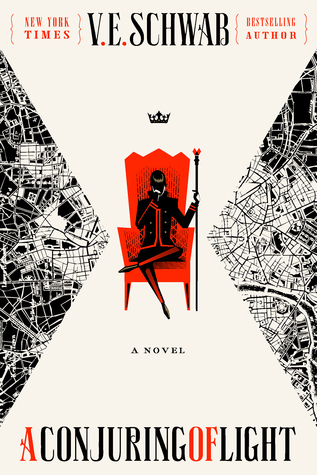
And on that sweet note, we closed out the interview so she could head off to her panels for the day and I could attempt to plot my comicon-ing for the remainder of the weekend. Thanks again for taking the time to talk with us, Victoria! It was so much fun to chat with her, and now my appetite is even more whetted for A Conjuring of Light, the final book in the Shades of Magic, due out in February 2017. How will we wait a whole YEAR?!? ((insert distraught emoji here)) At least This Savage Song will be out very soon, on July 5th, so our next hit of V.E. Schwab-y goodness is not too far over the horizon. Which is your favorite of her books? Who’s your favorite character? What questions would you have liked to ask her? Hit the comments down below and let us know!

Thursday, May 26, 2016

Phoenix Comicon 2016 is Coming!

It’s that time of year again…comicon time! Though neither S nor I made it to BEA this year, I will be making the summerly sojourn to Phoenix Comicon in about a week to partake of their lovely books and authors programming track. (I tried to entice S into joining me, craftily using her love of the Animaniacs against her—voice actors from the show will be there this year—but alas, it was to no avail.) It seems like this year there won’t quite as many big name SFF author guests at the con as there have been in previous years, but there will still be plenty to see and do and experience. I could seriously probably attend booksy-authory panels back-to-back the entire convention and still miss out on half the programming on that track. Two very big names will be attending again—Pat Rothfuss and Brandon Sanderson. I’m not a superfan of Sanderson’s work (I know, I know…unpopular opinion), but I am a big Rothfuss fan, and I think it will be especially cool to hear what he has to say coming off the recent and highly successful Tak kickstarter.

But anyway—who and what am I most looking forward to about this year’s PHXCC? Let’s see…

  1. OH MY GOD V.E. SCHWAB IS GOING TO BE THERE AHHHHHHAHAHGDHGOHZDGIHDPIUVH{OIDHOI
    So, if you’ve seen me on the blog or social media lately, you have probably witnessed my recent obsession with her books, A Darker Shade of Magic and A Gathering of Shadows. Ummmmm I may have just actually bought her entire bibliography (well, almost) on Amazon because I was so in love with those two books. DON’T JUDGE ME. Anyway, shortly after reading A Darker Shade of Magic, I found out she was doing a signing in my city…the previous week. In a fit of despair at missing out, I randomly checked on the Phoenix Comicon page and, lo and behold, she was listed as a guest! I am super excited to hear what she has to say about the writing life and any tidbits about the upcoming A Conjuring of Light and This Savage Song. Woot!

  2. Hooray, I’ll be able to get the last book in the Red Rising trilogy signed!
    Pierce Brown will be back at PHXCC this year. Red Rising was awesome, Golden Son was the best thing I read last year, and I’m currently prolonging my reading of Morning Star because I don’t want the series to end. (I suppose I should finish it by next week, though, so I don’t get inadvertently spoiled at panels.) At any rate, Pierce Brown is a fantastic storyteller and writer, and I’m eager to see what’s in store for him next. (And also deathly afraid of what might happen by the end of Morning Star.)

    There will be lots of old favorites and new faces as well as far as the author lineup goes, but if you really twisted my arm for a top two list of authors I’m looking forward to, thar it be. Now, what panels look intriguing, you ask? Well, let me tell you! Beyond the spotlight panels on various superfan-squee-inducing authors, I am looking forward to…

  3. Adventuring Parties, Still Cool? (featuring Patrick Rothfuss, Sam Sykes, Sarah Remy, and Todd Lockwood). “The world of fantasy has long been defined by the Fellowship but in a post Dragonlance world, does the adventuring party still have a place in epic fantasy?”

    Points for best panel name ever. I was sold on that alone. Also, I bet you a dollar Rat Queens comes up during the panel discussion.

  4. Del Rey Superfight (featuring Kevin Hearne, Michael J. Sullivan, Pierce Brown, and Scott Sigler). “Superfight! 3 authors enter, 1 author leaves…join Del Rey in our new favorite gaming tradition.”

    Watching favorite authors go all cutthroat on each other in pursuit of a win at the tabletop game Superfight was a blast last year—just as hilarious as Author Batsu, if not more so. Can’t wait to see what’s in store this year. BSing has never been so fun!

  5. Would You Lie to Me (featuring Beth Cato, Brandon Sanderson, Jason Hough, Mary Robinette Kowal, Sam Sykes, Scott Sigler, and V.E. Schwab). “Authors lie for a living, but are they any good at knowing when they are being lied to? Hosted by Jason Hough, our two teams of authors will try to outwit each other and discern fact from fiction.”

    Apparently I really, really like panels that run a little bit like game shows.

  6. Mythology and Folklore (featuring Alyssa Wong, Joseph Nassise, Mary Robinette Kowal, and Todd Lockwood). “Fantasy has always borrowed heavily from the myths and legends around the globe. As the genre expands, so too do the myths we draw upon. Our panelists discuss their favorite legends throughout history and how they use them in their work.”

    As a lifelong mythnerd, this is immensely appealing to me. I mean, one of my life ambitions is to join the Mythopoeic Society. In what world would I not be attending this panel?

  7. Guilty Pleasure Tropes (featuring Christina Henry, Gini Koch, Patrick Rothfuss, and Tom Leveen). “Weird magic, awkward relationships, witty banter; everyone’s got a favorite trope, even if it’s sometimes a dirty word. Our authors talk about the tropes we’re most embarrassed about but just can’t quit.”

    Serendipitous, because as S and I have been recently plotting a ridiculous romance novel (seriously ridiculous—it was inspired by word scrambles that sound like fancy names), it has come to my attention that I have a talent for generating tropes. S assures me this is perfectly acceptable—nay, required—for the romance genre, and I bow to her expertise on the subject.

  8. Fantasy Draft League (featuring Alexandra Oliva, Austin Aslan, Beth Cato, Lexie Dunne, Ryan Dalton, and Scott Sigler). “Fantasy football. Hold the football. Our authors assemble an adventuring party from fantasy characters and duke it out to determine the one bracket to rule them all.”

    What fun!! This sounds similar to something S was telling me about earlier this year that happened at her local library (she was hunting for a good cleric—she came up with Melisandre, and I came up with Lirael).

  9. Embarrassing Author Con Stories (featuring Kevin Hearne, Leanna Renee Hieber, Mary Robinette Kowal, Patrick Rothfuss, Pierce Brown, Sam Sykes, and Shannon Messenger). “Everyone’s got one. Sometimes they witnessed it. Sometimes they were a part of it. Sometimes they caused it. Our authors relive hilariously awkward and light-heartedly embarrassing experiences at conventions.”

    Ah, looks like more comedy gold. Who doesn’t love a little schadenfreude?


So much to see and do, and it all starts next Thursday! I can’t help but feel woefully unprepared, but it’s looking to be a busy, crazy, awesome weekend-after-Memorial-Day-weekend. Who are you most excited about at the con? Which panels sound the most intriguing? Hit up the comments and let us know!
Sunday, May 15, 2016

Cool Stuff: Tak on Kickstarter

In the past couple weeks, I have come across lots of really, really cool book-related stuff in my wanderings around the interwebs. Stuff that made me think, “This is a thing?? This is amazing! How did I not know about this?!” And then I would frantically text Susan or whichever friend I thought would most appreciate it to share the awesomeness I had stumbled upon. And that got me thinking—with all the really nifty, book-related stuff out there for one to come across mostly randomly and fortuitously (one might say like meeting a tinker upon the road?), why not have a new blog feature for sharing the very, very coolest of things like that that I come across? And thus, the creatively titled “Cool Stuff” genre of posts was born.

First up: The game Tak, from Pat Rothfuss’ Kingkiller Chronicle books, is becoming a real thing on Kickstarter. In fact, it already is a thing, with rules and instructions for creating your own game to start playing before the Kickstarter is even over.

If you are at all into fantasy novels, you’ve probably heard of these books, if not nommed them like a voracious reading beast. I’m sure I’ve written little blurbs about them here on RTET in the past, but it’s Sunday and I’m feeling too lazy to link to those past posts—suffice to say, they are very, very good (the books, not the posts). They’re the kind of books with a whole wonderful world that you could just crawl into. Good world-building, man. I am powerless to resist it. And it is so, SO cool when things from a beloved, so-well-crafted-as-to-feel-real fictional world make the jump and become real things in our world. (See also this article by Elizabeth Wein on the Book Smugglers site for further treatment of this topic.)

So. Tak. It was introduced in The Wise Man’s Fear, the second book of Rothfuss’ series, and is described by protagonist Kvothe as being “simple it its rules, complex in its strategy.” And now Rothfuss and game designer extraordinaire James Ernest of Cheapass Games have actually created it! It is an abstract strategy game for two players (ahem, I am learning so much about different genres of games and what they’re called these days), and it looks awesome. Fun for book fans, and also fun for people who like games and maybe know nothing about the books. I will be backing this Kickstarter for sure.

Monday, August 10, 2015

PHXCC 2015: Ann Leckie Spotlight Panel

 photo IMG_2186 copy_zpsvi4dwdpv.jpg

At last, some of my coverage from Phoenix Comicon 2015 appears on the blog! It was great fun this year, with lots of amazing author panels and signings, and some time left over for people watching and exploring the dealer’s hall. I was super, super psyched to go to Ann Leckie’s spotlight panel, as I had recently started her Imperial Radch series. I hadn’t yet finished the first book, Ancillary Justice, at the time, but it was a calculated risk between going there and possibly perhaps maybe getting a little spoiled, and going there and learning all kinds of neat things about the books and her writing. In the end (as if there had ever been any question!), the chance to hear all the cool stuff she had to say won out. We were a fairly small group at the panel, which made it nice and cozy, and pretty much everyone who wanted to ask a question had a chance to do so (even me!). As usual, I did my best with transcription of the audio, and hope you enjoy this taste of what went down at the panel!

A random smattering of interesting topics, tidbits, and happenings during the panel:

  • A story (that no one could state with certainty was true) that C.J. Cherryh’s publishers made her put an “h” on the end of her name because they thought no one would buy a sci-fi novel from a woman named Cherry
  • Lots of interesting information about what a rodman does on a surveying crew, which was a previous job of Ms. Leckie’s
  • The lesson that one should make sure they’re not holding a machete in the hand that they’re using to swat a horsefly that has landed on their body
  • Discussion of Breq as an unreliable narrator when it comes to herself
  • Jack Vance as a writer of gorgeous visual stuff—Ms. Leckie read a lot of Vance because she wanted to learn how to create good visuals in her work
  • Historical smuggling of tea out of China
  • Learning that it took her almost 10 years to write Ancillary Justice

And now for some of the questions she fielded during the panel that I found particularly interesting (and spoiler-free, for anyone who hasn’t read the books yet!).

Audience Member: Can you talk about the origins of the Ancillary series?

Ann Leckie: Basically, it was me putting shiny stuff together. I was one of those people who always wanted to be a writer from when I was quite young, but I never felt like any of my ideas were any good, or any of what I was doing was any good. Shortly after college I actually sold a story to True Confessions—which does not give you a byline, so that doesn’t count—not because I liked True Confessions—and this was an important lesson. I said, “Well, I want to write, but I don’t know what to write,” so I went to the drugstore and I got six dozen—the company had like 40 million different versions—there was True Love, and True Romance, and True Confessions, and True This and True That. I bought armfuls of these, and I read them until my eyes bled. And just whatever I flopped down on the paper was the story and I sent it in and they bought it. And I said, “Oh my gosh, I can actually do this. So, now write another one.” And I was like, “…no. It would not be worth it.” Even if they bought it. Because I really hated doing that. I hated reading them. I hated writing it. I’m never going to do that again. So then I didn’t write anything for a very long time.

Then in about 2002, I had smallish kids and I was home, because I had discovered very quickly after having kids that with the low paying jobs I was working—rodmen do not make a lot of money—I would be paying to go to work, what with childcare. So I was home, but I was just incredibly bored. I love my kids, they’re marvelous, and I would not trade them for anything. When they were one and a half they were not very intellectually stimulating. And so I said I need to do something. I’d heard about NaNoWriMo, and I said, “I’ll do NaNoWriMo, and I’ve got all these shiny things!” Because that’s what you do when you don’t have much else to think about—you put these shiny things together. So I sat down, and by then I already had the basic idea for Ancillary Justice, but I didn’t think I could write it because writing from the point of view of that particular character seemed impossible. I didn’t think I could do it. So, I wrote around the edges of that novel. I finished it and I said, “Well, this isn’t half bad. I’m going to revise it and send it out.” I sent it around to a number of different places, sent it around to some agents, and of course nobody took it. I am now eternally grateful that nobody bought it. Looking back on it now, it really wasn’t very good, which was another important lesson. I wrote a sequel to that novel just because next year’s NaNoWriMo came around. And then I said no, I’m going to do short fiction. So I did short fiction for 7, 8 years, I think. Then finally, I said okay, I’m going to sit down and I’m going to try and write the point of view from this particular character and just see what happens. What’s the worst that could happen? I waste the time and it goes in the drawer with the other two novels. That didn’t kill me. So that’s pretty much where that came from.


Audience Member: What was it like to win the Hugo?

Ann Leckie: Really surreal. Very strange. I strongly suspect that most science fiction and fantasy writers have a secret grandiose fantasy of winning the Hugo, and I suspect that most of us then say to ourselves, “Yeah, right. Now back to work.” Because, no. Lightning will strike first, right? So you always have that—you’re all alone, fantasizing being up on the stage giving a speech or whatever, and then you’re like, no. It’s not going to happen. So when it actually happened, I was lucky not to faint on the way up to the stage. I was pretty sure it wasn’t going to happen, in fact. I was pretty sure Wheel of Time was going to win. […] It still seems weird. But I can look at my mantle at home and there they are, so they must’ve really happened!


Audience Member: There was something in Ancillary Justice that I really enjoyed, and I was wondering if it was influenced by some of the Golden Age science fiction. In the beginning there’s a lot of mind wipe that was often used extensively within the Golden Age of science fiction to indicate that someone had their mind taken away, but they were still alive, still a person. I liked how in Ancillary Justice that you dealt with the overlay—what it does to what was there before, and the fact that even though physically they look the same, basically it’s a death of the personality.

Ann Leckie: Once I had the thought of the character with multiple bodies, then I said, “Well, what are the implications of that? What is there to play with there?” I started to look into the neurological basis of identity, which is really creepy when you read too much about it. If you have the right kind of brain damage, you will think you do not exist. If you have the right kind of brain damage, you can think you’re dead. Walking around—no, I’m dead, I’m not actually here. There was—I don’t remember her name, but she wrote a book, and she had what was probably a stroke. She died fairly young of a stroke, probably a series of strokes I suspect—where first she suddenly one day felt that she had been displaced out of her body and was following herself around. Eventually that came to a point where she believed she did not exist. She was like, “I know this body’s walking around, but there is no ‘me’ inside here. I’m talking to you, but there’s no ‘I.’” It was really distressing to her, and eventually she came to a settlement with herself about it by framing it as the sort of enlightenment of Buddhism, where the goal is to lose yourself. She felt more comfortable with the situation she was in after that.

That was really an interesting thing to read. It was pretty clear that she was having some neurological things and having to deal with them, and I’m like—you know, we kind of feel like “I’m me” is common sense, like I stop at my body and I am who I am. But it’s so fragile. It’s so subject to these tiny little physical changes that maybe we don’t have any control over. We don’t have any control over whether we’re going to have a stroke, or a particular kind of head injury.

The other one that I already sort of knew about, but read some more about was the two hemispheres of the brain. Most of the communication between them is handled by the corpus callosum between the two halves. In people who have really severe epilepsy, sometimes the only thing you can do to keep that from killing them is to actually sever that connection between the two hemispheres of the brain. Most of the time they do pretty well afterwards and it saves their lives. But if you do a thing where you put headphones on them and, say, goggles, and you show a picture to one eye and say something in the one ear, and then say, “Pick up whatever I’m showing you,” each hand will do a different thing, depending. And it’s very clear that the two halves of the brain aren’t communicating with each other and are responding to different things. It’s almost as though you’re talking to two different people. But if you talk to the person, they don’t experience themself as two different people. And so the more I looked into these things, the more kind of creepy it was, the idea that we know who we are, but do we really know who we are, or is that just a function of how our brains are working, and how fragile all of that is? So that was a lot of what I was thinking about when I was thinking, you know you kill that person—it’s actually very easy to do that, if you hit the right spot in somebody’s brain.


Audience Member: Can you talk about how you came up with the treatment of gender in the Radch? It felt very unique, something I hadn’t seen before.

Ann Leckie: That was something that, very naively, very early on, I said to myself, “I want to write a society that really does not care about gender. Genuinely does not.” And in that first novel that I wrote for NaNoWriMo I tried to do that. I assigned genders to people and I used the pronouns that seemed appropriate for those genders, and was really unhappy with the result because what I could see happening was that I was slotting people into particular kinds of roles based on gender. And I was like, “This is not really getting across the idea of not caring about gender.” There was a short story I wrote that thankfully has never sold, where I used “he” for everybody, and I was really unhappy with the result of that. And so I kind of began to poke around at ways to do that.

At this point I had not read The Left Hand of Darkness, which I probably should have read earlier in my science fiction career, but I did know that Le Guin had used “he” for everybody in that book, and that later on, years later, she had kind of regretted that. Although I suspect, as is often the case, in hindsight you think you could’ve made another choice, but I don’t doubt that she made what was the best choice possible at the time. That she genuinely felt at the time that that was the way to go. And so I said, what if I use “she?” I briefly considered using “they,” but when you’ve got characters who have thousands of bodies, using “they” introduces an ambiguity—normally, there’s nothing wrong with singular they, right? But we only have one body each and there’s no question about the plural thing. I also considered a number of the newer genderless pronouns, which are really cool and I really kind of hope that some of them get used more often because I think there is really a need for that. I felt like that was not going to work for the project, that it would be even more distancing than playing with the pronouns to begin with. Whether that was the best choice possible I don’t know. I made the choice that seemed most appropriate to me. So I said, well, what if I just use “she,” and what if I treat it like it’s being translated out of this language with no gendered pronouns? The confusing thing for some folks is then when they’re speaking another language, to use the gendered pronouns. So it was really just a matter of trying to get that first idea, and then playing around with ways to get it.

Same Audience Member: And then treating the characters—they don’t care about gender, not giving them attributes or forcing them into certain roles.

Ann Leckie: Yeah, and that was tricky. In fact, in the first draft of the first chapters of Ancillary Justice, I did assign genders to some of the characters. And then I found when I went back and just overlaid “she,” that it had a really interesting effect because it did kind of change the way that I was looking at those characters. So I thought that was really kind of interesting.


Audience Member: Can you speak about the religious system [in the Radch books]?

Ann Leckie: I am an atheist myself, but I find religion really fascinating as a human activity. I am not one of the folks who—occasionally I’ll run across somebody who’ll say, “Of course, once we’re all sufficiently educated, we’ll evolve beyond religion.” I don’t think that’s happening. I don’t think it’s going to happen. So I wanted to treat religion seriously, and I wanted it to have a place in the cultures I was making up. But I also didn’t want for whatever I was designing to be basically thinly-veiled Christianity, which happens very frequently. There are reasons why that happens, and that’s perfectly promulent. That’s cool. But I didn’t want that. And I said, well, it would be interesting to have a polytheistic, multi-god situation going on. I think because Christianity and Judaism and Islam, which are all very closely related religions, are so popular and so dominant in this country and in our culture, we tend to think of religion as working the way that particular kind of monotheism works. But in fact the actual variety of existing religions, existing now and historically, is much wider.

Well, okay, what if I look seriously at polytheism—how would that maybe work? And that’s one of the areas actually where I did pretty explicitly look at the Romans. Who, not alone in this, were in the habit of saying, “Oh, this is your local god, well obviously—because we know our gods are real, so obviously this is just Minerva in another guise. This is obviously Jove with a different name.” And so I said, “Well, that could kind of work.” And it worked well for the Romans, politically as well as religiously. I was also kind of interested in the contracts between [people and their gods]. We tend to think of religion as something that’s about faith, that’s about “you believe a particular fixed doctrine.” With the Romans…not so much. Some things were just obviously true, and if you behaved properly, then the gods would behave properly in their turn. If you did the right thing…if you didn’t do the right thing, you were in trouble, and then you would try and figure out what you’d done that was wrong. Some of that religious stuff was very contractual—it was kind of interesting, saying, “Well, if I give you exactly this thing, then you will give me this thing back, right? That’s our deal, right?” And so I was sort of intrigued by that. I was modeling it on that style of polytheism. And I said, well, realistically also, it worked for a large empire. It worked very well for a large empire for quite a long time. So yeah, that was kind of what I was thinking about with that. I was trying to take that idea seriously.

Same Audience Member: But it seems like the main character is not a believer.

Ann Leckie: No, she’s not. She isn’t. And not everybody is. Sometimes I get frustrated with the way that we often sort of reflexively talk about, in particular Greek and Roman religion, as though it was obviously just superstition and meaningless, and Christianity came in and obviously superseded it because it was so much better. It wasn’t “superstition, and now religious people have real faith and a real god”—no, that system meant a lot to the people who lived it. It was deeply important to them. Serious thinkers thought seriously about what the implications of the beliefs were. There were of course people who were superstitious, and there are people who are superstitious now. There had to have been, because people are people, as wide a variety of attitudes towards religion 2000 years ago as there is now. So you’re going to get people who are like, yeah, I don’t really believe any of it, but I’m not going to say anything because otherwise I’ll really get in trouble. You’re going to have people who fervently have mystical experiences and feel like they have some kind of personal relationship with God or with gods, and everything in between. You’re going to have that because people are people.


Awesome, right? Those were some of the panel questions that I found to be really interesting, and all in all it was a very thought-provoking panel! I also got my copy of Ancillary Justice signed by Ms. Leckie during the con, yay! She was so kind when I was talking to her, and gave me a fantastic Awn Elming pin! I love things like that that bring the fictional reality into our reality. I took the opportunity to ask her if she was a big language/linguistics nerd, because I’d gotten that impression from the book (for the record, she said she was more of a dabbler!). Lots of fun, and I found myself finishing Ancillary Justice a couple days later. Now on to Ancillary Sword!

 photo IMG_3671_zpsxnnjlggl.jpg

Sunday, May 24, 2015

Coming soon: BEA and PHXCC!!!

Well, it’s that time of year again! The sun is starting to beat down in earnest in my fair city, and soon S will be heading off to Book Expo America in New York, and I to Phoenix Comicon. So much excitement on the horizon!

I’ve perused the programming for PHXCC this year and I’ve made my tentative list of panels to see. I’ve pored over the convention center maps. I’ve dug out the books I want to get signed by attending authors. I am READY! Let’s have a look at some of the fun stuff scheduled to go down this year…

While there don’t look to be as many traditional fantasy authors as there were last year, there are still many authors I love whom I’m excited to see, and plenty more I’ve heard of but haven’t yet read their books. Richard Kadrey, who writes the Sandman Slim novels, Max Brooks of World War Z fame, Michael A. Stackpole, prolific author whom I most often associate with Star Wars books…the list goes on, with many familiar faces from years past, as well as new-to-PHXCC authors joining the fun. Here’s a smattering of some I’m really looking forward to seeing on panels/getting my books signed by them…


  • Ann Leckie!!! Hugo and Nebula award-winning Ann Leckie!!! I’m reading Ancillary Justice right now, and it is sooooo good. It’s not the kind of book I’m tearing through, but I’m taking my time and savoring it (and, to be honest, trying to make sure I keep everything straight in my head). So excited to meet this lady!


  • Max Gladstone!! I haven’t picked up any of his books yet, but people really, really love him. I’ve been trying something new this year, where I download a Kindle sample of books from all the authors at the con I’m interested in but mostly unfamiliar with, to get a feel for their writing and try to decide if I should pick up a copy of their book at the con to get signed, or just wait and check it out at the library. Last night I read a sample of Three Parts Dead, and I liked it—it felt fresh and complex, and even though the sample wasn’t really long enough for me to get a full grasp of the world, it was enough to make me want to read more. Very intrigued!


  • So, Cherie Priest—I already know I like her writing, right? So why haven’t I already bought and read Maplecroft?!? Good question. This is another one I decided to read a sample of to aid me in my purchasing decisions, and those were the questions I was asking myself when I’d finished. I remember her talking about this Lizzie-Borden-fights-Cthulhu-with-an-ax story the first time I saw her at PHXCC in 2013, but I never got around to picking it up when it came out last fall. The sample, however, hooked me—it ended and I wanted moooore! Will probably be picking this one up.


  • Naomi Novik! I have a pile of her Temeraire books at home that friends have recommended to me but I just haven’t started yet. Last year at PHXCC, though, I was given a sample of her forthcoming standalone novel, Uprooted. Fast forward to now—here’s what the back of the book looks like:
     photo IMG_3642_zps7jtzbhau.jpg

    ALL OF THE BEST PEOPLE HAVE GREAT THINGS TO SAY ABOUT THIS BOOK. Seriously, the only endorsements that could’ve bumped it up even higher on my insta-buy list are Holly Black, Megan Whalen Turner, and Elizabeth C. Bunce. So…I bought it. Of course, right? Can’t wait to dive it!


  • Pierce Brown! He was at PHXCC last year, but I hadn’t yet read Red Rising. Quite soon after the con, I dove into the free copy of it that I got at the Del Rey booth, and though I wasn’t that into it for the first 150 pages, the rest of the book was so good that I loved it even with the beginning that had been blah for me. And then when Golden Son came out this year…man, that was a phenomenal book. None of the things that I hadn’t liked about the first book were present in this book, and everything that I loved about it was there and made even more awesome! It was relentlessly paced (so much so that I couldn’t allow myself to read it on nights when I had to be at work early the next day), and just plain riveting. It’s sci-fi, but in my head it’s more like historical-fantasy-sci-fi…I love all the Rome-ish stuff, and the political maneuverings are reminiscent of some of my favorite historical fantasies. Would it be too much to hope for a sneak peek of Morning Star at PHXCC…?

That’s just a smattering of the authors I’m most excited to see on panels, but there are sooo many more! As for the panels themselves, there aren’t as many on my absolute-must-list as there were last year, so I’d been hoping my schedule might be a little less jam-packed this year, but as I look over it again, I’m realizing there will be more than enough to see and do, and a few tough decisions when panels conflict. Here are my top 5 panels I’m looking forward to as of now (not counting author spotlight panels), with the descriptions from the PHXCC website. Any of them sound intriguing to you?

  1. Historical and Fantastical and Maybe a Little Magical (featuring Cherie Priest, Django Wexler, Joseph Nassise, Michael Martinez, and Viola Carr). “What happens to history when reality is breached by more than just a person or 2 that never really existed? How does it stand up when strange, mystical, and/or magical occurrences take hold? Spice up history, make it more enjoyable with un-reality.”

    Yay for historical fantasy! Or at least, fantasy taking place in a time in history…?

  2. Here on Earth (featuring Ann Leckie, Chuck Wendig, Jason Hough, Jay Posey, Myke Cole, and Pierce Brown). “Science Fiction doesn't always have to take place in unknown space on unknown worlds. This panel celebrates Science Fiction on our planet Earth. Discussions and comparisons on how Earth-centric Science Fictions compare to the typical space opera.”

    I like Science Fiction. I like Earth. I like Science Fictions involving Earth. I’m not sure how I feel about this capitalization. Should “science fiction” really be “Science Fiction?” I’m not sure, and now I’m way off topic.

  3. Author Batsu with Sam Sykes (featuring Cherie Priest, Delilah S. Dawson, Myke Cole, Peter V. Brett, Pierce Brown, Scott Sigler, and Sam Sykes). “Our hapless authors join Sam Sykes for another batsu game! (Batsu: the Japanese word for 'punishment,') Each panelist is charged with performing a task under pressure. If they fail, they will be subjected to a 'horrible' punishment. Sounds fun! Right?”

    Who doesn’t like a little schadenfreude? (Yeah, try to tackle that one, spell check!) The Sam Sykes panels are always amusing.

  4. Unashamed Full Frontal Nerdity (featuring Django Wexler, Jason Hough, Michael Martinez, and Naomi Novik). “A panel for authors to gush about the facets of their research that surprised and delighted them.”

    I love supernerding, and especially supernerding about research!!

  5. Del Rey Superfight (featuring Jason Hough, Naomi Novik, Peter V. Brett, Pierce Brown, and Scott Sigler). “Who would win: Starlord with machine guns as legs or an ocelot that's really really emotional? How about Iron Man who hasn't slept in three days or Godzilla with an endless supply of trampolines? The Del Rey authors battle it out in a game of Superfight.”

    Um, what? This sounds amazing. And hilarious. Count me in.


And that’s it from me tonight! Any authors not on my shortlist that you’re super-psyched about? Any awesome panels you think I should check out and report back on? Hit up the comments and let me know! Only a few more days to go…

Sunday, January 25, 2015

Happy January!

Hello all, and happy 2015! It has been much too long, dear bookworms and moths! Susan and I have both been immersed in the responsibilities of new jobs for the past few months, thus our diminished online presence since autumn—but we have missed you fiercely, and are looking forward to getting back on the blog train in this year two thousand and fifteen. We hope it has been treating you well so far (the new year, not the blog train), and that you have been snacking on delicious foods and reading wonderful books during our absence! If you follow us on Twitter, you may have caught a glimpse of some of our readings and eatings over the past few months. Graphic novels, SFF, Thai shrimp soup…yums across the board! So, in the spirit of the “Best Of” lists that have come before, I thought I would share a short listing of some of my own 2014 bests. If the books I read last year all went to high school together, this is what the superlative pages in their yearbook would look like…

Alyssa’s Notable Books of 2014

Best New-to-Me Authors

Oh, Elizabeth C. Bunce and Scott Lynch, what was my life before I read your books? Where, oh where have you BEEN my entire life?! Well, sitting patiently on my shelf, apparently. I remember purchasing A Curse Dark As Gold when it first came out in 2009, but didn’t get around to reading it until 2014. And what a treat it was! Brilliant writing, brilliant detail, brilliant insight into people, and perfectly atmospheric. In fact, those words could be used to describe my experience with Scott Lynch’s Gentleman Bastard series, as well. The adoration I bear for Jean Tannen and Locke Lamora is an ardent one, and I’m eagerly anticipating the next book in the series. On that note, it hurts my heart a little bit (okay, a lot a bit) that Arthur A. Levine Books doesn’t appear to be publishing the third volume in Elizabeth Bunce’s Thief Errant series. WHY?!? Anyway, I love books with worlds so rich you could just crawl inside them and live there, and the writings of these two authors both fit that bill perfectly.

Best Picture Book

I find myself reading a whole lot of picture books to children these days, and this by far has been the biggest hit (though It’s a Tiger! and Press Here are also contenders). Teachers have told me a month later that the kids are still playing Shark in the Park on the playground at recess. Four months later they’ll come up to me and ask if I brought the shark book today. And what does that tell me? That tells me it’s an awesome, awesome book. So why is it out of print? I don’t know, but I really want to buy a copy for myself on eBay…

Best Graphic Novel (Serial)

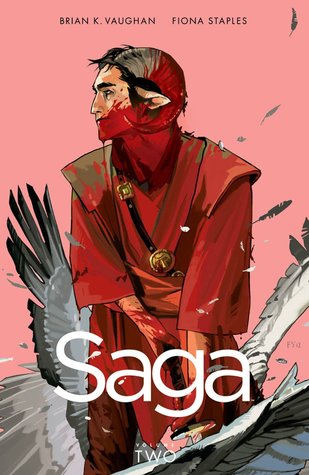
This fantasy-tinged sci-fi space opera is really kind of stunning. It is fearlessly imaginative, and creative, and hilarious, and action-packed, and yet still so very real. Our wry narrator guides us through the story, and an extensive cast of weird and wonderful characters inhabiting a weird and wonderful universe grab on to you and don’t let go. Again, this is one of those rich fictional worlds so fully realized that you just want to crawl inside. I just read volume four of the trade paperbacks, and can’t wait for the next installment.

Best Graphic Novel (Standalone)

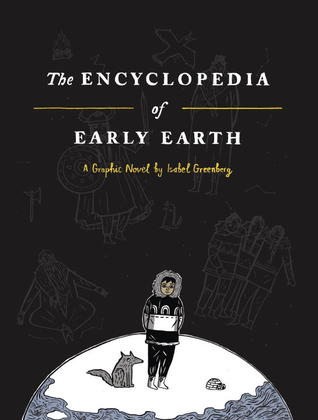
I’ve talked about this one many times before, and my love for it has only grown stronger with time. Its beautiful art, clever, funny writing, and demonstrated deep understanding of stories and their power make this one irresistible to me. A little odd in the way that all the best things are, and all kinds of awesome.

Best Series I Devoured Whole at a Most Unladylike Speed

I had never read anything by Seanan McGuire before (or anything published under her horror-writing pseudonym, Mira Grant), but she was on my radar as an author that authors I love, love. (Did that make sense…?) I picked up the first October Daye book, and it was all over. These books speak to and nourish the same part of me that Holly Black’s Modern Faerie Tales series does (favorites of mine since high school)—stories of a world both close to, and eons away from, our own. Atmospheric, beautiful, but a little dark, too. Watch out for those teeth. So of course I read the entire series in less than three weeks. More, please!

Book Most Likely to Affect My Enjoyment of a TV Series

Mr Selfridge on PBS is one of my favorite TV shows (sometimes I think I like it more than the recent seasons of Downton Abbey!), so I thought it would be fun to read the book that inspired the show. I’m not a big reader of nonfiction, but this book was quite fascinating. It allows you to see where the show had to fill in information, and where they found some of their inspiration, and it sheds light on a time and a topic (the advent of advertising and merchandising) that I hadn’t thought much about before. And yet, this was kind of the spoiler of all spoilers—knowing what happens to beloved characters and the way things ended up in real life was often quite sad, and now it’s sometimes hard to watch the show and separate it from what I know of the real life people and events it’s based on. I usually get over it pretty quickly, though—the show’s ability to dive into each character in a way not really possible in a book that can’t fabricate where there is nothing in the historical record reminds me that this lovely series is fiction, and a pleasant one at that.

Other Great Books I Read That Haven’t Got a Category Yet

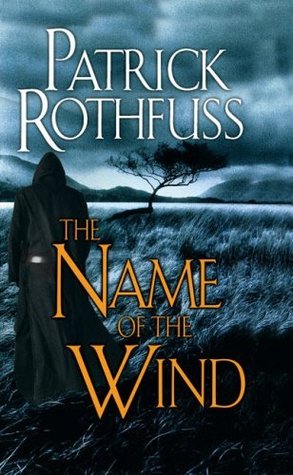
After hearing about the brilliance of The Name of the Wind for so long, I finally took the advice of many friends and read it. I enjoyed it, too, and hurried on to the second installment. Now, don’t get me wrong, they were fabulous books that I recommend to people all the time. But for me…they didn’t have the certain je ne sais quoi that made them into oh-my-gosh-holy-crap-all-time-favorites. However. As they’ve sat in my mind in the months since reading them, I find that they continue to grow in my estimation and to become more powerful. Reading the Bast short story in the Rogues anthology really slammed that home for me. These books are magical, powerful—with complex characters and a rich world (yes, one you can crawl into) that you find yourself personally involved in. And to segue…my first Terry Pratchett experience also introduced me to complex characters I cared deeply about and a world, maybe not so complex on the surface, but certainly complex underneath. Both authors are grandmasters, and both ones whose words and worlds I feel quite privileged to be acquainted with.

So what were some of your top reads of 2014? What superlatives would there be in YOUR 2014 books’ yearbook? What would you like to see from Read This / Eat That this year? Hit the comments and let us know!

Monday, July 14, 2014

Phoenix Comicon 2014: “Writing Rogues” Panel Report

“Writing Rogues” was the final panel I attended at this year’s Phoenix Comicon, and it was definitely a high note to end on. The lineup of author panelists was stellar, with Jim Butcher, Kevin Hearne, Patrick Rothfuss, Pierce Brown, Sam Sykes, and Scott Lynch all present to discuss rogues in literature with each other, the audience, and the moderator. The panel blurb went like this: “Kvothe, Harry, Atticus, Locke, Darrow, and Lenk are their names. Meet the writers who created these rogues.” In case you’re unfamiliar with these authors and their work, the author/protagonist-and-alleged-rogue match up is…Rothfuss/Kvothe (The Kingkiller Chronicle series), Butcher/Harry Dresden (The Dresden Files series), Hearne/Atticus (The Iron Druid Chronicles), Lynch/Locke (The Gentleman Bastard series), Brown/Darrow (the Red Rising trilogy), and Sykes/Lenk (The Aeons’ Gate trilogy). With regards to that “alleged”…there was a little discussion of whether or not some of these characters truly are rogues, but I don’t want to get ahead of myself. This was probably my favorite panel I attended during the whole convention! It felt kind of like those really good classes in college—you know, the ones where the discussion was always lively, you really felt like you were learning things and contributing to the dialogue, and left each session with a little fire in your brain and belly. Did you have classes like that? I had a couple, and felt really lucky to be a part of them. I’m digressing a bit, but that’s kind of what this panel was like—the conversation got into some deep, potentially sensitive territory, and I was impressed by the authors’ attitudes and their handling of the subject matter. Intellectual and geeky and respectful and so awesome!

 photo LynchampSykes_zps3321702a.jpg
Sam Sykes and Scott Lynch were the first to arrive, soon joined by Kevin Hearne.

As I entered the room, found a seat, and read the panel description in my guide, my first thought was, “Huh. There are no women on this panel.” (This comes up again later, which is why I make a point of mentioning it here.) As we waited for the other panelists to get there, Sam Sykes and Scott Lynch talked back and forth a bit, and Scott made a joke about how terrible it was that we’re at a panel about rogues, but were all so punctual. The other authors soon began to file in, and the panel got under way. Even before it had really started, though, Scott Lynch had us laughing some more when he told us about how at the Drinks With Authors event the night before, someone had mistaken him for Jim Butcher and began gushing to him about how much they loved the Dresden Files. Oops! They’ve both got long hair and glasses, so I guess I can see how it might happen… XD

 photo photo1_zps6c6a719b.jpg
Authors assemble! Left to right: Pat Rothfuss, Jim Butcher, Pierce Brown, Sam Sykes, Scott Lynch, Kevin Hearne, and our moderator (whose name I did not catch).

The moderator introduced all the authors and their books, and then brought up an interesting point to get the conversation started: “The name of the panel is ‘Writing Rogues’ and I’m not entirely sure why. A lot of your characters are beloved, and I’m not sure I’d qualify them as rogues. But I’m going to go with the theme, because I work in programming and programming tells me what to do. So, across literature, television, and books, everybody seems to like that roguish character. Not truly evil, but for lack of a better phrase, an SOB—but they also have those lovable qualities. Is that easy, or more difficult, to write? To keep them in that grey area, and not true black or white?”

Pat Rothfuss: I think it’s more of a return to basics. At some point, we forgot what the Greeks knew really well—that a good hero had flaws. And then at some point our heroes stopped having flaws, and when that happens, you need an external conflict generator, which is a villain, typically. And who’s really interesting? The villains are the interesting ones. When I was thinking of this character [Kvothe, I assume?], I’m like, ‘He should be a little bit of an arrogant bastard.’ And it’s charming, in a way.

Pierce Brown: Is that easy for you to write? Arrogant bastard? [much laughter from audience] Oh, sorry, Scalzi’s not here. [even more laughter] …I hope he doesn’t hear about that. [or something to that effect]

Rothfuss: I think it’s not so much a different thing…I think in some ways it’s a lot easier. I mean, Superman is fine and good, but who gets tired of Superman? Right? It’s like, goddamn Superman… Who likes Batman? [cheering from audience] Good internal flaw—it’s the classic flaw, it’s hubris. And there’s a reason it’s a great flaw—that really complicates your life, it complicates your story. It can kinda write itself. Except it really doesn’t actually write itself…

Sam Sykes: I think it’s also that it’s harder and harder to relate to the idea of someone not driven at least in a large part by self-interest. And I wouldn’t necessarily describe a rogue as a jerk or an SOB, but comparatively…yeah, they are kind of jerks, but I would classify a rogue as driven in no small part by self-interest. Like Han Solo—not necessarily a dick, but he clearly was not in it for the rebellion or the Force, just looking to get some. [laughter] Trapped on a ship with a wookie for awhile, anything else looks pretty good. I would say that it’s easier for people to identify that self-interest, and I think the appeal of it is not necessarily ‘Oh, you lovable bastard,’ but looking at what that rogue did and saying, ‘Ahh…I might’ve done the same thing, and that’s interesting.’

Pierce Brown: A lot of time I look at heroes from the past and sometimes I feel like they’re shaped more by what’s around them—they’re forced to do things, either good or bad, and they’re forced to do them. But I think the characters with agency are the ones that are interesting to me. Like Han Solo always had his own moral compass. He decided what he wanted to do and he did it. That’s more interesting for me because it creates that air of unpredictability, but also believability, because we do what we want to do. If we want to eat a Snickers bar, we eat the Snickers bar. At least I do. The point is basically that rogues are that unpredictable factor which makes stories so much more interesting than the cookie cutter King Arthur. Although, if you look at the classic King Arthur tale, he’s kind of an asshole as well. And it creates that interesting human layer which makes that story span a thousand years in our consciousness.

Scott Lynch: It’s difficult to get emotionally riled up about somebody for whom being good and decent is a persistent, easy attainment, something that’s always intrinsic to them and never goes away. Because for those of us living in actual reality, being decent human beings is a matter of making decision after decision, situation after situation—it’s something to aspire to. It’s not something you just automatically have, as a parity of virtue. Parities of virtue are very boring. People trying to be virtuous in the face of life itself are interesting. Rogues just bring a little bit more of that to the foreground. They’re just a little bit grayer than your average hero.

Related Posts Plugin for WordPress, Blogger...