Showing posts with label Kiera Cass. Show all posts

Friday, March 7, 2014

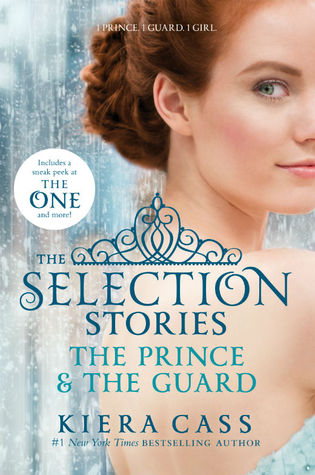
The Selection Stories: The Guard, by Kiera Cass

Title: The Selection Stories: The Guard
Author: Kiera Cass
Publisher: HarperTeen
Publication Year: 2014
Read: February 2014
Where It Came From: Barnes and Noble
Genre: YA-dystopian
Rating: 2 stars

The Quick and Dirty:


In a small tide-you-over novella in the Selection trilogy, Aspen, a palace guard, tries to convince the love of his life to forget about the prince with whom she may be in love. Largely a reprint of the Aspen-America chapters of The Elite, it's only meant for fans of the series. Possibly only fans of Aspen will truly be able to appreciate it, but the paperback book comes with some extra content and the first three chapters of spring's The One.

The Wordy Version:


Last year Alyssa, waiting eagerly for The Elite, discovered her library had an available digital copy of the companion novella, The Prince, and discovered that it had little merit aside from being something to read while waiting for the next part of the series. A little later, Alyssa caved into her craving and bought a hardcover Elite, and kindly sent it to me as soon as she was done. I wasn’t so impatient last year, but this year it seems I am VERY impatient for the rest of the story of America and Maxon (or Aspen, if the series takes a terrible turn), and when I saw The Selection Stories on a shelf in a Barnes and Noble, I barely tried to resist. I was sold as soon as I saw there were family trees for all three main characters, tracing them all back to the fascinating (if confusing) era of Gregory Illéa. (And now it’s on its way to A as a thank-you for lending The Elite.)

As a refresher, the Selection trilogy takes place in a post-WWIV North America, which is now the monarchial kingdom of Illéa. Tradition has it that the young crown prince of Illéa marries a commoner after winnowing down his options from a pool of 35 candidates. Seventeen-year-old America Singer, a musician of lower-middle caste, enters the draw at the behest of the love of her life, Aspen, whose caste and poverty is even less desirable than her own. Heartbroken by Aspen’s insistence that America try to find a better life than he can offer her, America enters the Selection in a decidedly unromantic mood that appeals to Crown Prince Maxon.

(Now come the spoilers) Maxon and America become friends despite some misunderstandings, and all seems on the track to True Love until America discovers that Aspen is now a guard at the palace (which has elevated his caste and given him both a great income and the confidence to pursue America’s love). When a more serious misunderstanding occurs between them (America believes Maxon is cold-hearted to allow a couple caught breaking the draconian law she herself often ignores to be punished), Aspen puts his life and America’s at risk to have secret meetings and agree that Maxon is not worthy of her love.

Author Kiera Cass has been rather vocal about her love for both of America’s love interests, especially as readers last spring began to complain that Aspen’s actions in The Elite were not so laudable. She was excited to give readers a better perspective of Aspen in the new novella included in this collection, and I was uncharacteristically optimistic that she could present Aspen, “The Guard,” as something other than an emotionally abusive ass in a story taking place during the timeline of The Elite.

And for the first 15-25 pages of the novella, things seemed to be pointing towards a sympathetic portrayal of Aspen. Following a dance between America and Maxon, Aspen seems to realize that the Amerispen ship sailed years ago, and it’s Maxerica that’s in port. He then shows some sense the morning of the punishment, sending America’s maids to comfort her and calming America’s family. Even when Aspen determines, “If Maxon truly was [sic] a decent man, America never would have been in this situation in the first place,” I’m kind of on his side. He’s jumping to conclusions about Maxon, but he’s nineteen and that’s as good a time as ever to jump to conclusions.

But then Aspen starts leaping to much more dangerous conclusions. Seeing that America has been crying, he declares, “I knew—I knew—she was supposed to be mine.” America thanks him for offering help, and “With her words, [he] knew without a doubt: she loved [him].” My margin notes suggest that Aspen could do with a lesson from Mr. Darcy about the difference between gratitude and love.

Roughly a third of the way through the story the parts I found most objectionable in The Elite return with no improvement. Aspen didactically tells America,

“The thing about Maxon is that he’s an actor. He’s always putting on this perfect face, like he’s so above everything. But he’s just a person, and he’s as messed up as anyone is. I know you cared about him or you wouldn’t have stayed here. But you have to know now that it’s not real.”
This is a line in The Elite and may be there just because it needed to follow the original story, but this line makes NO SENSE in the context of what Aspen has been witnessing in his duties in the palace. I can’t figure out why Kiera Cass dropped it in without showing Maxon doing something slightly duplicitous in front of Aspen in this novella. Without context all I can say about Aspen’s advice to America is that it is CREEPY. I can’t help assuming that he’s made up this whole side of Maxon’s character to serve his own purposes. And there would have been plenty of things Aspen COULD have said about Maxon that wouldn’t have come across so poorly. Like, “America, I hate that Maxon hasn’t been able to make you feel better about your friend, or even been able to explain how he could stand by and watch her suffer.” Instead we get Aspen’s next line from The Elite: “I know it’s hard to believe, but I’m really sorry Maxon turned out to be such a bad guy.”

Alyssa observed that The Prince didn’t add anything to The Selection by repeating the dialogue through a different character’s perspective, and this is entirely true for the sections of The Guard that come from The Elite. But there were a few things that were genuinely interesting and seem to offer tantalizing possibilities for the final volume of the trilogy. We learn a little more about the political situation in the south of Illéa, and that the guards at the palace are getting superpower injections.

And if all that weren’t enough to convince you to pick up the book, there are two more chapters to extend The Prince to Maxon’s decision to keep America around after she knees him on a date. PLUS the family trees and small backstories (some juicy murder in the royal past), and the first three chapters of The One.

Tuesday, June 25, 2013

Recipe Challenge: Chocolate Strawberry Tarts

 photo IMG_0365_zps2720b1b3.jpg

It’s pretty obvious what my experience with tart-making has been that when I was reading The Selection, I pictured the strawberry tart as a Strawberry Toaster Strudel. Not a Pop Tart though, because Pop Tarts are absolutely not fancy enough for young women wearing dresses (possibly gowns) all the time.

But when I looked in the Martha Stewart cookbook Alyssa gave me I saw pictures of tarts with crinkled circumferences or stretching sides. And I wanted to eat one of my own.

Such was my desire to eat one of these pastries that I bought mini tart pans (cuter and easier to store than the 11” pan I saw), pulled out my food processor, and read a slew of recipes for our Selection Recipe Challenge.

I went to my garden to pick some strawberries too, but this was about a month ago, and my berries weren't quite ripe yet. (Though they were still pretty!)

 photo IMG_0462_zps1f9c43b4.jpg

Sunday, June 16, 2013

Our Top 6 YA-Lit Dads

Girls in Capes is celebrating Father's Day in the best way possible--pointing out that there are no positive father relationships in geek culture, and that dads in YA only are deemed heroic when they've died young. Maybe this isn't the best way to celebrate Father's Day after all...

But as sad as the negative images of fatherhood are, we decided not to dwell on them this weekend, and to instead find ten examples of YA-lit dads who have excellent relationships with their children.

To qualify for this list, children had to be teenage main characters, and the books had to be on Susan's shelf this weekend. Dads we thought of who didn't meet these qualifications are welcome to apply again next year. (Specifically, fathers in The Fault in Our Stars, The Selection, and The Thirteenth Child.

6. Gen's Father, The Thief / Megan Whalen Turner (1996)

Gen, a young thief, has been telling his travel companions that his father has been disappointed with him for years for not becoming a soldier. Everyone thinks this means that Gen has disappointed his father, but they learn that Gen's father loves him regardless of his career choice.

I heard [the magus, Gen's travel leader] address someone as Minister and thought that probably meant minister of war. ... The magus described the fighting with the guard in detail and made me look very good indeed. The minister of war snorted. The magus didn't recognize this as high praise, and he said stiffly, "I've been told that his father wanted him to be a soldier. I'd be happy to inform his father that he has a son to be proud of." I stifled a snort of my own in the silence that followed. The magus must have been tired. ... He was talking to my father. ... While the magus, realizing his error, was trying to word an apology, my father came to look in at me. "I thought I heard you laughing up your sleeve," he said. ... "I'll come by later." Before he disappeared from the doorway, he nodded once, and that, I knew, would be his only sign of approval for all my hard work. He was not a man of many words.
In the world of Megan Whalen Turner no character speaks much. Hence scenes that would seem kind of cold in other books are the ones in MWT that are SQUEE moments. This scene is one of them (though perhaps a lowercase squee). Not only is Gen's father snorting and nodding in approval; he's also the model for Gen's own behavior. Gen's snort mirrors his father's but with a slightly different meaning, just as Gen's fighting skills are like his father's but used in slightly different circumstances. In the sequel to The Thief Gen relies on his father more than ever, and they become a pair in battle. (SQUEE)

5. Pop, Cherry Money Baby / John M. Cusick (2013)

In this novel, set to be released in September, high school senior Cherry Kerrigan lives in a trailer with her father and brother. Cherry has no plans for her life other than to marry her boyfriend, who lives next door and is planning on following his father into being a school janitor. Cherry's pop responds to these plans with a firm, "Nope." He encourages his daughter to work hard, sets firm limits about her behavior (it's refreshing to see a parent dole out a grounding, as well as a daughter who weighs whether being grounded is worth staying out past curfew), and hopes she will have more choices in her life than he has had in his. But what really got him his spot on this list was his ability to see past blame in the midst of a family tragedy:

[Cherry said,] "I shouldn't have left Stew alone."

Pop took another draw from his tall boy. "Yep. Wish you hadn't done that." He squeezed her tighter. "Accidents happen. I'm just glad we're safe. And together."

They were silent awhile, watching the blues deepen to oranges and reds in the sky.

"You don't hate me?"

He kissed her forehead. "I could never."


4. Ed Boone, Curious Incident of the Dog in the Night-Time / Mark Haddon (2003)

Christopher is a fifteen-year-old mathematician with behavioral problems and sensory differences. Because of Christopher's special needs, his parents marriage became strained, and a few years later Ed can tell his ex-wife:

I cooked his meals. I cleaned his clothes. I looked after him every weekend. I looked after him when he was ill. I took him to the doctor. I worried myself sick every time he wandered off somewhere at night. I went to school every time he got into a fight. And you? What? You wrote him some fucking letters.
To be fair, this is what we would expect any normal dad to do. It's touching to see the little things too, like Ed's fighting the school to make sure Christopher can take his maths A-levels, or his hand-touching compromise on hugs. Ed's not perfect though—frustrated one day he grabs Christopher, and another day he tells a massive lie. What makes Ed exceptional is that after he loses Christopher's trust, he is completely honest with his son, and he starts to work on their relationship with sensitivity and this speech:
Christopher, look...Things can't go on like this. I don't know about you, but this...this just hurts too much. You being in the house but refusing to talk to me...You have to learn to trust me...And I don't care how long it takes...If it's a minute one day and two minutes the next and three minutes the next and it takes years I don'tcare. Because this is important. This is more important than anything else.


3. Wizard Derk, Dark Lord of Derkholm / Diana Wynne Jones (1998)

Derk is an unconventional wizard whose interests lie in magical genetic engineering. With his wife, he has two human and five griffin children. Seven children ensure that life at Derkholm is never quiet or without sibling bickering, but it also means that when Derk must take on the job of Dark Lord for the tours that fuel the economy in his land, there are seven additional helpers eager to make their father's life easier.

Derk's fatherhood is one of the central themes of the book—what dangers he lets his children undertake, what roles he lets them play in making the most of their natural talents, and what sacrifices he's willing to put up with just to keep them safe are considerations that play out over the course of the story. But our favorite aspect of Derk's fathering is that he seems to have very natural relationships with his kids even as they try teenage rebellions. Here he is with his oldest griffin son, Kit, after Kit has failed to carry out an assassination:

[Kit said,] "It was a pity. I could have killed him in seconds, even with that demon in his pocket, but he would have been just like food. He wouldn't have felt guilty, and neither would I."

"I'm glad to hear you think you ought to have felt guilty," Derk observed. "I was beginning to wonder whether we'd brought you up properly."

...Derk was thinking things through, fumbling for an explanation. Something had been biting Kit for months. Long before there was any question of Derk's becoming the Dark Lord, Kit had been in a foul, tetchy, snarling mood—bloodthirsty, as he called it himself—and Derk had put it down simply to the fact that Kit was now fifteen. But suppose it was more than that. Suppose Kit had a reason to be unhappy.

..."Kit, come clean. You're another like Blade, aren't you? How long have you known you could do magic?"

Derk does what the best fathers do—gives his growing children space, listens closely to what they're saying and not saying, and then helps them find solutions to their problems.

2. Carson Drew, The Secret of the Old Clock / Carolyn Keene (1930)

Nancy Drew, sixteen-year-old super sleuth, needs no introductions, and it doesn't take long to see that she has a great father. This is actually an understatement because Carson Drew appears on the first page of the first Nancy book, The Secret of the Old Clock, and his positive relationship with his daughter is instantly apparent. Carson Drew stops reading his newspaper and gives Nancy "his respectful attention" so she can tell him about inheritance rumors. A few pages later we see that this type of conversation is common in the Drew household:

Carson Drew, a widower, showered a great deal of affection upon his daughter; it was his secret boast that he had taught her to think for herself and to think logically. Since he knew that Nancy could be trusted with confidential information, he frequently discussed his interesting cases with her.
Seriously, how cool is he?


1. Mr. Murry, A Wrinkle in Time / Madeleine L'Engle (1962)

When we meet thirteen-year-old Meg Murry, her father has been missing on physics research for a year, and everyone in town is convinced that he's abandoned his family. Meg embarks on an adventure across the universe to find her father and rescue him from the Black Thing.

Mr. Murry is an amazing father. In earlier years he would play number games with Meg, talk to her about her insecurities, reassure her that he loved her and that she was exceptional, and call her various nicknames, like "megaparsec." When Meg and her youngest brother find Mr. Murry imprisoned on a far-away planet, Mr. Murry jumps right back into parent-mode. First he carries Meg through a dark column (scarier than it seems from that description), and his presence calms Meg:

She tried to scream, but within that icy horror no sound was possible. Her father's arms tightened about her, and she clung to his neck in a strangle hold, but she was no longer lost in panic. She knew that if her father could not get her through the wall he would stay with her rather than leave her; she knew that she was safe as long as she was in his arms.
Isn't that what every child wants to feel in the presence of her (or his) father?

The best thing about Mr. Murry, though, is that within pages he turns out to be fallible. Despite Meg's mantra of "Father will make it all right," Mr. Murry has to leave his son in danger in order to save Meg. Mr. Murry isn't bad--he's managed to coach Meg through a horrible experience by tossing math problems her way--but he isn't a superhero like Meg had believed.

Meg's growing understanding of her father's imperfection allows her relationship with him to mature. Even though he has disappointed her, his words and assurances allow her to fight her final battle.

Thursday, June 13, 2013

Guilty Pleasures: The Elite by Kiera Cass

As you loyal readers know, we got sucked into the slough of the Selection series (slough in this case is pronounced SLEW. We just learned this today). As part of the immense fun of reading a series that cannot be taken seriously, we cannot seem to stop talking about it with each other. Volume 2, The Elite came out a month ago, and you have thismuchtime to read it before we spoil EVERYTHING by letting you in on our night of gabbery (not a real word; we just coined it today).

So Susan opened up our GoogleDoc unpacking of The Elite with the following questions.

1) Why is America so bad at human interactions?
2) How can we get rid of Maxon’s father?
3) Maxon’s mother--cool or weak?
4) Should we care about Maxon’s father when getting rid of Aspen is much more important?

We did eventually address these thought-provoking and important questions (some of them, at least), but first we had other items (a.k.a. gossip) to attend to. (From here on out, Susan is green and Alyssa is red. We are like Christmas!)

Aspen is hooking up with a maid. He will be, I mean. I forget which one, though...
YES. Though I kind of want Maxon to see him hitting on America and have him arrested.

This was followed by a bit of confusion, in which all dystopian YA books become the same book:

Now that America has decided to go all in for Maxon, Aspen is completely tangential to the plot now. Unless he becomes a secret rebel. Which might be cool. Although I don’t think he likes books enough to get recruited.
A la Gabe?
Who is Gabe?
The tangential childhood friend love interest in Hunger Games. Wasn’t his name Gabe?
Gale? Lol
Oh snap. Right. lol.

As the conversation continued, one might be led to believe that we hated this book, but au contraire! We actually enjoyed it. Don’t let our nitpickery fool you.

I’m just glad America is ready to go all in for Maxon. I could not believe her vacillation in the first half of the book. Or two thirds. Some horrible long time.
I was ready to puke with lines like these: “In Aspen’s eyes I saw a thousand different endings to that sentence, all of them connecting him to me. That he was still waiting for me. That he knew me better than anyone. That we were the same. That a few months at the palace couldn’t erase two years. No matter what, Aspen would always be there for me.” (48, sorry I have your book hostage) And then literally one page later, America is antsy because she wants to see Maxon so badly.

Yeah, they all annoyed me. America was super wishy-washy, Aspen was lame, Maxon was weird. I get that America was torn, but it didn’t need to take her THAT long to figure things out. THE WHOLE FREAKING BOOK.
America is stupid. She suffers from YA romantic lead stupidity problems.
Oh man!!! At the YA book panel, they talked about how ridiculous the names were. “She sings for a living, and she lives in what used to be America...let’s call her America Singer, and then not have to describe her character at all!”
LOL. I was wondering if her father was a singer too, or if he was a potter or something. How far back do these names go? “I’m Gregory Illéa, and I decree that whatever job you are doing TODAY will be your last name!”?

Then Voldemort made a visit to Illéa:

hahaha. Must be the case. Also, I think that the Gregory Illéa diary entries were a lot like Tom Riddle’s soul speaking to Ginny Weasley and then Harry through the diary. I wish there had been a big basilisk around to eat Aspen.
Yes, only Gregory Illea had the writing abilities of a 7th grader. Although I must admit, I do want to know what he did with his daughter. Who he sold her off to, I mean. Do you think there are people on the interwebs with theories about this sort of thing? Is it that popular? Are the fans that rabid? I do love a good crackpot theory.
Tom Riddle had the writing abilities of only a 10th grader. And that didn’t really help him. I think Illéa did much more in the long-run than Voldey did. Wasn’t she sold off to some European royal house?
Tom Riddle was a 10th grader at the time, though, right? Gregory Illea was middle-aged. Not that I’m arguing in favor of Voldey, I just think he probably had more smarts that Greggy-poo.

Next up was the debate about the fate of Scandinavia in the world Cass has created:

lolz. “Katherine was finally married today to Emil de Monpezat of Swendway. She sobbed the whole way to the church until I made it clear that if she didn’t straighten up for the ceremony, there’d be hell to pay afterward.” So she married into the combined Swedish/Norwegian royal house. (Do you think the author realizes that those two really did share a throne in history?)
OMG. You are so smart. I got the Sweden part, but not the Norway. Hah! What creative names... Why not Swendwaymarkland? Get all of Scandinavia in one go?
That would make so much more sense. Especially because I fail to see how the Swedish/Norwegian royal house would automatically get Greggy into a royal league. Sweden has a good economy and all, but their king is kind of unpopular right now, and I don’t think anyone really cares about Norway. The current crown princess of Sweden is half-liked, but that’s not too strong either. Ah logic. I must remember to set it free before I open the books.

THEN we finally got to the first question: Why is America so bad at human interactions?

Because she had no friends! As she loves to tell us! She would be a feral child, if not for her family. Her only male, non-familial interaction EVER seems to have been Aspen. Maybe she just falls in love with every dude her age she meets? Since she’s only met 2 so far, and has had a thing for both of them.

Which led to the question…how did she and Aspen even meet?

Oh, good point. I forgot that we didn’t know that. I had just assumed they met at school, but I guess they don’t go to school in the lower caste world in Illéa.
Aspen went to school, but America didn’t because she was homeschooled. Which was weird to me. You would think a higher caste would have better education opportunities. But maybe they just think if you’re going to be some sort of artist, artistic training is all you need.

Probably we aren’t as nice and class-blind as America, given our next thoughts:

But why bother sending Aspen’s caste to school? Why do they need to learn to clean houses and carry things?
So he can learn to read the labels on the bottles of cleaning product?
lmao. It’s so obvious when you put it that way.

At this point, discussion of previously posed questions dissipated and made way for ones invented on the spot.

All right, I have a question. Riddle me this, Batman--how do you think the author is going to make the competition for Maxon interesting for readers, since we are pretty certain he’s going to end up with America?
It’s going to be FORBIDDEN LOVE! Maxon’s father is 100% against America becoming the crown princess. And Maxon may not fully trust America as he continues to hang out with Kriss.

And then we came to a discussion of the nadir of Maxon’s character development.

Oh, not related---the Celeste make-out session with Maxon was straight out of my letter game*. Kiera Cass is probably my letter game partner using a pen name, taking my plot devices!
Omg that part was so hilarious. Maxon all, “I have NEEDS!” Nice try dude, but that excuse doesn’t really work when you have PROCLAIMED YOUR LOVE FOR ANOTHER. I’m actually surprised the monarchy hasn’t instituted polygamy. ALL OF THE GIRLS for the king/prince. That’s what the Selection is really for. That would be the gritty dystopian version of the Selection--all the girls are sent off to be sister-wives of a monarch they’ve never met. Tributes, like from the Hunger Games! Only for marrying, not killing!
OMG WRITE IT!!! I think both of us should start writing fanfiction for this series. It’s too easy to come up with absurd plots.

*Letter games are when friends write chapters of stories as letters to the characters being written by each other. Susan and a friend from high school wrote a 24-letter story this way years ago. Read Sorcery and Cecelia to see a successful letter game.

(Alyssa did go on to write the first chapter of this fanfiction. Susan would gladly read it to interested parties, except it makes her laugh too hard to speak.) And now we have some helpful graphics inspired by The Elite:

Where are the PR judges when you need them?

"[America's] dress was white, gauzy, and light, adorned with one long stream of green and blue tulle running along the right side. The bottom fell in such a way that it looked like a cloud, and its empire waist added a level of virtue and grace to the gown." (Kiera Cass, 2013)

 photo Eliteproject-runway America's dress in The Elite (Kiera Cass)

This is better with some zooming...

Read This / Eat That Assesses the Characters of The Elite photo EliteCharacterApproval_zps2719d1ff.png

There is a document with a comment and page number corresponding to every fluctuation on this chart. Sometimes we get carried away.

Tuesday, May 21, 2013

Recipe Challenge: Strawberry Basil Tart-Pouches

Strawberry Basil Tart-Pouches

In our recent fascination with Kiera Cass’ The Selection, we came across a mention of strawberry tarts:

I picked up a strawberry tart from the basket in the center of the table. [other random thoughts] I mulled this over as I bit into the strawberry tart. It was so sweet and the dough was so flaky, every millimeter of my mouth was engaged, taking over the rest of my senses entirely. I didn’t mean to make the little moan, but it was by far the best thing I had ever tasted. I took another bite before I even swallowed the first. (135)

I don’t think we were necessarily inspired by the description, but Susan and I were talking and decided we needed more recipes on the blog, and wanted to do another challenge, and were both in possession of strawberries at the time, and remembered there were strawberry tarts in a book we had read recently. Ergo, we both invent strawberry tart recipes!

I decided I wanted to make little ones (since in the book the prince sends a bunch of them to the heroine’s family—doesn’t make much sense to send lots of full-size tarts, so I interpreted that to mean that they were mini), and quickly decided on a dough-purse construction rather than the traditional tart crust. I also remembered I have basil plants proliferating in the garden, and thought basil would add a little something different to the strawberries.

I realized this was probably going to end up being a little apple dumpling-like (only with strawberries) and I wanted to have a nice, flaky crust reminiscent of the family shortcake, only in dough form. I adapted the dough from this Cook’s Country apple dumpling recipe to surround the strawberry-basil filling. The result is 8 cute little strawberry tart-dumpling-turnover-shortcake-pouches! They taste nice with, a) extra strawberries added on top, (b) a little milk poured over them, (c) some whipped cream, or (d) all of the above.

Tuesday, May 14, 2013

The Prince: A Selection Novella, by Kiera Cass

Title: The Prince
Author: Kiera Cass
Publisher: HarperTeen
Publication Year: 2013
Read: May 2013
Genre: YA-dystopian
Rating: 2.5 stars

A Mini Review for a Mini Novella:


The description says it’s 64 pages, Amazon says it’s 55—either way, it’s short. This is one of those exclusive e-book prequel/interim/alternate P.O.V. novellas (so prevalent in YA these days) published to tide readers over while waiting for the next book in a series. In my admittedly little experience with them, I have not been pleased with the results. But of course every author and every series and every book is different, and since I enjoyed the Selection quite a bit I thought I would give this one a go.

This one just wasn’t all that interesting to me. It’s told from Prince Maxon’s point of view from his 19th birthday in the weeks before the Selection happens, up through his initial meeting with America and his first interviews with all the Selection girls. I thought it would be fun to see things from Maxon’s viewpoint and to see America and the other girls who we know become fairly major characters through his eyes. And it was. Kinda. A little bit. But it just didn’t add all that much to the story overall (which I guess is okay, since these interim e-books aren’t supposed to be integral to the overall series—just like deleted scenes from a movie or something).

The most interesting things I gleaned from it are a) Maxon’s age (19, just like Aspen), and b) his father King Clarkson is a real d-bag. In The Selection I thought the king seemed kind of distant and vaguely displeased with some of Maxon’s decisions, but I never got the impression he was a complete, abusive asshole. But apparently he is! Poor Maxon.

Other than that, meh. Mostly just rehashing events we already knew about, with the new perspective not adding as much as I had hoped. America from Maxon’s point of view wasn’t all that different from the America we’ve gotten to know from reading a whole book from her perspective. One thing that was mildly interesting was seeing Celeste through Maxon’s eyes, and gaining a bit of understanding as to why he might see something in her when all of the other girls see her as a complete beeyotch. I was also relieved to see that Maxon’s thoughts in his own head are surprisingly fluid and normal, and not as awkward and stilted as his dialogue from The Selection would lead you to believe. The discrepancy between the way he speaks in his own head in this novella and the way he speaks out loud in The Selection becomes apparent in the revisitation of some of the prominent scenes from the first book, such as meeting America in the gardens. In his head he sounds completely normal, but when he gets to the point where he says the actual lines from the first book he sounds bizarre—there’s some disconnect and difficulty in integration of book 1 Maxon with novella Maxon there.

I usually reserve 2 stars for things that I really have problems with, and I didn’t have MAJOR major problems with this one, so I gave it half a star to boost it up above that level. It was just a little on the boring side. Like an empty-calorie treat to tide me over between meals. Which I guess is kind of what it was! Good thing the next book-meal just came out recently so I can move on to that. I probably couldn’t recommend paying $1.99 for this, but if it’s in your library’s e-catalogue, you already know you like the series, and you have an hour to kill, go for it.

Monday, May 13, 2013

Genre-ally Speaking: The Selection, by Kiera Cass

Title: The Selection
Author: Kiera Cass
Publisher: HarperTeen
Publication Year: 2012
Read: May 2013
Genre: YA-dystopian
Rating: ***.5

The Quick and Dirty:


In a dystopian future North America where life is dictated by a strict caste system, America is chosen as one of 35 girls to go to the royal palace and participate in the Selection, a reality TV The Bachelor-style competition to choose the girl who will marry Crown Prince Maxon and become the future queen of Illéa. I expected dystopian fatigue, and was pleasantly surprised by compulsively readable fun.

The Wordy Version:


I was not expecting all that much from this book, to be honest. There’s so much dystopian fiction out there right now, and not all of it can be good. The cover is pretty, and seems to be going along with the recent trend in YA book covers--girls in pretty, foofy dresses! From what I’d heard about the book beforehand, I was expecting a dystopian fairy tale. It turned out to be more just straight up dystopian, with the monarchy prince-princess thing being less fairy tale, and more just the form of government employed in the society. Which was fine! (I’m still intrigued by the idea of a dystopian fairy tale. Does this sort of book exist, to anyone’s knowledge?)

Anyway, Susan mentioned this book to me as one of those books that at the beginning you’re like well, this isn’t that great, but then as you keep reading it becomes enjoyable frothy fun, which is precisely the experience I had. At the beginning of the book, I was pretty okay with the world building. The existence of TVs and phones and electricity and other trappings of modern real-life life laid to rest any ideas I’d had about this being traditional-fairy-tale-like, and the numerical caste system was okay. I liked that teachers were as high as being level 3, but had to suspend my disbelief that artists and musicians would be down at level 5 (given the high status of entertainers in our own society). It isn’t the kind of dystopian society where it’s horrible but everyone seems to be tolerating it, but rather the people seem to be pretty okay with the current system of government, although they acknowledge there are some flaws to the system. There are mentions of rebels, but the characters see the rebels as the enemy of the monarchy, the state, and themselves, rather than a revolution that they’re hoping for. I thought this was an interesting change from the usual set up.

Related Posts Plugin for WordPress, Blogger...