Showing posts with label ya-dystopian. Show all posts

Friday, June 13, 2014

Phoenix Comicon 2014: Improbable Dystopias?

The first panel on my schedule on Friday was “Improbable Dystopias?” (“A look at dystopian fiction—what makes some worlds believable, and others not?”), featuring authors Janni Lee Simner (The Bones of Faerie), Jason Hough (The Darwin Elevator), Laini Taylor (Daughter of Smoke and Bone), Pierce Brown (Red Rising), and Seanan McGuire/Mira Grant (Feed and Parasite). They probably also could’ve called it, “Most Terrifying Panel of the Con.” Seriously, the takeaway from this one is that WE ARE LIVING IN A DYSTOPIA RIGHT NOW! When I left the panel I had a strong urge to purchase hand sanitizer and not eat chicken for awhile. But in all seriousness, it was a great panel—lots of ideas, lots of audience interaction, and lots of time spent digging deep into many different aspects of the theme. As usual, I arrived 10 minutes late, but made it there in time to catch the tail end of some discussion of utopias giving rise to dystopias. Seanan McGuire then brought up the idea that there are also dystopias that didn’t start out as utopias, but rather as a frantic bid to fix things. She built on the idea by saying that if you want to see how a dystopian future could come to pass, you should go to the airport and have a look at TSA—lots of people doing what they’re told, in a pretty arbitrary way. She noted that over the course of 15 years, we’ve gone from being able to walk up to the gate to meet arriving friends and family, to getting manhandled by strangers, having our liquids thrown away, being subjected to the radiation box, etc. “What do we do when they start putting in those steps where the TSA takes over the buses? Who’s going to stand up and say no, I’d rather risk terrorism than have TSA agents at the Greyhound station?” she asked.

Laini Taylor also thought the airport example was a good one. She mentioned how when she’d been at the airport recently, she’d flashed back to the scene from The Pianist (“unfairly, exaggeratedly,” she added), when people are being herded out of the ghetto and they’re going along with it simply because they didn’t believe anything extreme could happen. Pierce Brown also had an airports-as-the-beginnings-of-dystopia story, mentioning how when he’d been sitting in the airport to fly to Phoenix, he was listening to the broadcast and realized that it sounded like something straight out of Total Recall or Robocop—“Due to increased security measures…” It was like all the sci-fi movies he grew up with in the ‘90s are real!

The panel agreed that as things escalate incrementally, you’re afraid to say anything about it or rock the boat. Janni Lee Simner added, “Dystopia gets out of control when we believe in the illusion of safety,” which I thought was a really compelling, and scary, idea. Talk then turned to the concept of the “boiled frog dystopia.” Apparently, if you try to put a frog in a pot of boiling water, it will jump right out. No surprise, right? It’s not going to tolerate that. But if you put it in a pot of room temperature water and slowly turn up the heat, it will allow itself to be boiled alive because it won’t notice the tiny incremental changes in the water around it. (How this was all discovered, I do not want to know.) Seanan thought that these kinds of dystopias are the ones that feel the most realistic to her—the situation where something bad has happened, be it a bio attack or a terrorist attack, and we put in all sort of new measures that help us feel a little safer, and now we’d feel unsafe without those things. And if people want to look like they’re doing something about terrorism, they have to do something more extreme and go a little bit further, because you can’t dial it back. People would start to feel unsafe, even though their state of safety would be the same as it was before.

Friday, March 7, 2014

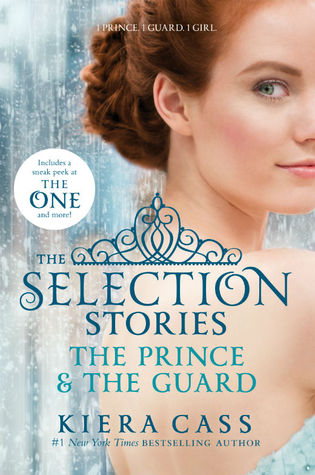
The Selection Stories: The Guard, by Kiera Cass

Title: The Selection Stories: The Guard
Author: Kiera Cass
Publisher: HarperTeen
Publication Year: 2014
Read: February 2014
Where It Came From: Barnes and Noble
Genre: YA-dystopian
Rating: 2 stars

The Quick and Dirty:


In a small tide-you-over novella in the Selection trilogy, Aspen, a palace guard, tries to convince the love of his life to forget about the prince with whom she may be in love. Largely a reprint of the Aspen-America chapters of The Elite, it's only meant for fans of the series. Possibly only fans of Aspen will truly be able to appreciate it, but the paperback book comes with some extra content and the first three chapters of spring's The One.

The Wordy Version:


Last year Alyssa, waiting eagerly for The Elite, discovered her library had an available digital copy of the companion novella, The Prince, and discovered that it had little merit aside from being something to read while waiting for the next part of the series. A little later, Alyssa caved into her craving and bought a hardcover Elite, and kindly sent it to me as soon as she was done. I wasn’t so impatient last year, but this year it seems I am VERY impatient for the rest of the story of America and Maxon (or Aspen, if the series takes a terrible turn), and when I saw The Selection Stories on a shelf in a Barnes and Noble, I barely tried to resist. I was sold as soon as I saw there were family trees for all three main characters, tracing them all back to the fascinating (if confusing) era of Gregory Illéa. (And now it’s on its way to A as a thank-you for lending The Elite.)

As a refresher, the Selection trilogy takes place in a post-WWIV North America, which is now the monarchial kingdom of Illéa. Tradition has it that the young crown prince of Illéa marries a commoner after winnowing down his options from a pool of 35 candidates. Seventeen-year-old America Singer, a musician of lower-middle caste, enters the draw at the behest of the love of her life, Aspen, whose caste and poverty is even less desirable than her own. Heartbroken by Aspen’s insistence that America try to find a better life than he can offer her, America enters the Selection in a decidedly unromantic mood that appeals to Crown Prince Maxon.

(Now come the spoilers) Maxon and America become friends despite some misunderstandings, and all seems on the track to True Love until America discovers that Aspen is now a guard at the palace (which has elevated his caste and given him both a great income and the confidence to pursue America’s love). When a more serious misunderstanding occurs between them (America believes Maxon is cold-hearted to allow a couple caught breaking the draconian law she herself often ignores to be punished), Aspen puts his life and America’s at risk to have secret meetings and agree that Maxon is not worthy of her love.

Author Kiera Cass has been rather vocal about her love for both of America’s love interests, especially as readers last spring began to complain that Aspen’s actions in The Elite were not so laudable. She was excited to give readers a better perspective of Aspen in the new novella included in this collection, and I was uncharacteristically optimistic that she could present Aspen, “The Guard,” as something other than an emotionally abusive ass in a story taking place during the timeline of The Elite.

And for the first 15-25 pages of the novella, things seemed to be pointing towards a sympathetic portrayal of Aspen. Following a dance between America and Maxon, Aspen seems to realize that the Amerispen ship sailed years ago, and it’s Maxerica that’s in port. He then shows some sense the morning of the punishment, sending America’s maids to comfort her and calming America’s family. Even when Aspen determines, “If Maxon truly was [sic] a decent man, America never would have been in this situation in the first place,” I’m kind of on his side. He’s jumping to conclusions about Maxon, but he’s nineteen and that’s as good a time as ever to jump to conclusions.

But then Aspen starts leaping to much more dangerous conclusions. Seeing that America has been crying, he declares, “I knew—I knew—she was supposed to be mine.” America thanks him for offering help, and “With her words, [he] knew without a doubt: she loved [him].” My margin notes suggest that Aspen could do with a lesson from Mr. Darcy about the difference between gratitude and love.

Roughly a third of the way through the story the parts I found most objectionable in The Elite return with no improvement. Aspen didactically tells America,

“The thing about Maxon is that he’s an actor. He’s always putting on this perfect face, like he’s so above everything. But he’s just a person, and he’s as messed up as anyone is. I know you cared about him or you wouldn’t have stayed here. But you have to know now that it’s not real.”
This is a line in The Elite and may be there just because it needed to follow the original story, but this line makes NO SENSE in the context of what Aspen has been witnessing in his duties in the palace. I can’t figure out why Kiera Cass dropped it in without showing Maxon doing something slightly duplicitous in front of Aspen in this novella. Without context all I can say about Aspen’s advice to America is that it is CREEPY. I can’t help assuming that he’s made up this whole side of Maxon’s character to serve his own purposes. And there would have been plenty of things Aspen COULD have said about Maxon that wouldn’t have come across so poorly. Like, “America, I hate that Maxon hasn’t been able to make you feel better about your friend, or even been able to explain how he could stand by and watch her suffer.” Instead we get Aspen’s next line from The Elite: “I know it’s hard to believe, but I’m really sorry Maxon turned out to be such a bad guy.”

Alyssa observed that The Prince didn’t add anything to The Selection by repeating the dialogue through a different character’s perspective, and this is entirely true for the sections of The Guard that come from The Elite. But there were a few things that were genuinely interesting and seem to offer tantalizing possibilities for the final volume of the trilogy. We learn a little more about the political situation in the south of Illéa, and that the guards at the palace are getting superpower injections.

And if all that weren’t enough to convince you to pick up the book, there are two more chapters to extend The Prince to Maxon’s decision to keep America around after she knees him on a date. PLUS the family trees and small backstories (some juicy murder in the royal past), and the first three chapters of The One.

Friday, October 25, 2013

YA Round-Up: Vampires and dystopias and Georgians, oh my!

Over the past few months I’ve accumulated some YA reviews that are purely internal—I have thoughts in my head about the books, but haven’t gotten around to typing them out, and now it’s been so long since I’ve read them that the details are no longer fresh in my mind. But some of these were books I quite enjoyed, and I’d really like to pass that on so maybe some other people can hear about them and possibly enjoy them, too! You see my #booknerdproblems-hashtag-worthy conundrum? Anywho, my solution is to write a mini-review for each (as mini as a verbose individual like myself can manage, anyway), preceded by the Amazon/Goodreads blurb, since too much time has passed since reading and/or I’m too lazy to blurb it myself. Let’s start things off!

First up we have a delightful specimen from the squished-together genre of YA-urban-fantasy-vampires:

Tana lives in a world where walled cities called Coldtowns exist. In them, quarantined monsters and humans mingle in a decadently bloody mix of predator and prey. The only problem is, once you pass through Coldtown’s gates, you can never leave.

One morning, after a perfectly ordinary party, Tana wakes up surrounded by corpses. The only other survivors of this massacre are her exasperatingly endearing ex-boyfriend, infected and on the edge, and a mysterious boy burdened with a terrible secret. Shaken and determined, Tana enters a race against the clock to save the three of them the only way she knows how: by going straight to the wicked, opulent heart of Coldtown itself.

The Coldest Girl in Coldtown is a wholly original story of rage and revenge, of guilt and horror, and of love and loathing from bestselling and acclaimed author Holly Black.

“Snarf” would be the word to describe how I consumed this book. I’ve loved Holly Black ever since my first acquaintance with her work once upon a high school drive back from California, when I turned around and asked my friend in the backseat what she was reading (it was Tithe, now one of my all-time favorite books). Count on this lady to inject some life back into vampire stories (har har) by making them scary and compelling again! I liked how vampirism in this world is like a disease, and the echoes of contagion/zombie fiction I found in the story were a nice twist on what I’m used to in vampire books. Tana is a strong, relatable main character, and in the usual Holly Black fashion the side characters are just as complex and complicated as the protagonist. I believe the book was meant as a standalone (yay for YA standalones!), but while it is self-contained and stands on its own perfectly well, there is room for more to come, and I would definitely read that “more.” Awesome book, and kudos to the author for writing the story that was in her heart, despite naysayers and skeptics in the post-Twilight (post-vampire?) YA landscape. Rating: 4 1/2 Garnets in a Necklace

In the middle of our YA sandwich we have a classic-meets-sci-fi story inspired by one of my favorite books:

It's been several generations since a genetic experiment gone wrong caused the Reduction, decimating humanity and giving rise to a Luddite nobility who outlawed most technology.

Elliot North has always known her place in this world. Four years ago Elliot refused to run away with her childhood sweetheart, the servant Kai, choosing duty to her family's estate over love. Since then the world has changed: a new class of Post-Reductionists is jumpstarting the wheel of progress, and Elliot's estate is foundering, forcing her to rent land to the mysterious Cloud Fleet, a group of shipbuilders that includes renowned explorer Captain Malakai Wentforth--an almost unrecognizable Kai. And while Elliot wonders if this could be their second chance, Kai seems determined to show Elliot exactly what she gave up when she let him go.

But Elliot soon discovers her old friend carries a secret--one that could change their society . . . or bring it to its knees. And again, she's faced with a choice: cling to what she's been raised to believe, or cast her lot with the only boy she's ever loved, even if she's lost him forever.

Inspired by Jane Austen's Persuasion, For Darkness Shows the Stars is a breathtaking romance about opening your mind to the future and your heart to the one person you know can break it.

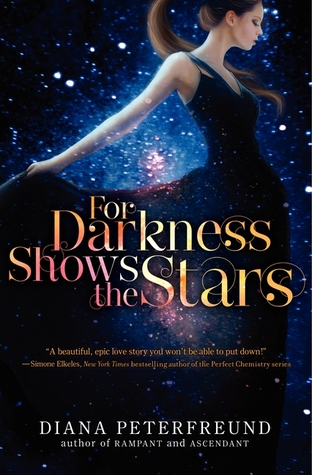
I loved Persuasion when I read it a couple years ago, so I thought this YA adaptation sounded fantastic. I looked at the cover, read the title, saw that the Wentworth character was a ship captain, and got really excited. What’s not to love about Persusasion in SPACE?!

…only it’s not in space. Malakai Wentforth is not a space ship captain, but rather an actual boat ship captain. While the blurb, cover, and title don’t explicitly state that it’s taking place in outer space, I think my assumption wasn’t completely out of the bounds of reason. I mean, look at the cover art!!! Needless to say, finding out the setting was in a post-apocalyptic agrarian dystopian society rather than THE FINAL FRONTIER was a little disappointing for me. But I got over it (mostly), and found the book to be quite enjoyable. It was full of Persuasion-y deliciousness, but was different enough to make it the author’s own. I liked the shout-outs to the original, such as Elliot being the protagonist’s first name rather than her surname and Wentworth becoming Wentforth, but the letter that is such an emotional lynchpin of the original felt a little phoned in to me in this one. Overall, though, it was a fun read, and the science vs. religion and genetic manipulation aspects of the story were an interesting sci-fi twist.

One subtle yet important difference I found between the two was that in Jane Austen’s book I never really found myself putting either Anne Elliot or Capt. Wentworth at fault for the tension between them (though there were times I wanted to shake them and tell them to stop being so silly!). You could say Anne’s at fault for allowing herself to be persuaded by Lady Russell to not marry Wentworth and his resentment is thus at least partially merited, but I never really felt like it was a “fault” thing—it was a decision, it happened, it had repercussions, and it wasn’t fun for anyone involved. By contrast, in Peterfreund’s adaptation, because Elliot is a good person she kind of had to refuse Kai—if she hadn’t, her estate and all the people on it would have suffered and probably died due to her father’s mismanagement. Which is a very valid (noble, even) reason for her to not marry him! It still sucks for both of them, but she had a responsibility to these people. Which is why it made me SO MAD when Kai was being a prime douchebag and generally jerky to her. Don’t take it so personally, dude—there were hundreds of lives at stake!!! So I spent a chunk of the book wanting to punch him in the face and for Elliot to run off with her neighbor Horatio, but this new slant to their relationship somehow ended up adding to my enjoyment of the book. I quite liked it, although I still wonder what it would’ve been like in space… Rating: 3.75 Genetically Enhanced Wheat Sheaves

And for our final entry, we have a historical spy adventure set in the royal court of Georgian England:

“A warning to all young ladies of delicate breeding who wish to embark upon lives of adventure: Don't.”

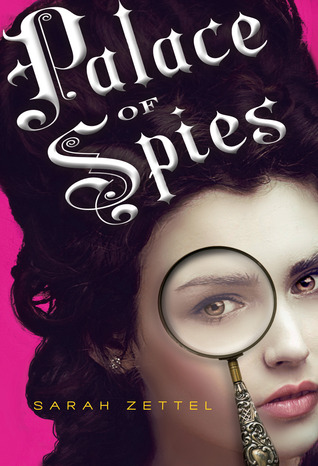
Sixteen-year-old Peggy is a well-bred orphan who is coerced into posing as a lady in waiting at the palace of King George I. Life is grand, until Peggy starts to suspect that the girl she's impersonating might have been murdered. Unless Peggy can discover the truth, she might be doomed to the same terrible fate. But in a court of shadows and intrigue, anyone could be a spy—perhaps even the handsome young artist with whom Peggy is falling in love...

History and mystery spark in this effervescent series debut.

Although it sounds like the sort of thing that would be right up my alley, this one was just…okay. The first person narration by Peggy is mostly enjoyable, but sometimes her flowery language and clever sentence structuring felt a bit overwrought. Though it was a little much for me at times, for the most part I found her distinctive voice to be an amusing and interesting perspective from which to see the workings of the Georgian court. It was clear that the author has researched the history and culture of Georgian England, but that research manifested itself at times in the form of slight infodumps. They didn’t completely eject me from the story, but I felt the info could’ve been woven in more smoothly at times. But then at other times, I was left wanting to know more of the history and culture! Okay, King George I is from Hanover, and there’s a pretender hiding out in France. Wait, how did a German become King of England?? Luckily, the ever-faithful Wikipedia was there to help me fill in the gaps in my knowledge of the history of the British crown.

I was also confused about Peggy’s place in the social hierarchy. Her uncle didn’t seem to be a nobleman, but had a high enough standing that he could marry off his niece to the son of a lord. Peggy’s mother was at court, but did not seem to have any title. So where does that leave Peggy? Was there a well-to-do merchant class at the time that was able to hobnob with the nobility? I don’t know if it’s just my lack of knowledge about the time period, but I thought that could’ve used some clarification to make the story seem more grounded in reality.

Unfortunately, one of my main problems with this book involved something that the entire story hinged on: Peggy’s ability to stand in at court for the deceased Francesca. I really had trouble suspending my disbelief that, even with makeup and a wig, Peggy would be able to impersonate her without anyone noticing. I found it very difficult to believe that she looked enough like Francesca that, especially with the dissimilarities in their personalities piled on top, even Fran’s close friends could not tell the difference.

Even taking these concerns into account, I was still pretty okay with the book until it got to the point where Peggy was jumping to some new, ill-reasoned conclusion every page about what was really going on with the intrigue. I found it to be tiresome, tedious, and a little exhausting to take the ride with her in arriving at each of these new conceptions mostly lacking in evidence. So I had a good laugh when on page 269 she said, “I listed my own proven inadequacies as a reasoner, and that list was depressingly long.” And how! At least she’s aware of it? Despite these criticisms, the book was still okay—I wasn’t shaking my fists and shouting at the heavens to get back the time I spent reading it, but I probably won’t be checking out any sequels. Rating: 2.5 Lace Fans

Have you read any good YA lately?


The Coldest Girl in Coldtown, by Holly Black
Published by Little, Brown Books for Young Readers (September 3, 2013)
Read in August 2013; Paper ARC from Book Expo America*

For Darkness Shows the Stars, by Diana Peterfreund
Published by Balzer + Bray (2012)
Read in September 2013; Bought it

Palace of Spies, by Sarah Zettel
Published by HMH Books for Young Readers (November 5, 2013)
Read in October 2013; eARC from publisher via NetGalley*

*As ever, much as we are grateful for the copies, our reviews are uninfluenced by their sources.

Thursday, June 13, 2013

Guilty Pleasures: The Elite by Kiera Cass

As you loyal readers know, we got sucked into the slough of the Selection series (slough in this case is pronounced SLEW. We just learned this today). As part of the immense fun of reading a series that cannot be taken seriously, we cannot seem to stop talking about it with each other. Volume 2, The Elite came out a month ago, and you have thismuchtime to read it before we spoil EVERYTHING by letting you in on our night of gabbery (not a real word; we just coined it today).

So Susan opened up our GoogleDoc unpacking of The Elite with the following questions.

1) Why is America so bad at human interactions?
2) How can we get rid of Maxon’s father?
3) Maxon’s mother--cool or weak?
4) Should we care about Maxon’s father when getting rid of Aspen is much more important?

We did eventually address these thought-provoking and important questions (some of them, at least), but first we had other items (a.k.a. gossip) to attend to. (From here on out, Susan is green and Alyssa is red. We are like Christmas!)

Aspen is hooking up with a maid. He will be, I mean. I forget which one, though...
YES. Though I kind of want Maxon to see him hitting on America and have him arrested.

This was followed by a bit of confusion, in which all dystopian YA books become the same book:

Now that America has decided to go all in for Maxon, Aspen is completely tangential to the plot now. Unless he becomes a secret rebel. Which might be cool. Although I don’t think he likes books enough to get recruited.
A la Gabe?
Who is Gabe?
The tangential childhood friend love interest in Hunger Games. Wasn’t his name Gabe?
Gale? Lol
Oh snap. Right. lol.

As the conversation continued, one might be led to believe that we hated this book, but au contraire! We actually enjoyed it. Don’t let our nitpickery fool you.

I’m just glad America is ready to go all in for Maxon. I could not believe her vacillation in the first half of the book. Or two thirds. Some horrible long time.
I was ready to puke with lines like these: “In Aspen’s eyes I saw a thousand different endings to that sentence, all of them connecting him to me. That he was still waiting for me. That he knew me better than anyone. That we were the same. That a few months at the palace couldn’t erase two years. No matter what, Aspen would always be there for me.” (48, sorry I have your book hostage) And then literally one page later, America is antsy because she wants to see Maxon so badly.

Yeah, they all annoyed me. America was super wishy-washy, Aspen was lame, Maxon was weird. I get that America was torn, but it didn’t need to take her THAT long to figure things out. THE WHOLE FREAKING BOOK.
America is stupid. She suffers from YA romantic lead stupidity problems.
Oh man!!! At the YA book panel, they talked about how ridiculous the names were. “She sings for a living, and she lives in what used to be America...let’s call her America Singer, and then not have to describe her character at all!”
LOL. I was wondering if her father was a singer too, or if he was a potter or something. How far back do these names go? “I’m Gregory Illéa, and I decree that whatever job you are doing TODAY will be your last name!”?

Then Voldemort made a visit to Illéa:

hahaha. Must be the case. Also, I think that the Gregory Illéa diary entries were a lot like Tom Riddle’s soul speaking to Ginny Weasley and then Harry through the diary. I wish there had been a big basilisk around to eat Aspen.
Yes, only Gregory Illea had the writing abilities of a 7th grader. Although I must admit, I do want to know what he did with his daughter. Who he sold her off to, I mean. Do you think there are people on the interwebs with theories about this sort of thing? Is it that popular? Are the fans that rabid? I do love a good crackpot theory.
Tom Riddle had the writing abilities of only a 10th grader. And that didn’t really help him. I think Illéa did much more in the long-run than Voldey did. Wasn’t she sold off to some European royal house?
Tom Riddle was a 10th grader at the time, though, right? Gregory Illea was middle-aged. Not that I’m arguing in favor of Voldey, I just think he probably had more smarts that Greggy-poo.

Next up was the debate about the fate of Scandinavia in the world Cass has created:

lolz. “Katherine was finally married today to Emil de Monpezat of Swendway. She sobbed the whole way to the church until I made it clear that if she didn’t straighten up for the ceremony, there’d be hell to pay afterward.” So she married into the combined Swedish/Norwegian royal house. (Do you think the author realizes that those two really did share a throne in history?)
OMG. You are so smart. I got the Sweden part, but not the Norway. Hah! What creative names... Why not Swendwaymarkland? Get all of Scandinavia in one go?
That would make so much more sense. Especially because I fail to see how the Swedish/Norwegian royal house would automatically get Greggy into a royal league. Sweden has a good economy and all, but their king is kind of unpopular right now, and I don’t think anyone really cares about Norway. The current crown princess of Sweden is half-liked, but that’s not too strong either. Ah logic. I must remember to set it free before I open the books.

THEN we finally got to the first question: Why is America so bad at human interactions?

Because she had no friends! As she loves to tell us! She would be a feral child, if not for her family. Her only male, non-familial interaction EVER seems to have been Aspen. Maybe she just falls in love with every dude her age she meets? Since she’s only met 2 so far, and has had a thing for both of them.

Which led to the question…how did she and Aspen even meet?

Oh, good point. I forgot that we didn’t know that. I had just assumed they met at school, but I guess they don’t go to school in the lower caste world in Illéa.
Aspen went to school, but America didn’t because she was homeschooled. Which was weird to me. You would think a higher caste would have better education opportunities. But maybe they just think if you’re going to be some sort of artist, artistic training is all you need.

Probably we aren’t as nice and class-blind as America, given our next thoughts:

But why bother sending Aspen’s caste to school? Why do they need to learn to clean houses and carry things?
So he can learn to read the labels on the bottles of cleaning product?
lmao. It’s so obvious when you put it that way.

At this point, discussion of previously posed questions dissipated and made way for ones invented on the spot.

All right, I have a question. Riddle me this, Batman--how do you think the author is going to make the competition for Maxon interesting for readers, since we are pretty certain he’s going to end up with America?
It’s going to be FORBIDDEN LOVE! Maxon’s father is 100% against America becoming the crown princess. And Maxon may not fully trust America as he continues to hang out with Kriss.

And then we came to a discussion of the nadir of Maxon’s character development.

Oh, not related---the Celeste make-out session with Maxon was straight out of my letter game*. Kiera Cass is probably my letter game partner using a pen name, taking my plot devices!
Omg that part was so hilarious. Maxon all, “I have NEEDS!” Nice try dude, but that excuse doesn’t really work when you have PROCLAIMED YOUR LOVE FOR ANOTHER. I’m actually surprised the monarchy hasn’t instituted polygamy. ALL OF THE GIRLS for the king/prince. That’s what the Selection is really for. That would be the gritty dystopian version of the Selection--all the girls are sent off to be sister-wives of a monarch they’ve never met. Tributes, like from the Hunger Games! Only for marrying, not killing!
OMG WRITE IT!!! I think both of us should start writing fanfiction for this series. It’s too easy to come up with absurd plots.

*Letter games are when friends write chapters of stories as letters to the characters being written by each other. Susan and a friend from high school wrote a 24-letter story this way years ago. Read Sorcery and Cecelia to see a successful letter game.

(Alyssa did go on to write the first chapter of this fanfiction. Susan would gladly read it to interested parties, except it makes her laugh too hard to speak.) And now we have some helpful graphics inspired by The Elite:

Where are the PR judges when you need them?

"[America's] dress was white, gauzy, and light, adorned with one long stream of green and blue tulle running along the right side. The bottom fell in such a way that it looked like a cloud, and its empire waist added a level of virtue and grace to the gown." (Kiera Cass, 2013)

 photo Eliteproject-runway America's dress in The Elite (Kiera Cass)

This is better with some zooming...

Read This / Eat That Assesses the Characters of The Elite photo EliteCharacterApproval_zps2719d1ff.png

There is a document with a comment and page number corresponding to every fluctuation on this chart. Sometimes we get carried away.

Thursday, June 6, 2013

In Which I Return from the BEA

Hello again, bookworms and moths! I’ve returned from the event of the season, Book Expo America, with a book haul to end all my previous presumptions of having impressive library hauls. Plus several new book blogging friends (Paper Reader, Girls in Capes, Dead Book Darling, and Headstrong-Tomgirl —all of them have much more established blogs with incisive reviews, so check them out!), and answers to most of my questions about American Girl books.

 photo IMG_0429_zpsf1ebe804.jpg
Anyway, for everyone as clueless as I was before I registered for this shindig, the BEA is to the publishing industry what NY Fashion Week is to the garment industry.

NYFW BEA
Dress is extremely fashionable Dress is power-lunch or power-walk
Runway shows with next season's clothing Galley proof giveaways of next season's books
Stars are mobbed for autographs Authors are mobbed for autographs
Editors spew theories about "upcoming trends" Editors spew theories about "upcoming trends"

Totally the same thing! Except with people happily eating cupcakes at parties, and a focus on books instead of clothing...

Mo Willems Cupcake

Trend Report


YA Dystopian is Dead. Long Live YA Contemporary, Diversity, and Melded Genres

Editors from Arthur A. Levine Books/Scholastic, Candlewick Press, The Atlantic, and Disney-Hyperion proclaimed that the YA Dystopian trend is over, but every few minutes they seemed to decide another buzzword was the future of the YA market. I can’t remember if different publishing houses were predicting different trends, but it seems like the YA book world could be spending the next season in transition before a new real trend emerges. Let’s face it, diversity and melded genres cannot be a fad the way that vampires/werewolves/angels/corrupt futuristic governments have been because something that’s offering novelty at every corner is not going to gain the trust of reluctant readers. (Unless you distill “diversity” into a trite common theme of “I’m different but I love myself for it!” which I very much hope doesn't happen.)

Based on the galleys I picked up and the books I heard about at the panel, transcending time is a theme, whether through literal time travel (the much-hyped All Our Yesterdays), genetic immortality (Wake Up Missing), or ghosts (Marie Antoinette, Serial Killer; Plague in the Mirror; Raven Boys quartet; These Broken Stars).

As for the editor-observed diversity theme, maybe there’s a Native American Indian moment coming this fall (Ghost Hawk, If I Ever Get out of Here, Sorrow’s Knot), but it looks like there’s a long way to go still.

Welcome Back, Stand Alone Novels!

The editors on the YA panel said that they are “weary” of the trilogy craze that has dominated the market for years. We can only hope that readers agree, and that John Green gets some healthy competition on the NYTimes YA Bestsellers list.

New Adult Fiction

This is the latest buzzword, and it seems to describe YA-like books with late teen / early twenties main characters who have more sex than normal YA characters. I think I picked up two that may qualify (Left Drowning and The Art of Falling). The only thing truly interesting about New Adult is that there’s no consensus on whether it exists.

I think it may work like imaginary numbers, so when a publisher has only one manuscript that seems like New Adult, it gets marketed as YA; but two manuscripts get farmed to genres, three claim a mature YA designation, and if there are four then the publisher can announce that New Adult is real. (Yes, the math on this is not just imaginary but wrong.)

American Girls Historical Book Questions

(because you know you had them too)


Why did Elizabeth Cole (Felicity books) become a blonde, and did someone simply Photoshop all the images of her to keep girls from learning she originally had beautiful dark brown hair?

At the time of the Elizabeth Cole BFF doll creation, American Girl determined that they had overrepresented brunettes, and for the sake of balance they needed another blonde. I really enjoyed talking to the American Girl editor, but it is INSANE that the American Girl/Mattel people thought that blondes should be 40% of their visual image.

As for how such hair changes are done, the illustrator was asked to rework some pictures. There may have also been some Photoshopping involved, but it was mostly done by hand.

Why wasn’t Ivy the main character of the Julie/Ivy 1970s pair? Did American Girl really need another blonde?

The process of making an American Girl historical character starts with brainstorming issues or events that the company would like to address, matching these to a time period, and fleshing out further themes for the series. The company then commissions an author, who develops the character’s personality and stories. After that, the company determines what the character looks like (by figuring out what color hair they need, as we saw above).

In the case of Julie/Ivy, author Megan McDonald wrote a draft of Meet Julie that described Ivy. The production team loved Ivy so much that they hired an additional author, Lisa Yee, to write a separate book about Ivy in time for the Julie launch.

I still think it’s weird that American Girl’s efforts towards showing the diversity of experiences and circumstances in American history, as well as the unity of family and friendship bonds, hasn’t led to an AAPI main character in the historical line. I can only guess that the story the editor told me about Ivy’s inception means that American Girl legitimately didn’t realize it was ignoring the AAPI community, and when they saw Ivy in the Julie draft, they decided to create an Ivy doll before drawing too much attention to their oversight.

Why did they stop giving all the books formulaic names beginning with Kaya?

Booksellers HATED that the titles for each girl were essentially the same. Family members who didn’t fully understand the concept of a series of different girls would get confused and buy the wrong books for presents. And the original Pleasant Company had never expected they would have so many characters that the repetitive titles would become a problem.

What’s up with new girls not having stories that take place during a year ending with 4 (earlier books were set in 1904, 1864, 1774, etc.)?

Pleasant Rowland, founder of the company, created the original characters as a way for girls to connect with history. Ms. Rowland had a background in education, and figured that by making all the years end with a 4, children would have an easier time remembering the century and decade. But in order for the 4 to fit all the later stories, some finagling on the part of the production team was necessary. The Julie books were intended to be about the bicentennial celebrations in 1976, but to keep the year 1974 the first book had to take place two years before the celebration book. When the company wanted to use the events of the 1853 New Orleans yellow fever epidemic, they decided it would be extremely confusing to talk about the year in the books but put 1854 on the covers. Thus, they freed themselves from their final digit restriction.

Tuesday, May 14, 2013

The Prince: A Selection Novella, by Kiera Cass

Title: The Prince
Author: Kiera Cass
Publisher: HarperTeen
Publication Year: 2013
Read: May 2013
Genre: YA-dystopian
Rating: 2.5 stars

A Mini Review for a Mini Novella:


The description says it’s 64 pages, Amazon says it’s 55—either way, it’s short. This is one of those exclusive e-book prequel/interim/alternate P.O.V. novellas (so prevalent in YA these days) published to tide readers over while waiting for the next book in a series. In my admittedly little experience with them, I have not been pleased with the results. But of course every author and every series and every book is different, and since I enjoyed the Selection quite a bit I thought I would give this one a go.

This one just wasn’t all that interesting to me. It’s told from Prince Maxon’s point of view from his 19th birthday in the weeks before the Selection happens, up through his initial meeting with America and his first interviews with all the Selection girls. I thought it would be fun to see things from Maxon’s viewpoint and to see America and the other girls who we know become fairly major characters through his eyes. And it was. Kinda. A little bit. But it just didn’t add all that much to the story overall (which I guess is okay, since these interim e-books aren’t supposed to be integral to the overall series—just like deleted scenes from a movie or something).

The most interesting things I gleaned from it are a) Maxon’s age (19, just like Aspen), and b) his father King Clarkson is a real d-bag. In The Selection I thought the king seemed kind of distant and vaguely displeased with some of Maxon’s decisions, but I never got the impression he was a complete, abusive asshole. But apparently he is! Poor Maxon.

Other than that, meh. Mostly just rehashing events we already knew about, with the new perspective not adding as much as I had hoped. America from Maxon’s point of view wasn’t all that different from the America we’ve gotten to know from reading a whole book from her perspective. One thing that was mildly interesting was seeing Celeste through Maxon’s eyes, and gaining a bit of understanding as to why he might see something in her when all of the other girls see her as a complete beeyotch. I was also relieved to see that Maxon’s thoughts in his own head are surprisingly fluid and normal, and not as awkward and stilted as his dialogue from The Selection would lead you to believe. The discrepancy between the way he speaks in his own head in this novella and the way he speaks out loud in The Selection becomes apparent in the revisitation of some of the prominent scenes from the first book, such as meeting America in the gardens. In his head he sounds completely normal, but when he gets to the point where he says the actual lines from the first book he sounds bizarre—there’s some disconnect and difficulty in integration of book 1 Maxon with novella Maxon there.

I usually reserve 2 stars for things that I really have problems with, and I didn’t have MAJOR major problems with this one, so I gave it half a star to boost it up above that level. It was just a little on the boring side. Like an empty-calorie treat to tide me over between meals. Which I guess is kind of what it was! Good thing the next book-meal just came out recently so I can move on to that. I probably couldn’t recommend paying $1.99 for this, but if it’s in your library’s e-catalogue, you already know you like the series, and you have an hour to kill, go for it.

Monday, May 13, 2013

Genre-ally Speaking: The Selection, by Kiera Cass

Title: The Selection
Author: Kiera Cass
Publisher: HarperTeen
Publication Year: 2012
Read: May 2013
Genre: YA-dystopian
Rating: ***.5

The Quick and Dirty:


In a dystopian future North America where life is dictated by a strict caste system, America is chosen as one of 35 girls to go to the royal palace and participate in the Selection, a reality TV The Bachelor-style competition to choose the girl who will marry Crown Prince Maxon and become the future queen of Illéa. I expected dystopian fatigue, and was pleasantly surprised by compulsively readable fun.

The Wordy Version:


I was not expecting all that much from this book, to be honest. There’s so much dystopian fiction out there right now, and not all of it can be good. The cover is pretty, and seems to be going along with the recent trend in YA book covers--girls in pretty, foofy dresses! From what I’d heard about the book beforehand, I was expecting a dystopian fairy tale. It turned out to be more just straight up dystopian, with the monarchy prince-princess thing being less fairy tale, and more just the form of government employed in the society. Which was fine! (I’m still intrigued by the idea of a dystopian fairy tale. Does this sort of book exist, to anyone’s knowledge?)

Anyway, Susan mentioned this book to me as one of those books that at the beginning you’re like well, this isn’t that great, but then as you keep reading it becomes enjoyable frothy fun, which is precisely the experience I had. At the beginning of the book, I was pretty okay with the world building. The existence of TVs and phones and electricity and other trappings of modern real-life life laid to rest any ideas I’d had about this being traditional-fairy-tale-like, and the numerical caste system was okay. I liked that teachers were as high as being level 3, but had to suspend my disbelief that artists and musicians would be down at level 5 (given the high status of entertainers in our own society). It isn’t the kind of dystopian society where it’s horrible but everyone seems to be tolerating it, but rather the people seem to be pretty okay with the current system of government, although they acknowledge there are some flaws to the system. There are mentions of rebels, but the characters see the rebels as the enemy of the monarchy, the state, and themselves, rather than a revolution that they’re hoping for. I thought this was an interesting change from the usual set up.

Sunday, April 21, 2013

Genre-ally Speaking: Matched by Ally Condie

Title: Matched
Author: Ally Condie
Publisher: Dutton Juvenile
Publication Year: 2010
Read: April, 2013
Genre: YA-Dystopian
Dys-miss or Dys-hit: Dys-miss. **

The Quick and Dirty:

Tired dystopian clichés make the background for a typical YA love triangle. Attempts to make the book "deep" (i.e. quoting poetry) merely irritate me.

The Wordy Version:

Tolstoy’s famous quote is that every happy family is alike but every unhappy family is unhappy in its own way. If only this could be applied to futuristic novels in addition to families. As far as I can tell, almost every unhappy future envisioned by novelists is unhappy for the same reason of having a fundamentally flawed socialist government taking away people’s individual freedom.

Related Posts Plugin for WordPress, Blogger...